Want more from Front Office Sports
in your search results?
NCAA president Charlie Baker has previously said that the NCAA would not grant any eligibility to players who have previously signed an NBA contract—including a two-way deal.
It might not be up to Baker, though.
On Wednesday, an Alabama state judge granted temporary eligibility to former and possibly future Alabama men’s basketball player Charles Bediako despite the fact that he has participated in three seasons of G League basketball and briefly signed a two-way deal.
The ruling, if confirmed in later proceedings, could open the door for G League and two-way players across the country to go back to college. It’s yet another blow to the NCAA’s eligibility rules, which have been under attack through dozens of lawsuits. The NCAA has won many of those cases from players seeking extra eligibility, but repeatedly said that it wants antitrust protections from Congress in order to enforce eligibility rules.
The organization reiterated that in a statement Wednesday.
“These attempts to sidestep NCAA rules and recruit individuals who have finished their time in college or signed NBA contracts are taking opportunities away from former high school students,” the NCAA said in a statement to Front Office Sports.
“A judge ordering the NCAA [to] let a former NBA player take the court Saturday is exactly why Congress must step in and empower college sports to enforce our eligibility rules.”
No. 17 Alabama plays Tennessee on Saturday.
Alabama judge James Roberts Jr. gave Bediako a temporary restraining order, which prohibits the NCAA from enforcing its rules against Bediako for at least 10 days, until a preliminary injunction hearing takes place on Jan. 27, or until the parties reach an agreement. The NCAA is also prohibited from enforcing its “rule of restitution,” which would punish Bediako or Alabama if Bediako plays in games over the next ten days but is ultimately found by the court to be ineligible down the line.
“Mr. Bediako is immediately eligible to participate in all team activities with the University of Alabama’s basketball program including, but not limited to team meetings, practices, and games,” Roberts wrote in his rulling.
He first filed the lawsuit Tuesday against the NCAA, which he said denied his request for eligibility to play for Alabama this season. He is represented by prominent college sports attorney Darren Heitner, who has also represented Miami football player Xavier Lucas, Washington quarterback Demond Williams, and Duke quarterback Darian Mensah.
Bediako played for the Crimson Tide for two seasons, earned SEC All-Freshman team honors, leading the program with 51 blocks and field goal percentage (.692). In his sophomore season, he averaged 6 rebounds, 0.6 assists and 1.8 blocks. His 67 total blocks were No. 22 in the nation.
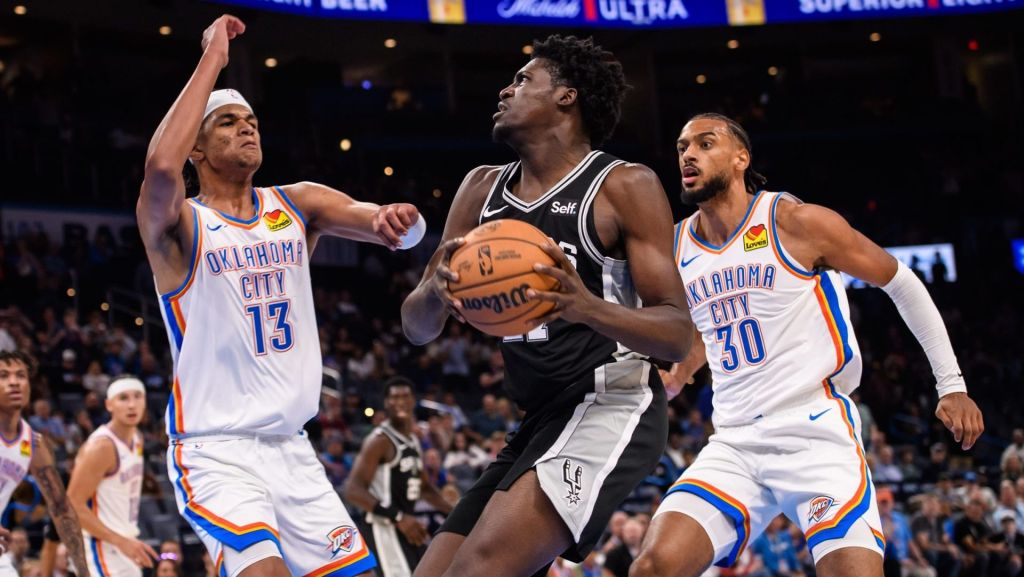
Bediako left Alabama in 2023 after playing two seasons, but was not selected in the NBA draft. Instead, he signed a two-way contract with the San Antonio Spurs, though the deal only lasted a month as Bediako got hurt. He has participated in three G League seasons, playing for the Austin Spurs in 2023-24, the Grand Rapids Gold in 2024-25, and the Motor City Cruise this season.
The NCAA had previously released a statement before the TRO was decided: “Mr. Bediako signed three NBA contracts after competing in college for two seasons. The NCAA has not and will not grant any prospective or returning student-athletes who have signed an NBA contract.”
It is possible that the contracts the NCAA is referring to here are the three he signed with NBA teams: the two-way with the San Antonio Spurs, as well as Exhibit 10 contracts with the Denver Nuggets and the Detroit Pistons—though he did not play in any NBA games and was waived by all three teams.
However, the NCAA has granted eligibility to players who only played professionally in the NBA’s G League, or overseas—and even one player who was drafted. Santa Clara men’s basketball player Thierry Darlan previously played two seasons in the G League before playing for the Broncos. Baylor men’s basketball player James Nnaji played professionally overseas and in the NBA Summer League, but never appeared in a G League or NBA game—though was drafted by the Pistons and traded to the Hornets.
“The NCAA has arbitrarily determined that it is acceptable for a student-athlete to compete professionally (either internationally or straight out of high school) and then compete in college, but it is not acceptable for a student-athlete to compete in college, leave college to pursue a professional career in the U.S., and then return to college as a student-athlete,” the complaint read. “There is no principled justification for treating these groups of student-athletes differently.”
Bediako is represented by prolific college sports lawyer Darren Heitner, who has been the lawyer for athletes in scores of cases against the NCAA and its members.