Want more from Front Office Sports
in your search results?
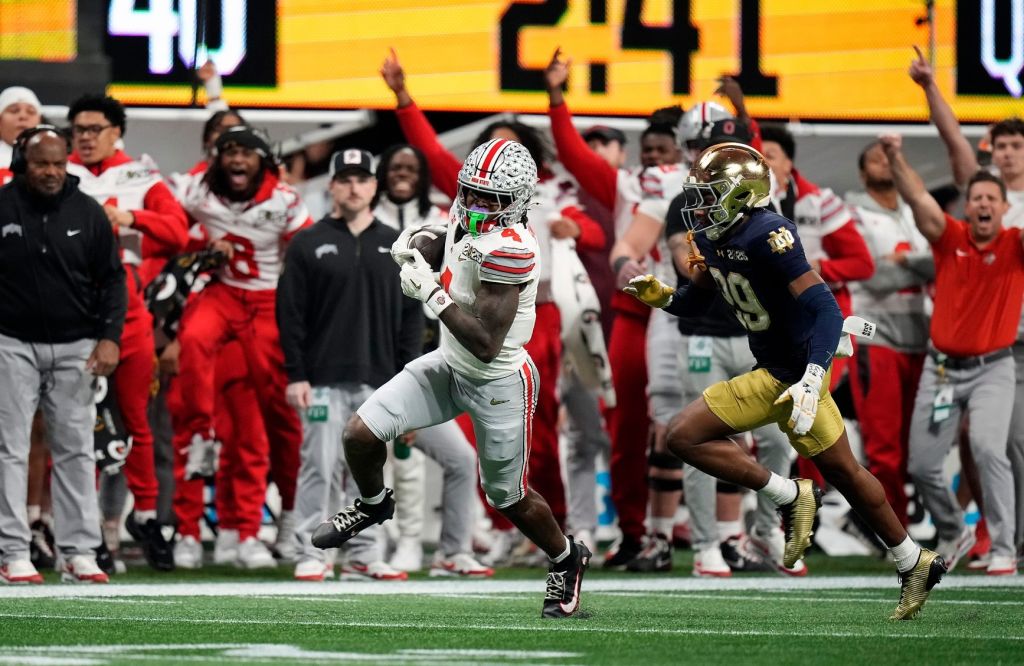
There are a lot of reasons why Ohio State won the first national championship in the expanded 12-team College Football Playoff era. It boasted one of the most complete defenses and a balanced offense. It had 1,000-yard running backs and arguably the best wideout room in the country paced by freshman phenom Jeremiah Smith. It showed it could win games with both methodical drives and spasms of explosive offense.
It’s tempting to boil that all down to the school’s reported “NIL payroll” of $20 million, believed to be near the top in the country.
It’s understandable why many fans and analysts would conclude others will try to emulate that strategy. Robert Griffin III framed it in those terms: “Moral of story for College Football. Spend $20 Million on your roster.”
But the actual facts don’t line up so neatly with the idea that Ohio State “bought” the best roster, or that championship college football rosters can be easily purchased. Once you look under the hood at Ohio State’s strategy, the narrative becomes much more complicated.
1. The Buckeyes did not heavily rely on the portal.
Every single Buckeyes starter for the national title game on the offensive and defensive lines committed to Ohio State from high school, rather than from the transfer portal. Nine of the team’s 11 offensive starters were high school commits, as were nine of the defensive starters. Compare that to, say, Oregon, whose starting offense featured five transfers, or Ole Miss, who added 25 transfers to its 2024 recruiting class. One of Ohio State’s transfer starters, junior cornerback Davison Igbinosun, transferred to the Buckeyes before the 2023 season.
Ohio State did add players via the transfer portal. Safety Caleb Downs is one of the very best in the country at his position; but he left Alabama only after Nick Saban retired, and Ohio State was a major player in his original high school recruitment (center Seth McLaughlin, who was injured during the Playoff, also came from Alabama). Quarterback Will Howard (Kansas State) and running back Quinshon Judkins (Ole Miss) were the other major transfer additions.
All four (plus Igbinosun) played significant roles for the Buckeyes, which speaks to what may become the most effective template for transfer portal use in roster management. Rather than trying to grab 30 players to flip a roster, it may be best to go out and get the right four or five players, which you use to supplement the experienced roster you already have.
For what it’s worth, while Ohio State signed top-five high school recruiting classes over the last three seasons, it never signed the top class, nor did it sign the top transfer portal class.
Plenty of teams that brought in high-profile transfers, like Colorado, Florida State, Missouri, and Miami, finished well outside the College Football Playoff bracket.
2. They built a culture and spent money to keep their own players.
The bulk of Ohio State’s NIL (name, image, and likeness) money is believed to have gone towards talent retention rather than acquiring new players via the portal.
“You can say whatever you want about how much money guys were making in NIL and different things like that; that was just because NIL was available,” said coach Ryan Day in the postgame presser. “The majority of our team came back. These guys have been here for a long time.”
Ohio State athletic director Ross Bjork shared a similar message while talking with reporters after the game. He told Front Office Sports, “It’s not about the money. It’s about the culture, leadership, chemistry, and belief. The players … they’d die for another. Look at all the guys that returned. Guys that could have left, could have transferred … they came back for a reason.”
Multiple players on Ohio State’s roster—like defensive linemen Jack Sawyer and JT Tuimolaou, offensive lineman Donovan Jackson, safety Lathan Ransom, and wide receiver Emeka Egbuka—could have declared for the NFL Draft after last season.
They elected to stay, not just for NIL dollars—though that surely had a lot to do with it—but because Ohio State’s culture, team, and coaches, in their estimation, were worth one more year.
Culture can be a buzzword that’s difficult to quantify, but there’s some hard evidence of a high-functioning one in Columbus. After all, Ohio State’s November ended in the most brutal and embarrassing way possible: a fourth straight loss to its hated rival, in a game where the Buckeyes were favored by three touchdowns.
Other teams might have struggled to emotionally recover in time for the Playoff. But this team didn’t.
Said Day, “If you surround yourself with great people, you’re resilient, and you believe in the guys around you … you give yourself another chance.”
3. You have to pay the right players and put them in position to succeed.
Nick Saban said it himself on College GameDay at the beginning of the season: “You guys keep talking about a $20 million roster. … If you don’t pay the right guys, you’ll be shit out of luck.”
He’s right, but the “right guys” aren’t just guys who are good at college football. In Ohio State’s case, they’re experienced guys. Caleb Downs was the only underclassman starter on Ohio State’s defense.
It’s hard to get hard and fast numbers about NIL spending, since virtually every college has declined to share NIL earning information via public records requests, and individual player contracts are private. But based on what I’ve heard from agents, athletic directors, and industry professionals over the season, I’m inclined to believe Bjork. I don’t believe Ohio State was the only program to have a “payroll” in the $20 million neighborhood.
We’ll have more data over the next several years, and if the House v. NCAA settlement is approved, the ability for schools to directly share revenue with players will undoubtedly cause new challenges in trying to figure out the best way to get the most bang for your roster buck.
There’s no doubt that having lots of NIL resources is important. The best players don’t play for free, and you don’t win championships without lots and lots of the very best players.
But there’s an awful lot to winning a championship besides just money and star rankings. Leadership, player development, culture, and the ability to navigate adversity are all very, very much part of the equation, too. And those things aren’t as easily measured on message board charts.
Matt Brown is the publisher of “Extra Points”, a newsletter covering business and policy stories in college sports.
Download the FOS App
The business of sports, in your pocket.



Scan the QR code to get the app now.