![[US, Mexico & Canada customers only] Dec 5, 2025; Washington, District of Columbia, USA; United States of America President Donald Trump, FIFA President Gianni Infantino and Canada Prime Minister Mark Carney watch from the stands during the FIFA World Cup 2026 Final Draw at John F. Kennedy Center for the Performing Arts.](https://frontofficesports.com/wp-content/uploads/2025/12/USATSI_27745262_168416386_lowres-scaled.jpg?quality=100)
The 2026 World Cup draw is now set after a lavish ceremony in Washington, D.C., raising expectations further for the competing teams and media-rights holders.
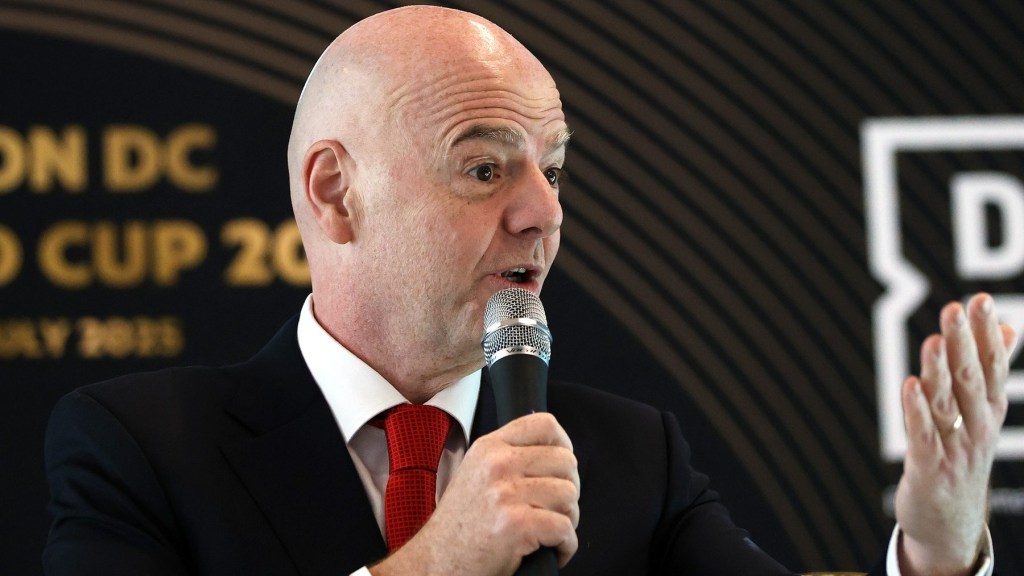
FIFA has settled the 12 groups for the men’s tournament, to be held next year in the U.S., Canada, and Mexico. Far from a simple process, the event was an over-the-top affair held at the Kennedy Center running for more than two hours and involving the heads of state from the three countries, as well as a bevy of celebrities in attendance, both performing and not.
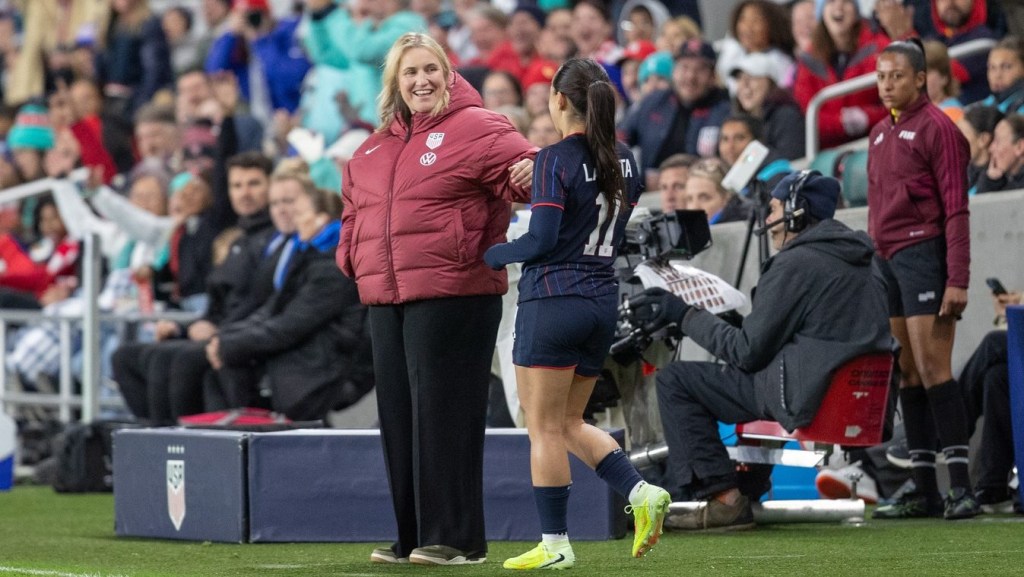
The U.S. national team will be in Group D, competing with Australia, Paraguay, and the winner of a European playoff between Turkey, Romania, Slovakia, and Kosovo.
With the groups now set, a full match schedule, with placements in host cities, will be issued Saturday. It is already set, however, that the U.S. team will open June 12 against Paraguay at SoFi Stadium in California.
As expected, FIFA also used the ceremony to award a peace prize to U.S. President Donald Trump. The award is something of a consolation prize after he did not receive a Nobel Peace Prize, which he has openly coveted. Trump returned the obsequiousness toward FIFA, saying onstage that “this is football. … We have to come up with another name for the NFL stuff.”
Viewership Matters
Fox Sports, which holds the English-language media rights in the U.S., sees the upcoming event as a seminal moment for soccer in the U.S.—not unlike the optimism conveyed Thursday night by Major League Soccer commissioner Don Garber.
“This is the most television territory in the world, the world’s leading economy, and the third-biggest population. The U.S. is the most important country for the success of this event worldwide,” Fox Sports president of insights and analytics Mike Mulvihill tells Front Office Sports. “And just think about how much the culture of soccer has changed since the 1994 World Cup [also held in the U.S.], how much more soccer is available to viewers, and so on.
“Everything is really in place now for this tournament to be a real catalyst.”
Mulvihill said the World Cup will have many parallels to an NFL season on Fox.
“It’s as many games as we do in an NFL season, compressed into five weeks,” he said.
To that end, Mulvihill predicted that the World Cup will have a similar level of total viewership reach as during an NFL season. Average match viewership, however, will certainly be lower than a typical NFL game, in part due to the presence of some weekday broadcast windows during the soccer tournament. The World Cup final, however, is expected to be the most-watched soccer match of any type in U.S. history.
Additionally, Nielsen’s expansion of its out-of-home measurement methodology, introduced early this year, is expected to be particularly impactful given the group viewing inherent to the World Cup.
“Big Data + Panel and out-of-home get conflated a little bit, because they rolled out at the same time, but for this event, out-of-home is going to make a huge difference,” Mulvihill said.