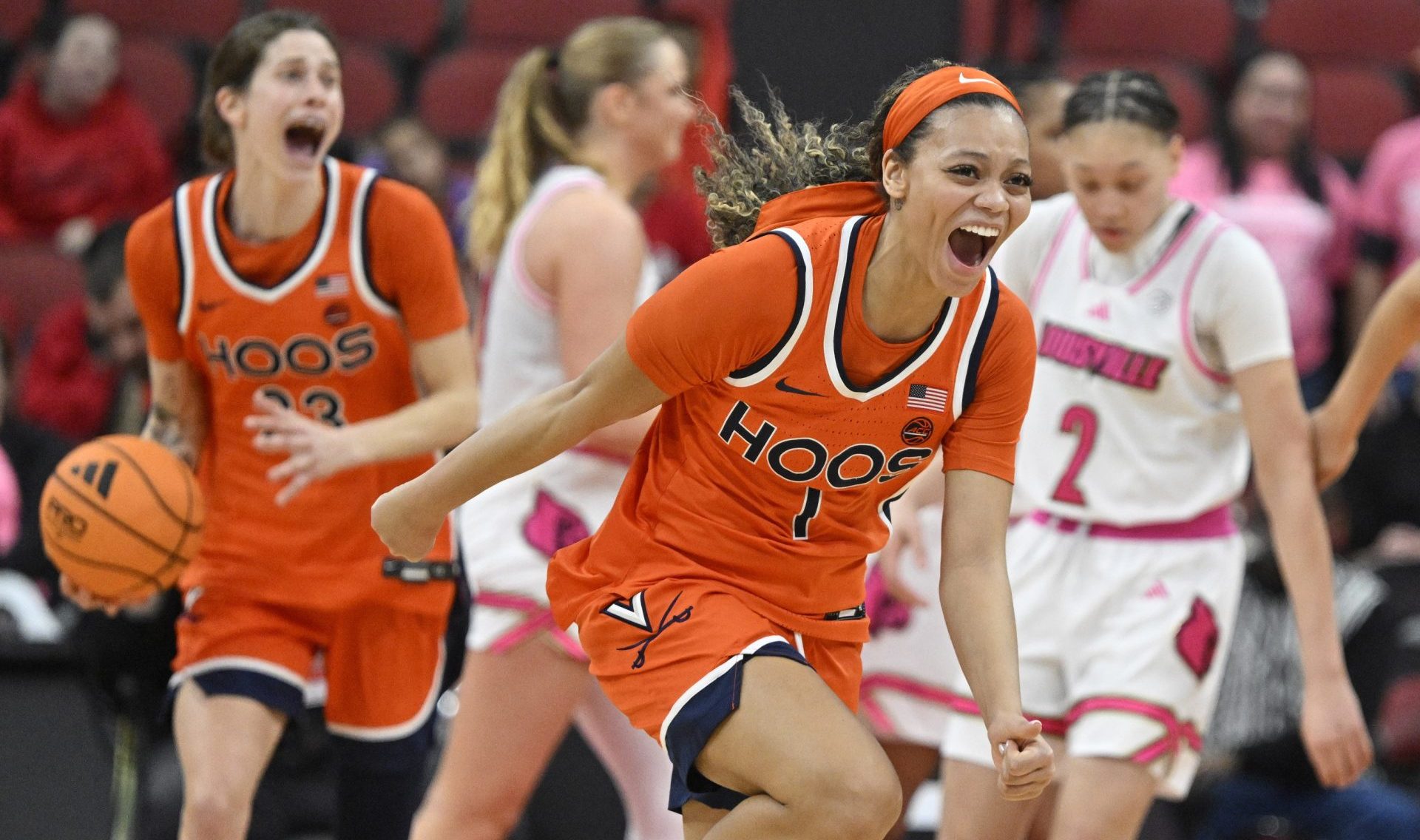
Roughly 16 months ago, Virginia alum Alexis Ohanian made a donation to his alma mater’s women’s basketball program.
The university touted it as “transformational,” as major contributions are often described. The multiyear gift from the Reddit cofounder was the second largest in the history of UVA women’s sports, earmarked to help the basketball program compete with the behemoths across the NCAA.
Ohanian, who with his Seven Seven Six investment firm is a major investor in women’s sports alongside wife Serena Williams, said in December 2024: “It’s time to bring the nation’s best hoops talent to Charlottesville and win some championships in the next four years.”
On Monday, the 10-seed Cavaliers—who started the tournament as a play-in team in the First Four—punched their ticket to the Sweet 16 by defeating Iowa in a double-overtime thriller. On Saturday, they’ll play 3-seed TCU for a spot in the Elite Eight.
Their success is a potential blueprint for programs clawing for national relevance. Gone are the days of two or three powerhouses controlling women’s college basketball with insurmountable infrastructure and legacy.
Now, any program can be a contender with the right dollar amount.
“I knew where this program has been,” said UVA coach Amaka Agugua-Hamilton, who has run the Hoos program since 2022. “I always remembered wanting to play at Virginia. I just wanted to be part of bringing it back to the glory days.”
Virginia women’s basketball has a storied history. Led by Hall of Fame coach Debbie Ryan, the Cavaliers made 20 straight NCAA appearances between 1984 and 2003, including three trips to the Final Four. Dawn Staley, Monica Wright, Jenny Boucek, and Heather and Heidi Burge are among the program’s most formidable alumni who suited up for Ryan.
Between 2005 and 2010, Ryan led her team to four more tournament appearances, but never made it out of the second round. At the time, two coaches—Tennessee’s Pat Summitt and UConn’s Geno Auriemma—owned Division I’s women’s basketball. Together, they accounted for 15 titles in a 26-year span.
After Summitt retired in 2012, Auriemma led UConn to four straight titles, dominating opponents along the way. The highest form of currency for women’s basketball’s top recruits at that point was winning. Auriemma had the market cornered. But things have changed.
In the era of NIL, UConn has won just one title in 2025 as other programs have caught up, including South Carolina and LSU.
The House v. NCAA settlement added another wrinkle to the landscape. The historic deal, which went into effect July 2025, allows colleges to share revenue directly with their athletes up to $20.5 million annually. The number is set to increase each year.
The distribution model most programs were expected to follow designated 75% of the funds to football, between 15% and 18% to men’s basketball, and less than 10% to women’s basketball. According to a fall report from Opendorse, less than 15% of all revenue-sharing money was expected to be directed toward women’s sports.
Private capital has already begun to make all the difference to boost women’s programs and bridge the gap—especially donations the size of Ohanian’s, which will infuse more than $3 million over four years into UVA’s women’s basketball, according to Sportico.
“I think it will be a net positive,” Ohanian told Front Office Sports. “It has already been a positive in women’s sports, because the free market doesn’t care about your feelings, the free market just wants to put dollars to where it thinks it can generate value.”
This year has proved that donor dollars can be a shot in the arm to any program, in any sport. In January, Indiana football—historically among the worst power conference teams—won its first national championship after years of increased spending on the program. Billionaire alum Mark Cuban made his second consecutive donation to the school’s athletic department, telling FOS, “Let’s just say they are happier this year than last year.”
The approach: Spending big results in winning big.
When Ohanian’s money filtered into the program, Virginia finished the season with a 17–15 record. The Ohanian fund hasn’t instantly transformed Hoos basketball into a juggernaut: This season, UVA was relatively inconsistent with a 22–11 record and entered the 2026 tournament as a bubble team. But it did get in for the first time since 2018, and once it made the dance, it reached its first Sweet 16 since 2000.
What’s ahead is perhaps more durable than this year’s March Madness run: The combination of a deep transfer class and the decisions of Kymora Johnson and Paris Clark to remain next year has the team in a position to build toward a future that puts the Cavaliers in the upper echelon of NCAA women’s basketball.
In the name, image, and likeness era, Ohanian is proof that winning can be for anyone—but at a cost.