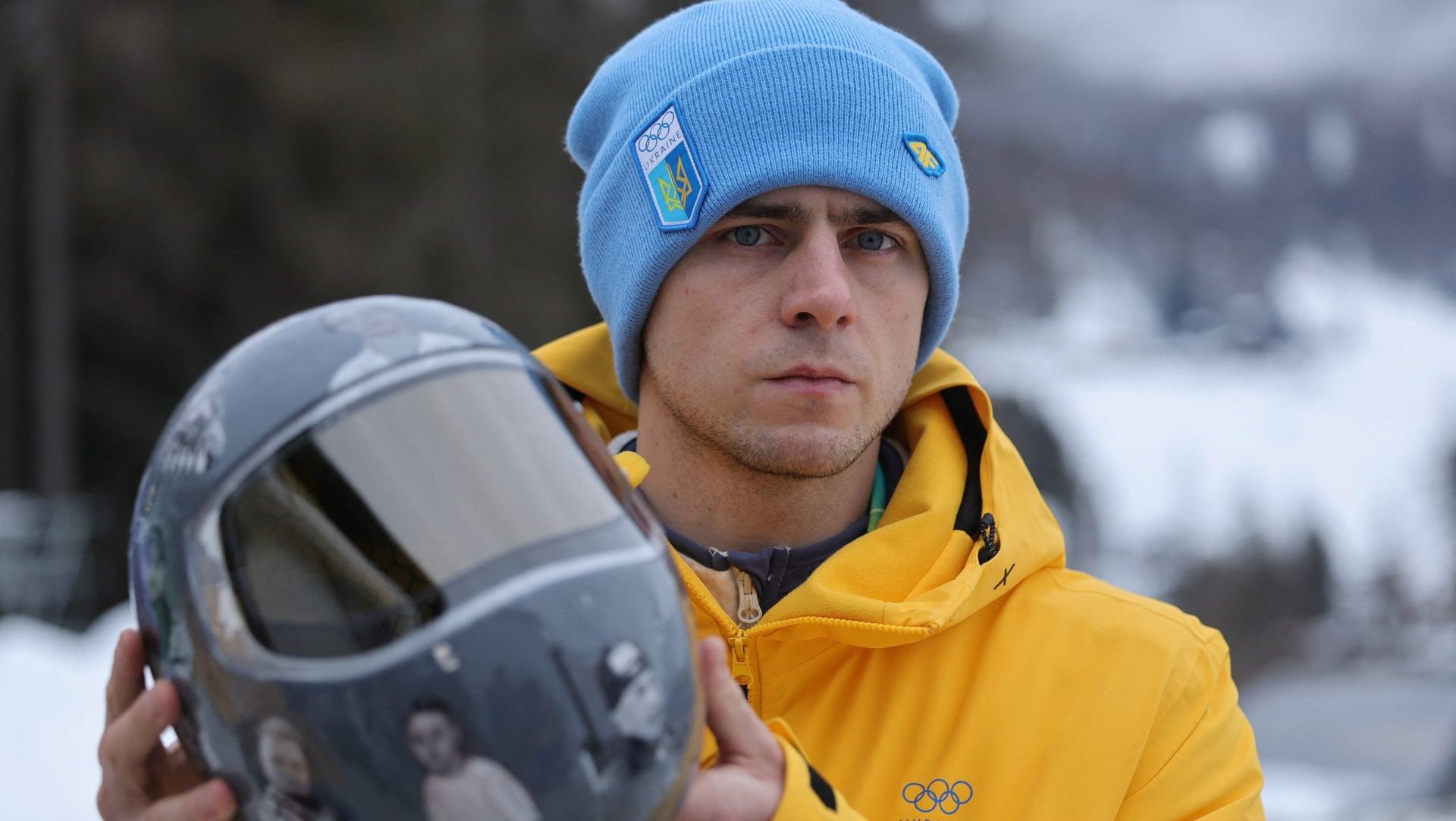
Ukrainian skeleton athlete Vladyslav Heraskevych is out of the Winter Olympics after insisting on wearing a helmet honoring athletes killed during Russia’s invasion of Ukraine.
The International Olympic Committee disqualified Heraskevych on Thursday less than an hour before competition in a final request to change his helmet after several days of warning.
The helmet has images of more than 20 Ukrainian athletes and coaches who were killed by Russian strikes.
Political expression on uniforms has long been banned at the Olympics.
Rule 50 of the Olympic Charter states says “Advertising, demonstrations, propaganda,” are not permitted unless authorized by the IOC.
“No form of publicity or propaganda, commercial or otherwise, may appear on persons, on sportswear, accessories or, more generally, on any article of clothing or equipment whatsoever worn or used by all competitors, team officials, other team personnel and all other participants in the Olympic Games, except for the identification,” the rule says.
Heraskevych, 27, was competing in his third Olympics after placing 12th in 2018 and 18th in 2022. He was a medal competitor this year, especially after strong finishes during training runs.
He was acutely aware that his helmet would put him at risk of competing in Milan. In 2022, Heraskevych showed a sign to the camera that read “No War in Ukraine” after his run.
“This is price of our dignity,” Heraskevych tweeted following his disqualification.
“I believe, deeply, the IBSF and IOC understand that I’m not violating any rules,” Heraskevych said. “Also, I would say painful that it really looks like discrimination because many athletes already were expressing themselves. … They didn’t face the same things. So, suddenly, just the Ukrainian athlete in this Olympic Games will be disqualified for the helmet.”
Ukraine president Volodymyr Zelenskyy defended Heraskevych in a tweet following the ban.
“Sport shouldn’t mean amnesia, and the Olympic movement should help stop wars, not play into the hands of aggressors,” Zelenskyy wrote. “Unfortunately, the decision of the International Olympic Committee to disqualify Ukrainian skeleton racer Vladyslav Heraskevych says otherwise. This is certainly not about the principles of Olympism, which are founded on fairness and the support of peace.”
The IOC put out a three-part statement on X, detailing the timeline of events leading up to Heraskevych’s disqualification.
It started Monday when the International Bobsleigh and Skeleton Federation informed the IOC of Heraskevych’s helmet during a training heat. The IOC says it met with the Ukraine’s National Olympic Committee, detailing “different options which are available to athletes to express themselves.”
Heraskevych remained firm on his decision, confirming in writing to the IOC on Thursday afternoon that he would still wear the helmet. IOC president Kirsty Coventry met with him in person for the final meeting before the disqualification.
Coventry told reporters after meeting with Heraskevych that she does not disagree with the Ukrainian athlete’s message, but insisted the Olympic Charter must be followed.
“It’s not about the messaging; it’s literally about the rules and the regulations. In this case – the field of play – we have to be able to keep a safe environment for everyone. And sadly, that just means no messaging is allowed,” Coventry said.
The IOC overturned an original withdrawal of Heraskevych’s credential which would have effectively barred him from attending the remainder of the Olympics.
Athletes from Russia and Belarus are barred from competing under their flag for the Winter Olympics following Russia’s invasion of Ukraine in 2022. Nearly two dozen Russian and Belarusian athletes are competing in Italy as “individual neutral athletes.”