Want more from Front Office Sports
in your search results?
While Michael Jordan’s legacy is well known by sports fans, few have seen it as closely as John Dahl. The vice president and executive producer of ESPN Films has played a key role in the 10-part documentary about Jordan’s Chicago Bulls dynasty of the 1990’s, but the history between Dahl and Jordan goes back much further. As a young reporter, Dahl covered Jordan while both were students at the University of North Carolina.
Front Office Sports took a deep dive with Dahl into the documentary, which taps over 100 live interviews and 500 hours of never-before-seen footage.
This Q&A has been lightly edited for clarity.
FRONT OFFICE SPORTS: Has ‘The Last Dance’ become a communal viewing experience?
JOHN DAHL: Without a doubt. It’s been amazing to see how this is unfolded as a cultural event. Our director, Jason Hehir, just did a phenomenal job. It’s been blowing my mind. There are stories about stories in each episode. That’s what’s been extraordinary to see. The conversation just keeps going from week to week.
FOS: ESPN capitalized on hunger for sports content during pandemic by moving up its premiere date. But didn’t that cause pressure behind the scenes?
JD: The production wasn’t done. The last couple of episodes weren’t done – and we were making the commitment to move this up by six weeks. We had to find a cadence that made sense. I drew up over a dozen scenarios when [ESPN Executive Vice President of Content] Connor Schell asked me to start exploring what was possible. I was talking a lot to Jason, his production team, his post-production supervisor, trying to figure it out. I think we found a really good ground to land on here with two (episodes) a week for five straight weeks. You’re trying to sustain the conversation for a month. It’s really 29 days. It’s about a month that you’re trying to hold the conversation. And, incredibly, we have.
FOS: So why a 10-parter?
JD: The way Jason made them, the way they’re constructed, they very much work in pairs. [Episodes] 1 and 2 go together, 3 and 4 go together, and so on. That really encouraged us to do two a week. Programming chose Sunday night, which I think is a great night to feature this kind of content. Sunday prime time is fertile ground. It just has totally exploded.
FOS: Michael always had control over this footage. So why now after more than 20 years?
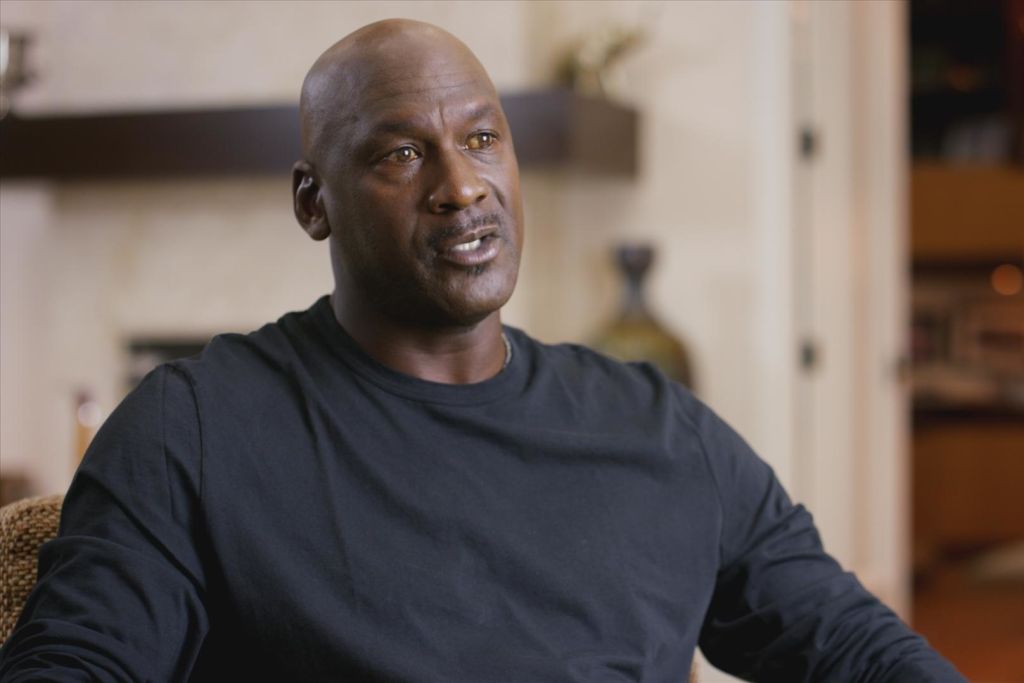
JD: I think Michael just had to get to a point where he was ready to open up his life because I think what you’re seeing in the series, and what Jason has done such a magnificent job of doing, is just getting Michael unfiltered. Exactly what he feels, what he thinks. You really get those moments when Jason pulls out the iPad and shows him what Isaiah Thomas said. Or shows him what his Mother said about the letter he wrote her while he was in college. Those are just priceless moments. So Michael had to be ready to just pour it all out there unfiltered. And he got to the point where he was ready.
FOS: Who’s conducting the one-on-one interviews with Jordan?
JD: That’s Jason. He does such extraordinary research to get ready for those sessions. He did a total of three interviews with Michael. He was able to basically ask him anything and everything. And Michael answered every time. Jason did most of the interviews, the great majority. Sometimes he might have his producer doing an interview here and there. I mean, look, he had 106 people interviewed for the film. Michael was interviewed three times, so that would be 108. So there’s a lot of interviews to get done. But Jason did the vast majority of these interviews, including everything with Michael.
FOS: Are people rediscovering sheer force of Jordan – who admitted he could be ‘tyrant’ to teammates?
JD: What you’re seeing is that Michael is reminding people what was so special about them and what is so special about him now. He has a presence. He’s long had that presence. And I think when I was at Carolina, we saw something that the rest of the country and world didn’t quite know, or understand yet, but would. I think we had a better sense of his developing greatness when he was in college than everybody else because he was playing in a team system at the time. He was playing team ball, which was a great quality for the development of his game by the way. The series was constructed around that final championship season of 1997/1998. That’s always the foundation of every episode. Then, off that, Jason goes back in time and does these time warps so you can get a much better understanding of the key characters to really understand Michael’s journey.
But what you’re seeing going into Michael’s journey is everything he’d been through – and everything he really did. It’s easy to start forgetting with the passage of time, how great he really was. And you watched that footage like there was that one year, I think he was MVP, he was Defensive Player of the Year, he was MVP of the All-Star Game and he was the Slam-Dunk champion. I think that was 1988. That’s just crazy. He could have gone into the Hall of Fame just on his defense alone. That’s unbelievable when you think about how transformative he was an offensive player.
FOS: Dennis Rodman is a standout in this doc. Did it surprise you that Michael would put up with The Worm’s antics?
JD: That’s the thing about a great team. So much of this is about greatness but also chemistry. And they were able to form chemistry, which I thought was so fascinating with Dennis Rodman, considering he’d been on the Bad Boy [Detroit] Pistons.
He pushed [Scottie] Pippen out of bounds in that game in ‘91 when the Bulls were about to eliminate them. But Michael respected people who really were professional about their craft. He recognized that Dennis cared. For all the antics and what-not, what Michael and Dennis had in common was a real work ethic and a seriousness about doing the job right. You saw in that one scene where Dennis is talking about how he understands the spin of the ball. All these different players – and how they shoot the ball. Michael respected that and that’s why it worked. Scottie Pippen was the greatest supporting No. 2 you’ll ever find. A really great player in his own right. And Phil Jackson? People say he had Michael Jordan and Kobe Bryant, of course, he won 11 titles. It’s not that easy. No way. You’re juggling all these personalities. Through ‘The Last Dance,’ you get to see how Jackson calibrated it with all the different characters. How he found a way to respect their individuality for the good of the team.
FOS: Could this team have survived today’s social media?
JD: Yes, I think they could have. It would have been more challenging to do so.They were just a great unit that was peaking there through the ’90s. It’s just amazing they could win three in a row in the early ’90s with Horace Grant in the Rodman role and John Paxson being in the Steve Kerr role, then Michael goes away, plays baseball, comes back, and they win three more in a row. Again with almost all different players. The only common player from the very first championship to the fourth one, where they went 72-10, was Scottie Pippen. Does that not speak to Michael Jordan’s greatness? That he could basically have a new group around him other than Scottie Pippen and win three more from the first championships earlier in that decade?
FOS: What do you think of criticism from Ken Burns that this is not “good journalism” since Michael has ultimate editorial control?
JD: I don’t think it’s a fair criticism. When Ken made the comments, he had not seen any of the series. I don’t know if he’s seen any episodes since. But he had not seen it then.
The thing you have to understand is Michael always had control over the 1997/98 footage. It wasn’t going to happen unless he said, ‘OK, I’m going to let this happen, let’s do it.’ That’s just the rights he was granted back in 1997/98. I can just tell you that Michael has never prevented anything from being in the film. He never said, ‘Don’t put this in.’ He’s not doing that. Jason has been able to put in pretty much what he wants to put in. I think it’s been a very successful venture.
FOS: The late Jerry Krause comes off as the perfect villain. Does Krause get a fair shake in this doc?
JD: I do think he gets a fair shake. By the end of this series, you can step back and say he got a fair shake. I knew Jerry Krause a little when I was in the [ESPN] Chicago bureau with Andrea Kremer for a couple of years. I met him. I’ve been around him. The story is what it is. He was a really talented general manager. He built multiple championship teams here around Michael. He deserves tremendous credit. I think people do credit him in the episodes for that. They recognize that. He’s the one who drafted Scottie Pippen and Horace Grant and made the trade for Bill Cartwright, which was not an easy trade to make. He found the pieces to make it work two different times. You know, he had to start again when Michael left, and then came back.
The thing is though the footage is what it is. Whatever was captured in that 1997/98 season, it’s authentic. So if Michael is saying something about [Krause’s] height, or somebody is saying something else in the footage from the time, that’s just what happened. The controversies are what they are. [Krause] did go after Tony Kukoc. He courted Tony Kukoc. Then Michael and Scottie wanted to show them who the kings really were.
READ MORE: ESPN Invokes The Force of Disney To Market Michael Jordan Doc
So I think, in the end, the story is the story. I think Jerry Krause represented ownership; him and Jerry Reinsdorf. At least Jerry Reinsdorf is still with us, able to participate and speak. With Jerry Krause, we have to rely on archived material. And Jason and his team have done a great job finding as much archive interview material from Jerry as they can to make sure he’s properly represented.
FOS: Is ‘Last Dance’ a cautionary tale about management thinking they’re more important than players?
JD: Well, there are a lot of factors. I’m sure if Jerry Krause were here today, he would explain factors about finances and contracts and they can only pay so much to so many. There’s a lot that goes into it. It’s not that simple.
But sure. It is kind of an unprecedented story in that a championship team, winning multiple championships and becoming a dynasty, is not being ended by another team, or by injury, or illness, but by its own management.
That’s why we have a 10-part film here. Because that just doesn’t happen. That a team goes out and wins championships right down to the last championship. It only stopped because it all broke up in the end with contracts and management decisions. That just doesn’t happen. So yes, it’s a unique story in that way.
FOS: As a young reporter at UNC, you profiled Jordan in 1982. What was “Mike” Jordan like?
JD: Oh, he was really a friendly, approachable guy. He was in a program that emphasized the team over the individual. I mean he revered [UNC Coach] Dean Smith. Dean Smith is a legend in basketball and college basketball. So many positive qualities were instilled in all the players at that time and certainly in Michael. His parents did such a great job raising him and instilling such good values and qualities. So when I met him the first time, it was October of 1982, and I was a freshman at Carolina and he was a sophomore. He had just hit the shot to beat Georgetown a few months earlier. That season I wrote for the Chapel Hill newspaper. It was the town paper.
My first basketball assignment was to do a one-on-one interview with Michael at the start of Fall practice. He was hurt at the time. I think he had a wrist injury that he was getting past. We did a one-on-one on the court at Carmichael Arena. Then I wrote a big feature on it. I covered him throughout that year for the Chapel Hill newspaper, which was his sophomore year. And then the next year I was actually a production assistant for the Tar Heel Sports Network. I went to just about every game. It was my sophomore year and it was Michael’s junior year. So that was Michael’s last year at Carolina.
READ MORE: ESPN Moves Fast On McGwire Vs. Sosa Doc To Ride ‘Last Dance’ Wave
I saw almost every game that he played in person, right down to the last one in Atlanta. I was there when Indiana upset Carolina. And I remember, I’d see Michael on campus occasionally. The day he turned pro, I remember passing by him on campus. It was a Saturday in May in ‘84.
I remember when he came back to Carolina and was secretly working out at Woollen Gym, getting ready to come back in his second season after breaking his foot – and the Bulls didn’t even know about it. This was before social media. So everybody at Carolina just kept it quiet. But we all knew Michael was looking to come back that second season. I remember seeing him on the golf course at the Finley golf course, learning golf for the first time. So I was around him a lot then. He was in my graduation ceremony at Carolina because he graduated the same year I did, 1986, because he came back and got his degree, quite quickly. I think the foot injury did allow him the time to work on getting his degree.
Download the FOS App
The business of sports, in your pocket.



Scan the QR code to get the app now.