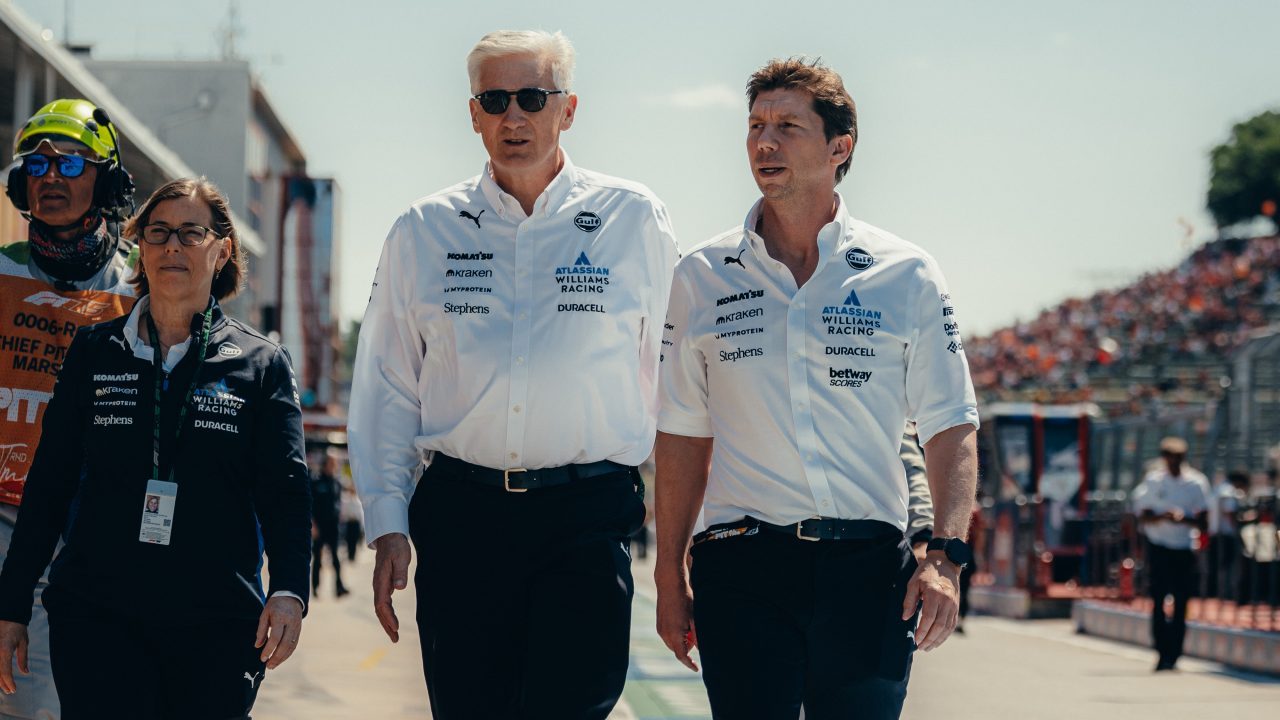
There was a grim air surrounding Williams Racing in the late 2010s and early 2020s. The legendary, family-owned team with the third-most constructors’ titles in Formula One history, finished in dead last three times in four years.
Williams also had a reputation in the paddock that was poor, literally and figuratively. Its annual spending was a fraction of the rest of the teams.
Then a lifeline came in 2020.
Williams was sold for $200 million to Dorilton Capital, a private investment firm co-founded by Matthew Savage and Darren Fultz.
The team invested in key operational improvements, upgrading the notorious Excel spreadsheets it used to track its car’s build. They nabbed James Vowles, a coveted engineer at Mercedes, as team principal.
Half a decade later and Williams is coming off a 5th-place finish, its best in nearly a decade.
Dorilton has seen their return in spades as the team is valued at $2.5 billion, per Forbes. But the firm is not cashing out anytime soon.
In an interview with Front Office Sports, Savage explained his long-term approach to Williams, the team’s expectations given sweeping rule changes coming next year, and the future of the F1 in the U.S. This interview has been edited for length and clarity.
Front Office Sports: What led you from MBA grad to buying a legacy Formula One constructor?
Matthew Savage: I’ve worked in finance since graduating from Oxford, when I was a physicist. So I’ve always had a technical bend. I was an M&A banker for 22 years, and then in 2009, had the opportunity to start an investment firm, Dorilton. We focus primarily on private equity types, which is really what led us to Williams.
The immediate introduction there was through [former driver] James Matthews. We noticed that the family was finding it hard to keep up with the big guys and they didn’t have the resources.
One of the things I did the math on was that in the history of F1, something like 154 teams have failed and gone of out business, which is sobering when you’re thinking of buying a team. When Matthews brought the idea to us, we looked at it, while also looking at minority stakes in other sports teams in the U.S. like NFL and NBA. What we liked about Williams was one huge legacy name and great history.
We wouldn’t have invested if not for the cost cap [in 2021]. There’s just no way we could have caught up otherwise. What it did was it turned the sport into a business competition; You need to be more efficient in everything you do, because every dollar saved is one you can put in the car as an upgrade.
We also bought the team at one times revenue. We’ve obviously had to put additional capital in, but now teams are trading at about seven times revenues.
FOS: When the Williams acquisition was announced, you said you would take a “flexible and patient investment style.” We’re half a decade later—at what point of the investment are you in now?
MS: We’re still taking the patient approach and the long-term perspective.
One of the pluses about a cost cap is that other teams can’t go nuts. The downside is that you can’t catch up quickly. The other piece to F1 is that it’s a complex engineering business, so you can’t just hire a couple of great drivers and be good. We felt this was going to be a long road, and we had to invest in basic processes and systems.
We even told James Vowles that we didn’t mind if he came in 10th for three years as long as the 2026 car was good.
Comparing it to other sports, in soccer, you can just buy a bunch of players and be good the next season. Peter Kenyon, CEO of Man United and Chelsea, he’s leading our commercial effort and I joke with him that’s kind of what he did with Chelsea. You can’t do that in F1.
McLaren is a neat case study for us because they were really having difficulties and then they started rebuilding after that. So where we are now, you could use one of those Winston Churchill quotes. It’s the end of the beginning, not the beginning of the end. We’re just getting started.
FOS: There are several changes in 2026 that many believe will shake up the championship race. How much variance will there really be?
MS: It’s hard to know until we hit the track. It’s a kind of a black box, and it’s a black box in two directions. One is engine and engine performance, and the other is chassis design and aerodynamics.
We’ve just had the most competitive season ever in terms of how close the field was, which is awesome for the sport. But I think you’ll most likely see an expansion of the delta between teams. It’s what usually happens in a Concorde Agreement when it starts off as people try to figure out different solutions, and then they copy each other, and everybody ends up closer.
I also know that we’re not quite there yet in terms of being World Championship-level with our processes across the whole team. So I would expect others to have been a little further advanced than us. I feel quietly confident in where we’ll be, but I don’t think we’ll be beating everybody. That will take some more work.
I hope to again be competing for podiums. I’ve told the teams, there’s a couple more steps on that podium and we’re not done yet.
FOS: Dorilton Capital owns 100% of Williams. You’ve said you have no plans to sell despite growing valuations. Why?
MS: We have the capital to keep investing in the business. We expect to take further steps forward in the constructors and I think valuations will keep going north.
We’re also growing our commercial revenue significantly. Last year into this year, we grew 100%, and next year we expected to grow another 50% or more.
The neat thing, unlike some other private equity funds, is that we don’t have to sell. We can keep this for the long run. We’ve always thought about this as a 10, 20, 25, 30-year project potential.
FOS: Are you eyeing acquiring other sports teams?
MS: I think we’re going to focus on Williams. There’s still a lot of work to do there. It doesn’t mean to say that there are other great opportunities out there, but I want to spend all of my energy on Williams other than get distracted.
FOS: Can F1 continue to grow in the U.S.?
MS: I do think there’s more to go. You have Cadillac entering next year, then there’s not just Drive to Survive, but the F1 movie. Another piece to all of this is to create fantastic experiences around F1 races. I think of race in each individual country—it’s like the Super Bowl of motorsports.
I also look at some of the numbers. Something like 43% of fans are under 35 and 42% are women. A bunch of other sports would kill for that kind of support.
FOS: What are your thoughts on the Apple TV deal in the U.S.?
MS: I think it’s going to be a really good partnership. Apple did a really good job on the F1 movie, so this is a good step forward.
Another potential piece is that this deal may not have to be limited to the U.S. They could take the coverage to other markets over time.
![[US, Mexico & Canada customers only] April 13, 2025; Sakhir, BAHRAIN; Oscar Piastri leads George Russell into the first corner at the start of the race during the F1 Bahrain Grand Prix at the Bahrain International Circuit.](https://frontofficesports.com/wp-content/uploads/2026/03/USATSI_25925940_168416386_lowres-scaled.jpg?quality=100&w=1024)