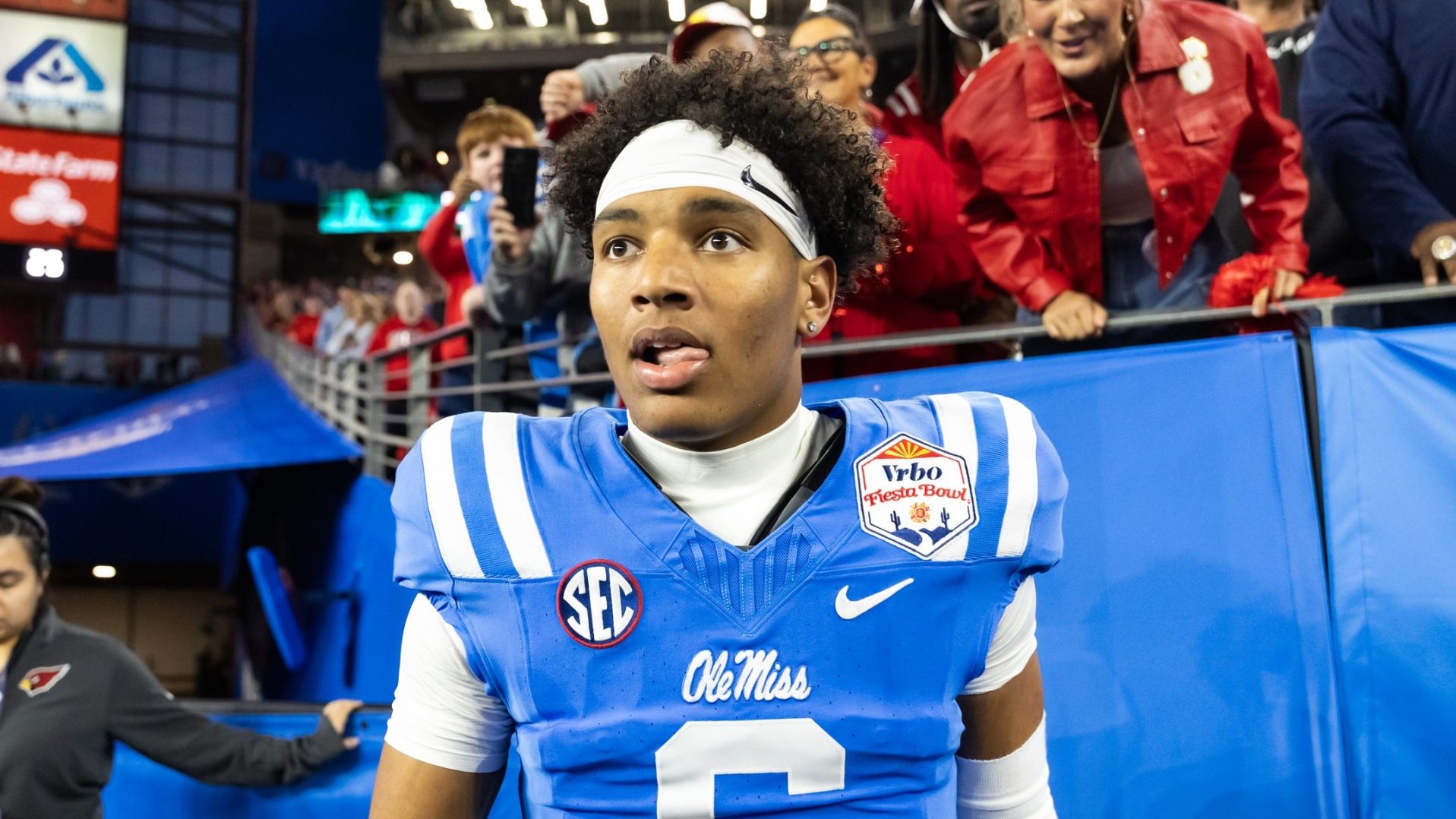
Ole Miss quarterback Trinidad Chambliss has taken his eligibility fight to court.
On Friday, Chambliss—represented by prominent attorney Tom Mars—filed a lawsuit in Mississippi state court against the NCAA. It argues that the governing body violated its own bylaws by denying a waiver that would allow Chambliss to play in the 2026–27 season for the Rebels. The complaint, a copy of which was obtained by Front Office Sports, requests monetary damages as well as an injunction allowing Chambliss to play.
It’s the latest step in the eligibility battle after Chambliss that extends back to October.
The NCAA’s current eligibility rules allow players five years to complete four full seasons; Chambliss argues he should be able to play another season despite the fact that he would complete four seasons in six years.
Chambliss began his career at Division II program Ferris State in 2021, but redshirted after “medical and physical incapacity” due to complications related to the Epstein-Barr virus or mononucleosis, as well as COVID-19, which prevented him from playing, the lawsuit says. He didn’t play in 2022, either. Chambliss played in 2023 and 2024 for Ferris State, and transferred to Ole Miss—where he led the Rebels to unprecedented success in the College Football Playoff.
Chambliss filed a waiver in October 2025, but the NCAA told an Ole Miss employee that his waiver would be denied, according to the complaint. Chambliss then filed an appeal,
The NCAA denied the appeal on Jan. 9, the day after Ole Miss lost to Miami in the College Football Playoff semifinal. “The irony, if any, is the timing” of the statements, the complaint read. “The NCAA released its statements…the morning after Trinidad competed against the University of Miami and its quarterback Carson Beck in the College Football Playoff semifinal game at the Fiesta Bowl. At the time of that contest, Carson Beck had been playing college football for over six years.”
The NCAA said in a public statement that day that Chambliss would not receive a waiver because he could have only used a redshirt waiver once, and that he did not sufficiently demonstrate that the reason he needed a waiver was out of his or the schools’ control. “This decision aligns with consistent application of NCAA rules,” the NCAA said in the lengthy statement. (The lawsuit argued multiple aspects of this statement were “false or misleading.”)
If Chambliss can’t compete, he won’t just lose another opportunity to play for Ole Miss and get another shot at the national championship. He’ll also lose out on a lucrative NIL (name, image, and likeness) package that the school and NIL collective have put together for him should he be able to compete next year.
When asked for comment, the NCAA pointed to its statement made last week.