SANTA CLARA — The NFL and its virtual first-down measurement partner are aiming to expand the technology to actually spot the football in just four years.
“We’re working with the NFL and their Future of Football Committee, with sights on having something in place in the next three-ish years,” Sony Hawk-Eye North America commercial director Justin Goltz told Front Office Sports on Tuesday at Levi’s Stadium. “I know 2030 is a big goal for them.”
Should there be a first-down measurement during Super Bowl LX on Sunday, it will be the first time that virtual measurement technology is used in the NFL’s championship game, as Sony will have more than 175 cameras at Levi’s Stadium. The virtual first-down measurements debuted during the regular season, and there have been five virtual measurements already during the playoffs, all with the ball spotted six inches or less from the first-down marker.
“I think it’s a very realistic goal,” Goltz said of virtually spotting footballs so soon. “But it’s also maybe one of the hardest problems to solve in sports—to the granular level that we do automatic balls and strikes and tennis line calling, and things like that.”
Sony Hawk-Eye’s sports presence is perhaps most known in tennis, with the technology used for electronic line-calling at Grand Slams like Wimbledon and the US Open, among other top tournaments. In soccer, Sony Hawk-Eye’s clients for VAR (video assistant referee), goal line tech, and semi-automated offside include FIFA, UEFA, and the English Premier League. Sony Hawk-Eye tech will be used for MLB’s new automated ball-strike (ABS) challenge system in 2026.
After one season of virtual first-down measurements in the NFL, the league and Sony Hawk-Eye are “already starting to think and work toward the precursors” for spotting the ball, Goltz said. “I think the audience was exposed to the process, but he also realizes that the ball is still spotted by an official. So, we’re trying to understand, which is a very difficult problem, how we can help spot the ball in critical situations.”
On Monday, NFL commissioner Roger Goodell, in his state of the league address, said technology is “something we need to embrace in the game in every way we can,” citing the specific importance of officiating.
“We need to be able to use [technology] to help our officials get it right,” Goodell said. “They want to get it right. They’re incredibly dedicated professionals. But we also need to give them that tool. And I think AI is going to be a real opportunity there. We are talking with our partners and talking with others about how we implement that to help our officials.”
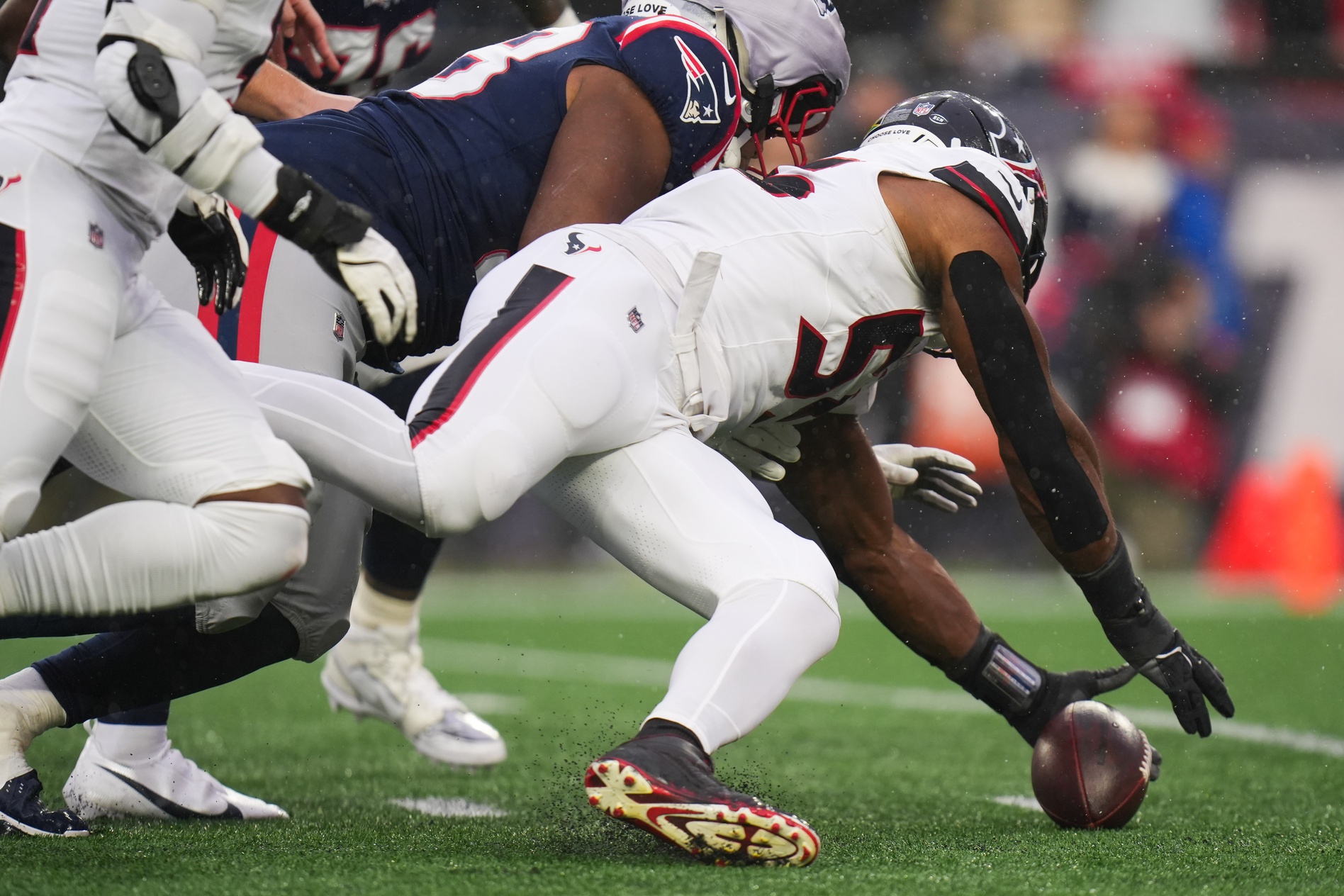
The crowded nature of football—22 players on the field every play—makes it difficult to capture every small detail.
“Cameras aren’t always the most friendly technology when the ball is hidden,” Goltz said. “But there’s also some really interesting combinations of things we can do with optical and sensor-based technologies to be predictive and estimate where the ball could be spotted based off of a lot of information around it—similar technology to what we’ve implemented with semi-automated offsides.”
Zebra Technologies is the NFL’s current ball sensor provider, and Goltz said he believes there “needs to be enhancements” to the sensor in the ball—currently positioned in the middle of the football—to be more accurate, particularly around ball orientation, which can drastically change the spot of the football. Sony Hawk-Eye currently doesn’t make ball sensors.
Still Work to Be Done
NFL EVP of football operations Troy Vincent said the topic of spotting the football “comes up all the time” among the NFL’s competition committee and owners, who would ultimately have to approve any official switch to using technology to spot the football during game action.
“You have to keep in mind that you still have a human element that will always exist,” Vincent said Wednesday when asked by FOS during a media panel in San Francisco. “Where is the ball spotted? And where is the forward progress stopped? So, that human has to place the ball.” Vincent said the conversations thus far have largely been: “Can technology get us there?”
NFL senior director of Next Gen Stats Josh Helmrich said, “There’s a lot of variables that go into this by default—forward progress, possession, and location of the ball is one part of it. The chip in the ball married with optical tracking can help get better when you have that data. But that’s only part of the equation. So, I think over time it’s helping. It helps when punts go out of bounds, but on some plays where it’s a forward progress play, absolute location—even if you knew it with perfect precision—it’s not enough.”
Helmrich said the league has tested having multiple chips inside the football, but have so far concluded that’s not necessary. “If you have orientation, you can do math and know where the nose of the football would be,” he said. “We’re getting better with the accuracy of the football. I think it will be an input in the long term to help the process, but it can never be the process because there are those other elements that go into the spot of the ball.”