Want more from Front Office Sports
in your search results?
The NFL free agency cycle is in full swing as more than a billion dollars in contracts were agreed to over the weekend, and several more massive deals were agreed to Monday.
While the dollar amounts will get many of the headlines, a deeper look shows a growing trend in the NFL: a pay gap between high-value positions like quarterback, edge rusher, and wide receiver versus the rest of the league.
In 2011, the highest-paid quarterback in terms of average annual value (AAV) was Peyton Manning, who earned $18 million per year. As of 2025, the leader is Dak Prescott, who makes $60 million annually, more than three times as much as Manning did.
The NFL salary cap has risen significantly since 2011, so the salaries must be adjusted against inflation. The salary cap in 2011 was $120.4 million and has increased by an average of 6.3% every year to hit $279.2 million by 2025.
The average annual value percentage, which is calculated by dividing the average annual value of a player’s salary by the salary cap totals during the years of a player’s contract, shows that quarterbacks are paid a larger share of a team’s salary cap.

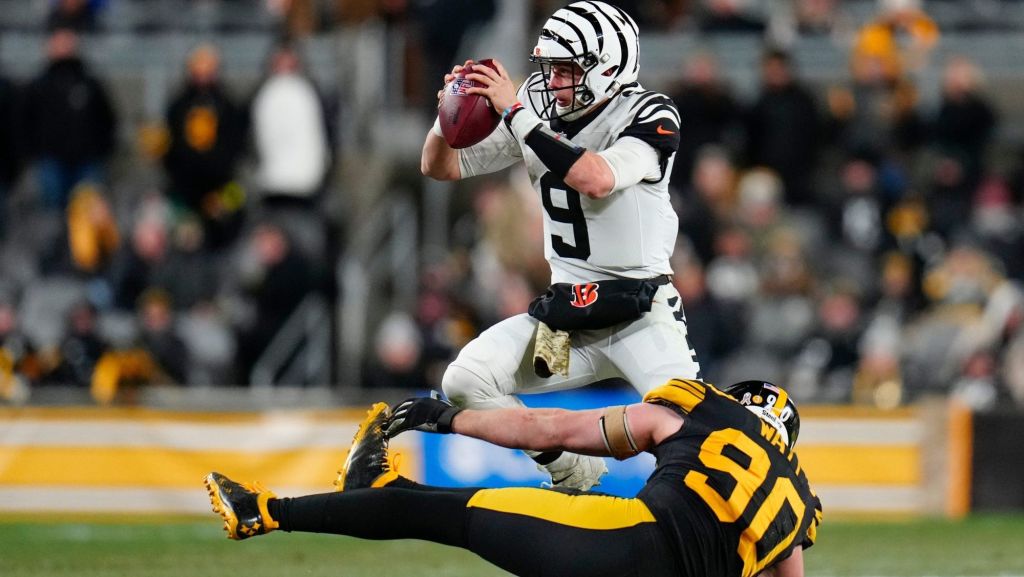
(Because AAV% is based on the years of a player’s contract, Joe Burrow, whose five-year deal at $55 million per year runs from 2023–2027, has a higher AAV% than Dak Prescott, whose four-year deal at $60 million per year runs from 2025–2028.)
Burrow has led the NFL in AAV% since 2023 at 24.5%, nearly 10% more than Peyton Manning’s 14.9% from 2011, according to data from Spotrac. In 2025, the top 18 players in AAV% are quarterbacks—compared to 2011, when only four of the top ten players in AAV% were QBs.
Quarterbacks began to dominate about a decade ago, as the last time a non-QB made the top ten in AAV% was 2014. However, the AAV% for quarterbacks has continued to rise since then, showing just how much teams are valuing their signal-callers.
But QBs aren’t the only ones seeing an increased percentage share of team payrolls. Wide receivers have seen an even more drastic bump, as entering 2025, a dozen wideouts are set to be paid at least 10% of the salary cap throughout their contract. In 2011, only one player, Larry Fitzgerald, had an AAV% above 10%.
Edge rushers are another beneficiary, as eight of them will have crossed the 10% mark for AAV% entering 2025 compared to only four in 2011. T.J. Watt leads all edge rushers with an AAV% of 15.3%, 4.3% more than Dwight Freeney, the leader in 2011.
Unsurprisingly, running backs have been negatively affected, even as Saquon Barkley proved to be a vital piece of the Eagles’ Super Bowl run and signed the largest contract for a running back by AAV just last week. In 2011, eight running backs had an AAV% of at least 5%. Only three—Barkley, Christian McCaffrey, and Jonathan Taylor—are past that threshold entering 2025.
Download the FOS App
The business of sports, in your pocket.



Scan the QR code to get the app now.