
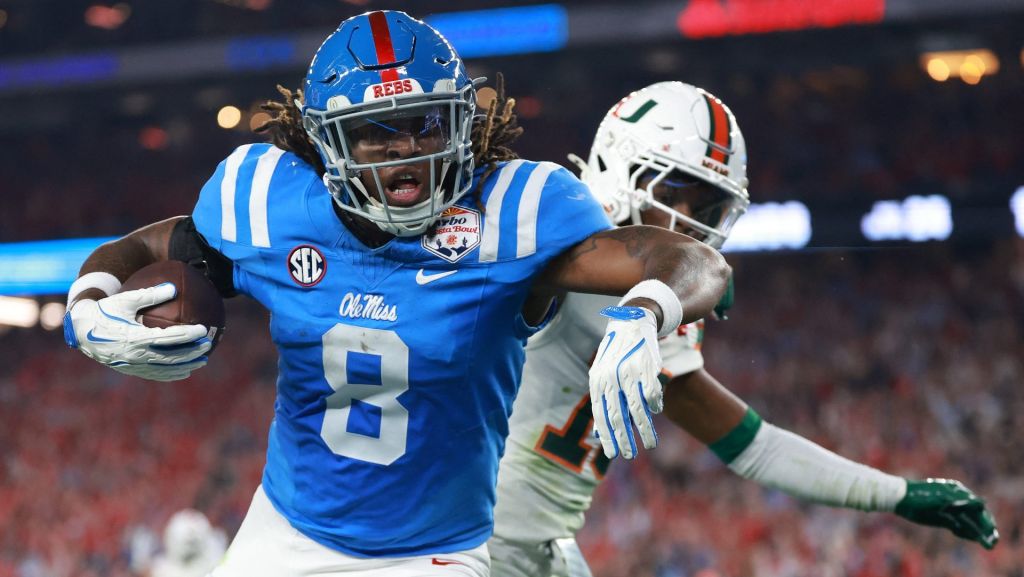
Dae’Quan Wright is set to become the first player to have participated in an NFL preseason game to return to college—a situation unthinkable even a few months ago. He probably won’t be the last.
Wright, who was waived by the Cleveland Browns on Sunday, has a deal in place to play for LSU this season, his agent Drew Rosenhaus confirmed to Front Office Sports. Wright is allowed to return to college thanks to a lawsuit he filed alongside other athletes, including 16 football players, in Louisiana state court last week.
The situation has led players and college teams nationwide to wonder whether they could follow the path of Wright and his fellow plaintiffs as another round of NFL roster cuts approaches. Players currently or formerly in NFL training camps are contacting attorneys to consider whether they can or should file eligibility lawsuits of their own; meanwhile, schools are currently exploring whether to sign them, multiple industry sources tell FOS.
Says one source affiliated with a power conference school: “You have to be looking at any possibility of what could transpire.”
How We Got Here
Wright’s situation stems from a cascade of lawsuits unrelated to NCAA eligibility rules regarding professional sports participation. Instead, the lawsuits challenged the implementation of the “age-based” eligibility policy.
The new policy, which the NCAA passed in June, allows players five years to complete five seasons of competition (up from four) starting when they enter college or on their 19th birthday—whichever comes first. But the NCAA decided not to apply this policy to players who entered college in 2022 and had exhausted four years of eligibility. In response, many of these players filed lawsuits to get that extra fifth year.
Wright, along with many others, joined a lawsuit filed last week in Louisiana state court challenging the exclusion of 2022 athletes. The case argued these football players never would have participated in NFL training camps if they had known earlier this year they might have a chance to return to college.
Other plaintiffs include Wright’s old teammate at Ole Miss, safety Wydett Williams Jr., who suited up for the Arizona Cardinals this weekend; former Oregon State running back Anthony Hankerson, who played for the Seattle Seahawks this weekend; and former LSU linebacker Jack Pyburn, who played for the Tampa Bay Buccaneers.
The lawsuit also included players who participated in NFL minicamps or preseason training camps but never signed contracts with NFL teams or appeared in preseason games. Another old teammate of Wright’s, Zxavian Harris, was signed by the New Orleans Saints but never appeared in preseason and was waived in early August. He’s reportedly also headed to LSU, as of Monday evening.
Former James Madison linebacker Trent Hendrick previously participated in NFL minicamps with the Browns and Chiefs but wasn’t signed. Now, he’s reportedly committed to UCLA. (Though through a different lawsuit, Texas’s Cole Hutson also similarly participated in training camps but never signed; he’s back in Austin this season.)
The judge granted a temporary restraining order Wednesday night, with a hearing for a full injunction scheduled for Aug. 31. For players to be eligible, however, the judge stipulated two important requirements: First, they had to terminate their professional contracts. Second, they had to give back any money they earned while part of the NFL preseason roster.
In a statement published after the decision, the NCAA said: “Courts across the country granting relief to ineligible athletes who already had every opportunity to compete in college — sometimes without even having a hearing — are failing to appreciate the destabilizing effect their rulings are having on college sports.”
On Monday, LSU coach Lane Kiffin defended signing Wright despite his NFL activities. “At the end of the day, because of these rulings, they’re either going to play for you, or they’re going to play somewhere else around the country,” he said. “So we made the decision to recruit them, like a lot of other people are.”
A Rare Opportunity
As of Monday, only the players involved in the Louisiana case—those covered by the injunction—are eligible to return to college. But that could change.
On Aug. 31, all NFL teams have to cut down their rosters from 90 to 53 players. That could lead to a scramble for players seeking college eligibility if they get cut. The path for players to replicate Wright’s situation is possible but complex.
To initiate the process, these players must be part of the class who entered college in 2022, completed four years of eligibility, and are under the age of 25. Only then could they consider filing a lawsuit like the one Wright and others filed.
One source affiliated with a power conference program explained the current process to FOS: These players—and increasingly, their agents—are reaching out to schools to ask whether schools might be interested in signing a player, if that player could theoretically secure another year of college eligibility. If there is interest, the player will file a lawsuit to secure an injunction.
Between Wednesday night when the Louisiana injunction was decided and Monday morning, sports attorney Darren Heitner had gotten at least a dozen players or their representatives inquiring about filing a potential lawsuit of their own, he tells FOS.
He notes that he usually gets requests from players or family members—but now he’s getting inbound requests from agents themselves.
“I do envision there’s going to be quite a bit more over [requests] throughout the day, and maybe the next few days,” Heitner says.
Players would theoretically have to file a lawsuit, secure an injunction, and get waived from their NFL team before a set of deadlines, including university enrollment periods, season kickoffs, and roster finalization and submission requirements. Sources pointed out possible exceptions, but gaining eligibility becomes increasingly difficult as the days and weeks go on.
In the long run, however, sources do not anticipate players being able to go from NFL training camp back to college in future years. That’s because the current situation was a symptom of the players challenging the NCAA’s treatment of the freshman class of 2022 specifically.
“This is likely a one-time deal clearly in football,” a power conference administrator tells FOS. “This is not, ‘The sky is falling’ in football. This really is a one-off.”
—FOS NFL reporter Mark Maske contributed to this story.