Laura Rutledge has been everywhere on ESPN’s college football and NFL coverage this season. She’s serving as a sideline reporter for ESPN’s coverage of the College Football Playoff and Monday Night Football—while still juggling her hosting duties on NFL Live and SEC Nation.
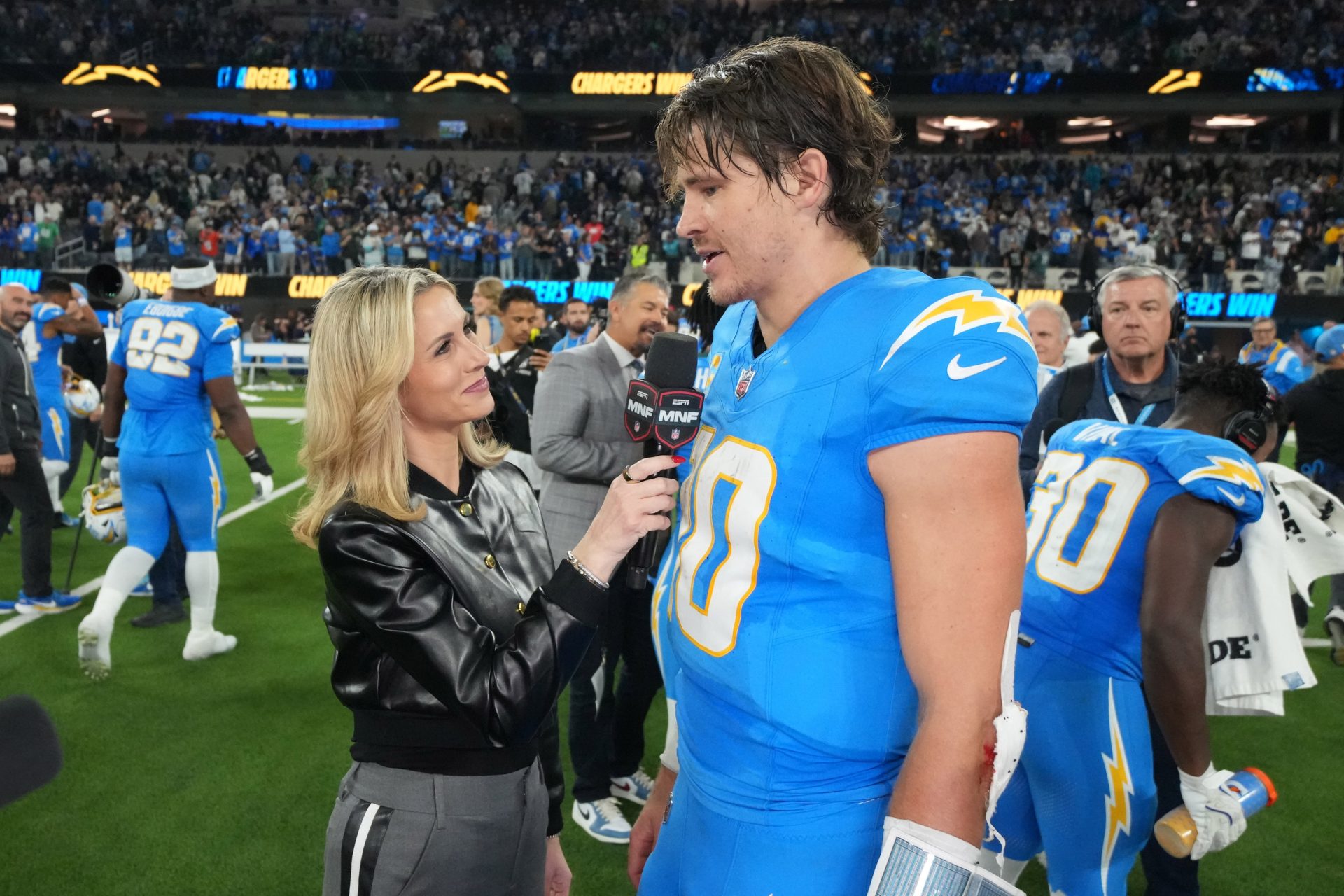
The star reporter went viral last Thursday after TV cameras caught her sprinting across the field at the Sugar Bowl in a madcap dash to host the halftime show. She also quickly shut down rumors Seahawks QB Sam Darnold snubbed her postgame on Saturday. She’s still getting kudos for respectfully, but firmly, getting boorish Chargers QB Justin Herbert to answer her questions in December.
Front Office Sports talked to the 37-year-old star about her wild month on the gridiron. Below is an edited excerpt of our interview:
Front Office Sports: Let’s talk about the viral reaction to your 100-yard dash at the Sugar Bowl. I loved how the legendary Chris Berman sang your praises with his signature “WOOP!” narration. Your reaction?
Laura Rutledge: I am sort of embarrassed because I did not know that anybody was going to be filming that. Had I known I might have tried to run even a little faster. I was actually upset with myself because I’d been on a long trip, and sometimes it’s hard to think about all the packing, and all the things that you would need, for the different roles and the different games and shows. And what I had brought to wear was not my best option for running—because my pants were too big and baggy and the heels on my boots were kind of slowing me down. So I think it would have been a little faster had I had a little bit better of a setup.
But it’s so nice, the people that have been positive, I’m just really thankful to get to do this. And it’s pretty funny, [ESPN EVP of sports production] Mike McQuade, actually it was last year, because we started doing this last year at the Sugar Bowl. He asked me, “Do you think you can make it? Do you think you’d be able to get there in time?” I’m like, “Sure, give me a chance. Let’s see if I can do it.” And to just have the faith of the leadership here back me up and to be able to pull it off has been so much fun, but it really doesn’t happen without a great crew helping me. And in that video, you see it, you know, I sit down, we’re changing mics out. It’s like a NASCAR pit stop.
FOS: Besides hosting NFL Live and SEC Nation, you do sideline reporting for the CFP and primetime college football games. And this season, you were promoted to the cast of Monday Night Football. How do you juggle all these assignments?
LR: It’s been really fun, to be honest. … But I think, when it comes down to juggling all of it, it’s a matter of compartmentalizing time. So a lot of times, I’ll be at the SEC Nation site and then I’ll have to switch gears really fast to do something for Monday Night Football. I’ll be doing an interview for Monday Night Football. And it’s just like being right where your feet are in that moment to make sure that you’re super-dialed-in on whatever it may be, I think is the most important thing. And then trusting yourself, too. I’m a big over-preparer. I’m a big self-doubter at times. And so for me, it’s been constantly reminding myself like, “No, you’ve got this, you are prepared, you can show up.” Because inevitably with all these different roles, I can’t do the level of prep that was probably too much, to be totally honest. I can’t really do that every single time like I want to. But I think what’s been interesting about that is in some ways it’s made me a better host. It made me more curious. It’s made me not be somebody who’s trying to force a stat in, or force things in that maybe I would have in the past, just because I had done so much work on it.
FOS: Fans rushed to your defense when they thought Sam Darnold of the Seahawks blew you off for a postgame interview. But you were quick to note on Twitter that that was inaccurate. What happened?
LR: I try not to engage too much with some of the things that are out there, right? Because it’s just all clickbait, I think. But I hate when these players get any sort of bad rap from something that happens, you know, that was clearly not what people thought it was. And in this case, right as we hit the end of the game, our producer, Steve Ackels, got in our ear and said, “Hey, we have about 12 minutes off-air. So take your time getting the interviews.” I knew that Lisa Salters was also going to be interviewing somebody. So she was chasing down her person. I’m chasing down my person. In other scenarios, we have to get off the air super-quick, especially if the game goes to overtime. You know how this works, right? You got to get off the air. We got to toss to something else. We only have a certain amount of time in our broadcast window. But in this case, because the game had ended a little earlier, we had some time to fill. So I was kind of slow-playing it and Darnold saw me. And he said, “Hey, you know, do you want to go now?” And I said, “No, you actually have time.” And that’s what the camera caught, me saying, “You have time, you know, go do whatever you want to do.” He said, “Well, I just want to go see Brock [Purdy].” And I said, “O.K., I’m going to be close by so that whenever you’re done, we’ll reconvene. We’ll do the interview.”
I felt I needed to say something because it frustrates me when these guys are being great gentlemen about it, and they’re being so kind, and they get any criticism at all. He could not have been a kinder person about it. And then he was so thankful afterward, he came up to me again, which nobody saw after we finished the interview, and thanked me for letting him have that time. He knows, too, that that’s a little bit rare to have that amount of time to seek somebody out. So that was all that happened. I just wanted to make sure that he didn’t get any criticism for how he handled it.
FOS: But I have to ask about that awkward interview with Justin Herbert of the Chargers, because that was different. It did seem like he was trying to avoid you. And I give you tremendous credit as a journalist for just sticking with the job and very politely, but very firmly saying, look, “I’ve got a job to do here and I’ve got a limited time to do it. So answer some questions.” What happened there?
LR: Yes, so that one was a different scenario, right? Just so people understand, and I think Justin Herbert’s amazing, and I get it, not everybody wants to do these interviews, right? We’re there to do our jobs, they’re there to do theirs, and I actually credit him for still standing there and doing the interview. But for background reference, we okay these interviews with the team. So the team has PR. We go to the PR, we make sure they know, “O.K., so you’re gonna get this person, this is how it’s all going to go.” It’s actually a really interesting conversation. And in that game, remember, it came down to the final moment because it was an interception on the last play in overtime that won the game for the Chargers. So it wasn’t like we could do a bunch of planning, but we knew, and we had even talked pregame, that if they won, Justin Herbert was going to do an interview with me, because I had the Chargers; Lisa Salters was on the other side. So anyway when the game goes final, we’re trying to give him as much time as possible, and they’re in my ear saying, “You’ve got to get him, you’ve got to get him.” I’m like, “I know, I’m trying to give him some space.” We have a talkback button so we can talk to the truck. I keep saying, “I don’t have him,” and they can see that I don’t have him. I keep saying, “I don’t have him, I don’t have him.”
Well, finally they thought I had gotten close enough to him, which I had, because I was right on him, but I was trying to give him enough time to say hello to everyone and all that. It was over 90 seconds after air, which doesn’t seem like that long, but in TV and really in that type of scenario, it is. Because there’s plenty of time to see people. Most people had cleared off the field. Finally, I had to just get to him and I realized my mic was hot and I’m like, “O.K., we’re on, you know, we got to go here.” And, you know, it was interesting because I know he had been through so much. I mean, he had a broken hand, and he was frustrated, I think, with the way that some of the parts of the game had gone and he had been so tough. He had played so well with everything he was dealing with. But I completely changed my interview structure because I wanted to get him out as fast as possible. I didn’t want to keep him any longer than we had to. I’m so sensitive to somebody not wanting to necessarily be there. … He doesn’t want credit. He loves to give credit to his teammates. I think that was a lot of the reason why it went the way that it did. But again credit to Justin for sticking through it—and doing the interview. No hard feelings by me.
Emotions are high down there, Mike. That’s the other thing that’s crazy. I think, you know, there are so many people that are sitting on their couch, and they think they sort of understand what’s going on, and that that’s all great. But it is also our job to bring the emotion of the game to life. And sometimes like what’s happening down there on the field, they just played in this crazy game, and then all of a sudden we’re going to be talking to them. That’s kind of the beauty of it. There are some fans that say we’re bothering them and things like that. I get that perspective, but also as a fan, for me, I want to know, what’s happening down there? What’s actually going on? And that really is sort of the truest inside peek of what these guys are actually dealing with down there.
FOS: Is sideline reporting a no-win job sometimes? You have guys who say women shouldn’t be sideline reporters at all. You even had people saying you hurt Herbert by touching his broken hand.
LR: I barely touched him, but I felt bad. I was like, “My God, I hope I didn’t.” I think you said it well: It’s a little bit of a no-win. … We don’t feel sorry for ourselves. We’re so fortunate to get to do this. And there’s so many harder jobs out there, right? But I do think that it’s a misunderstood job, a lot of times. We get on the air, I don’t know, two or three times in a game normally, and we do interviews here and there, right? Really the whole point is the essence of time, but also delivering information as quickly as possible with the most important information. And a lot of times we have 12 seconds to get a report in, before the ball’s gonna snap. Or we have just a couple seconds to ask a question because we don’t want to hold a coach too long. It’s so high-pressure. It’s just wild and crazy down there. There’s so many things happening. But I think what’s maybe misconstrued, or what people don’t understand, is that it’s not like somebody’s in our ear telling us what to say. So it’s sort of all on you. But then also, there’s so much that we do outside of the actual reporting on-air.
FOS: You were promoted to MNF this season. All 25 of ESPN’s NFL games had not one but two sideline reporters. What has your experience been like?
LR: Joe [Buck] and Troy [Aikman] are amazing. It’s been such an honor just to be in meetings with them, and listen to how they look at the game, and learn from them about how they broadcast. They have so many big games under their belts. And just to see two guys that have worked together for 20-plus years, and know each other so well, and the way that they feed off of each other. But I think it’s not just that. It’s the attention to detail to every single part of our crew. I mean, they know everybody on the crew. They’re so kind to everybody. They’re inclusive. Troy will say, “Hey, I’m going to take the stats group to dinner. Just spend some time with them.”
Joe will spend extra time with whomever it is. Joe’s been a great mentor to me, too. And he actually said the nicest thing to me when I saw him at the 49ers game that we just did. And I was coming off of the Sugar Bowl. He was saying “great job,” which coming from him, you know, means the absolute world. He’s one of the best to ever do it. But he also said, “Doesn’t it make it all easier when you’re running around like that? It makes you better, it makes it easier, it makes it like, hey, here we are, it’s halftime, whatever, I just did the game.” And the way he said it was said with so much respect to me. But also it made me feel like I was in a category that’s a little bit in his category, right? I’m nowhere near him. I’m not saying that, but just like the way he said it was so inclusive and kind and supportive.