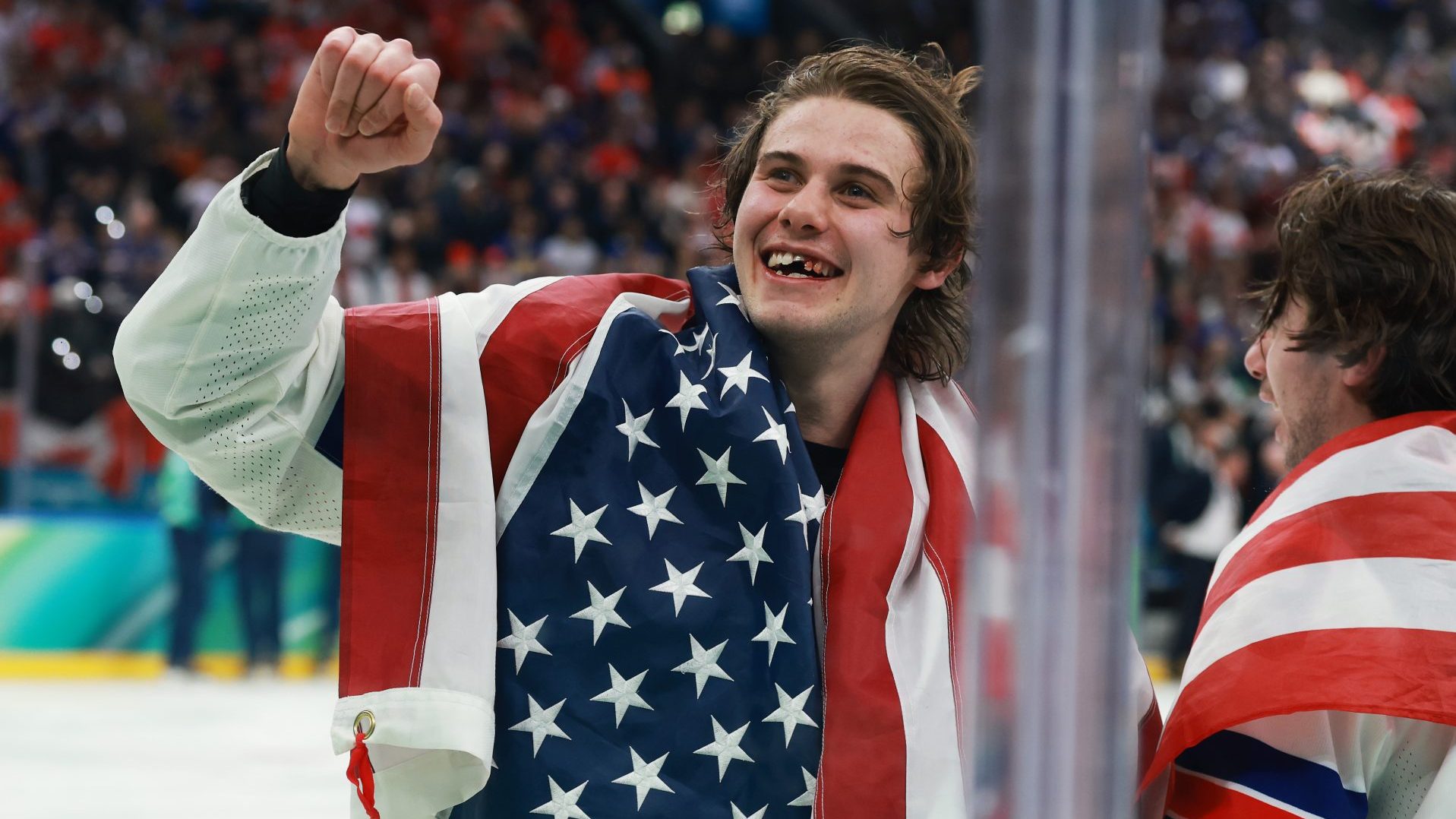
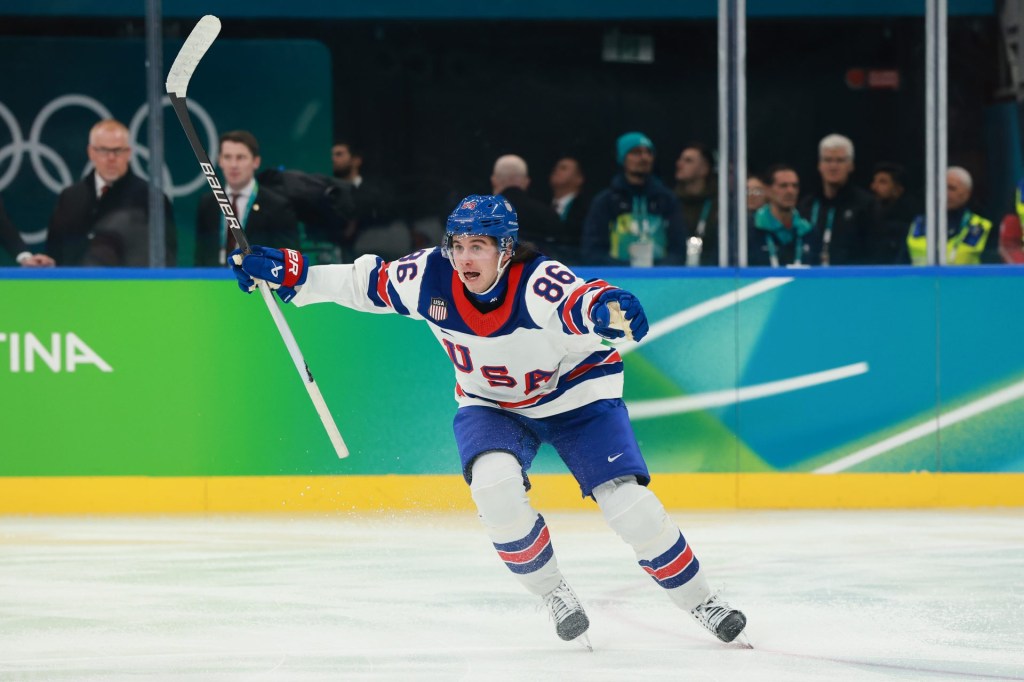
After Jack Hughes netted the overtime winner that secured the U.S. men’s hockey team its first Olympic gold medal since 1980, the forward draped himself in an American flag and flashed a bloody, chipped-tooth smile.
On the other side of the glass, Elsa Garrison snapped a few rapid frames of the moment, which lasted only a few seconds. Just minutes later, her photo became the defining image of the 2026 Winter Olympics.
The Getty Images photographer, who goes by simply Elsa, spent much of the Games near the ice, shooting figure skating, speedskating, and hockey. She took thousands of images, but the Hughes picture has taken on a life of its own. From Milan, she spoke to Front Office Sports about how she got the shot and the wild few days she’s had since landing her work among the most iconic U.S. sports photos. This interview has been edited for length and clarity.
Front Office Sports: Your image just became the defining visual of one of the biggest moments in American sports history. How do you feel?
Elsa: It’s still kind of surreal. Honestly, I thought, “Yeah, the picture’s fine.” I knew it might have some legs for a while, but I didn’t think it would kind of resonate as well as it has. But it still kind of feels not real.
There are people that are talking about, like, “Oh, this is as good as the 1980 [Miracle on Ice] Heinz Kluetmeier picture. Or the Sonny Liston–Muhammad Ali picture that Neil Leifer shot.” And those are pretty big people to be in a group with as far as great sports moments. That’s flattering, but I’m still kind of like, “What? Really?”
FOS: How did you get the shot?
Elsa: We had five photographers at that gold medal match, and so I was one of the three that were ice-level, and then we had two in elevated positions. So, I was kind of on an off-angle. Mostly what I was there to capture was reaction pictures of some of the players. I thought that Canada would probably win, so I was [positioned] looking into the Canadian bench. It was where USA was attacking first and third, and then in the overtime they continued to attack that goal.
You plan all these scenarios in your head, but we are reacting to the moments that happen in front of us so quickly that if you are debating your contingency plan of like, “Well, what should I do when this moment happens?”—you’re going to miss it. I was looking at the video when Jack scored the goal and when the bench cleared, and then they were by the penalty box. It was probably about three seconds, maybe four.
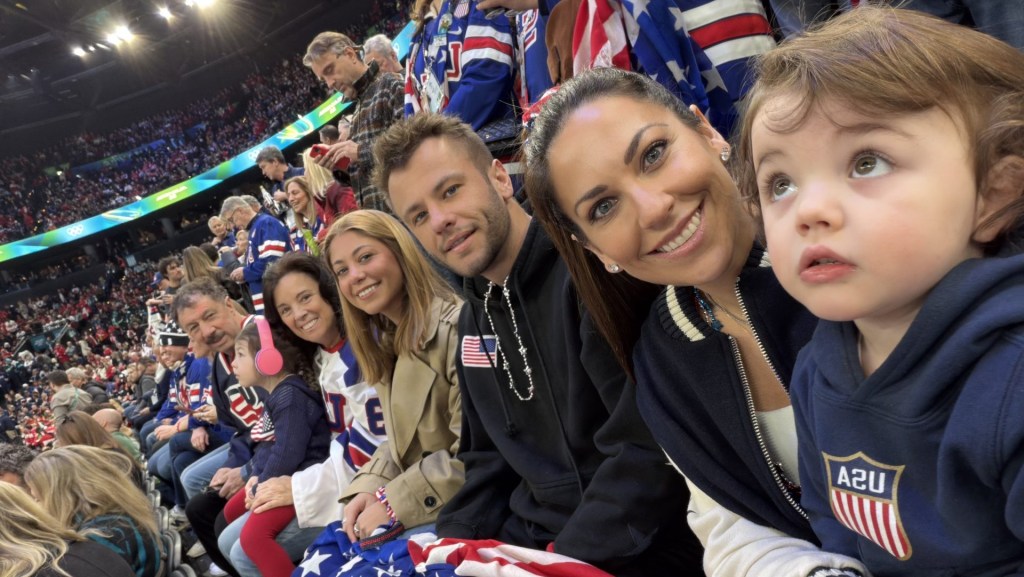
I’m a big proponent of doing research before an event. I knew that the two other photographers were going on the ice to prepare for the medal ceremony, and so it was my job to work the perimeter of the rink for that initial celebration. Before the game, I sussed out, this is where the Canadian families are. This is where the U.S. families are. And I knew that after the initial celebration happened, and they grabbed their flags before they lined up for the medals, they would likely skate towards their families. And that’s exactly what they did.
I was basically right underneath where the Team USA families were seated, and that’s how I got that picture. And [Hughes] wasn’t there at the glass very long. He and his brother [Quinn] were kind of skating together, and then they just kind of looked up and that was it. I think I probably got, like, three frames off, and then they were off to line up for the medal ceremony. It was all very fast.
FOS: Getting moments like this sound a little bit like pulling from your strategic professional history and the technical side of things, but also serendipity.
Elsa: Some days it all comes your way. But I think when it does, you need to be prepared and you need to react accordingly. Certainly with Olympic hockey, we’re shooting through the glass. So, that presents another technical challenge to overcome. If you shoot at the wrong angle, the images aren’t as crisp. Just getting that right angle and getting all the technical stuff all set, I don’t have to think about it. I’m just running and doing my job and chasing down those moments.
FOS: Did you hear from anybody after you were identified as the photographer?
Elsa: That night, that picture was used on several different platforms: SI, ESPN, the NHL, and Team USA Hockey, and then other random places as well. Some were crediting me as the photographer, some not. But I had a ton of DMs in my Instagram. I looked at it; it was like, You are mentioned in 95 stories. I’m like, “Jesus.” I’ve gained 3,000 new followers in two days, which is unheard of. I guess it’s resonated with a few people.
I think the last time something was like this was the Olympics in Paris, when a picture that I shot from gymnastics of Simone Biles, Rebeca Andrade, and Jordan Chiles went a little viral as well—but not to the scale that this has. So, now it seems like there’s a trend. I’ll have to shoot a viral image every Olympics. No pressure for LA28, I guess.
FOS: Does it change the bar to which you’re going to hold yourself or the way you’re thinking about how your images might proliferate on different platforms?
Elsa: It’s just still about carrying on and doing the job that I’m set out to do. What I think about is, O.K., what potential stories are going to come out of this match event, and how best am I going to position myself to get those things, whether it’s the action or the reaction? There’s not really one formula for success at any sort of event. You just kind of reassess every time.
FOS: What do you think it is about this photo—technically from a composition standpoint and also culturally—that made people latch onto this image of the thousands that were shot?
Elsa: It certainly got out pretty fast. Our editing team was pretty spot-on, and a lot of the other photographers and their outlets were out on the ice waiting for the medal ceremony to happen. So I was next to a cable, and I was able to send it out quickly to the editor within seconds after I took it.
I think the thing that resonates with people is in the third period, he got smacked in the face, he chipped his tooth, he had a bloody lip, and he still carried on. It shows the physical toughness and the mental toughness of hockey players. Then he goes on to score the game-winning goal in overtime, and he’s still bleeding. And he’s got the American flag draped on him. So, it was definitely the image of grit and toughness and patriotism all in one.
FOS: How has social media changed your job?
Elsa: I don’t know that it has. I’m of that generation that started well before that. We were in film, and then now we’re all digital. The immediacy of delivery is what’s really changed. And I think sometimes, especially with social media, some images don’t necessarily have a long shelf life—everyone’s moved on to that next moment.
I’m kind of surprised that this one’s still kind of sticking a little bit. So maybe it’s just that the men’s team hadn’t won in 40 years, so that could be part of it, but I feel like sometimes with social media, the longevity is not as what it is in print.
[Technically,] pictures that are a little wider in scope, that are more sort of scene setters, maybe don’t necessarily play as well on mobile devices, versus something shot a little tighter—that has a little bit more impact. And so I’ve always kind of shot a little tighter and a little more for impact. I think my style of photography works well on social media for the most part.
And with the advent of websites and social media, a lot of images are horizontal versus vertical. I still do think vertical images exist—certainly, basketball is a vertical sport. Sometimes, it works horizontally, but primarily now I’m shooting horizontally, just because that’s going to get the most use in a lot of different platforms.
FOS: And why just “Elsa”?
Elsa: When I first started in 1996 fresh out of college—which is crazy to me that it’s going to be 30 years—it was always frustrating to me that publications would misspell my first name. They turned me into a dude. Somehow Elsa became Eli, and then they’d add extra vowels into my last name. And so I thought as a joke to my assignment editor at the time, I said, “Well, maybe I should just go by Elsa and like, they could figure out how to spell that first.”
I took my husband’s last name when I got married because it was easier to spell and pronounce, so I figured that was half the battle. But by that time, I had already been using just the one-name byline for easily 10 years. It was kind of the gag that stuck, and it was really kind of sealed.
FOS: What else do you want people to know about the photo?
Elsa: Everything just kind of happened so fast. But I think planning goes a long way—to have a kind of game plan for every scenario that could potentially happen in the back of my mind, so I can just react and I just go. And I think that method has served me well.
Had Canada scored on the other end, my focus would have been straight on the Canadian bench, because the way the arena was set up, there was no way I could shoot anything down on that end. I was on the blue line, so my side was my range of shooting. That was my plan—I’m just going to hit the Canadian bench because I will see them first, and then their goalie will be in the middle, and they’ll probably run all down there.
So, with the opposite, it didn’t even look like a goal shot that Jack Hughes was taking. My thought was, “Is he passing?” I shot it anyway—I got the follow-through, and then followed him through it. And it was a slightly delayed celebration, which maybe helped me get a little bit more of him before I pivoted to the bench and it was all chaos and madness. So, thanks, Jack, for lingering.