![[Subscription Customers Only] Jul 13, 2025; East Rutherford, New Jersey, USA; Chelsea FC defender Reece James (24) lifts the trophy as he celebrates with teammates as U.S. president Donald Trump after the final of the 2025 FIFA Club World Cup at MetLife Stadium.](https://frontofficesports.com/wp-content/uploads/2025/07/USATSI_26637216_168416386_lowres-scaled.jpg?quality=100)
FIFA wrapped its $1 billion club soccer tournament with a 3–0 Chelsea victory over Paris Saint-Germain in New Jersey on Sunday.
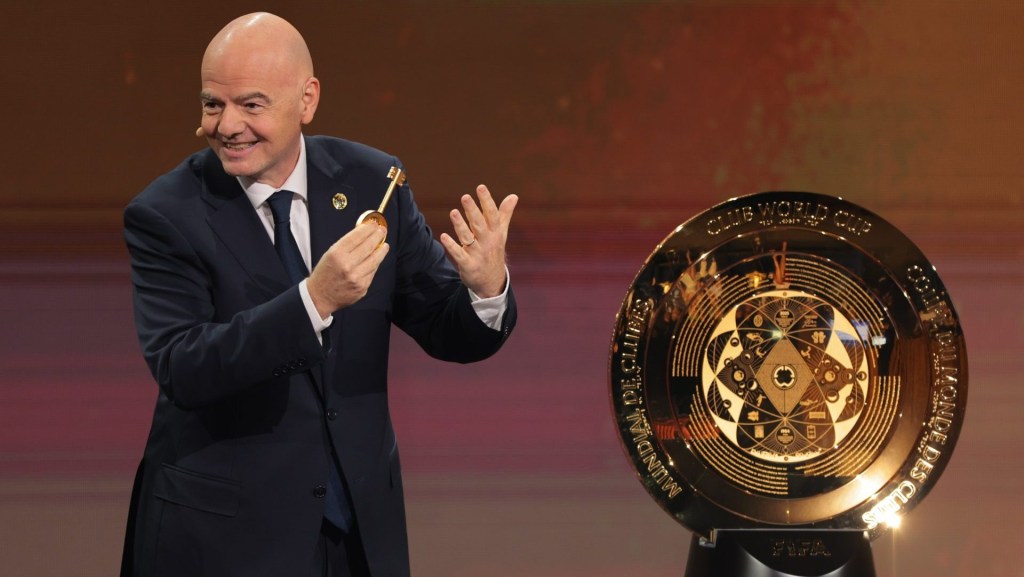
The most memorable moment of the match arguably occurred after the final whistle, when President Donald Trump joined Chelsea onstage and stayed front and center during the trophy-hoisting photo-op. The team pocketed more than $110 million from the significantly revamped tournament.
FIFA grew the Club World Cup from 7 teams to 32 this year and enticed big European clubs to participate with larger chunks of the $1 billion purse than the rest of the world. The tournament has been strongly criticized for its added workload during the international soccer calendar’s offseason. With one year to go ahead of the men’s World Cup, which will also be largely hosted in the U.S., some players like Cristiano Ronaldo opted to rest instead of sample FIFA’s new competition. Going forward, FIFA will hold the Club World Cup every four years rather than annually, just like its major national competition.
In many ways, the tournament was a test run for next summer and gives a glimpse into how FIFA will stage next year’s competition hosted by the U.S., Mexico, and Canada.
Here are four takeaways from FIFA’s expanded club tournament.
Prize money is enough to attract Europe’s top teams
In the years leading up to the new experiment, some European clubs balked at the tournament and threatened not to play. Then FIFA announced the $1 billion purse, with the participation bonuses heavily skewed in Europe’s favor. The teams signed on, and many earned a huge sum.
Manchester City, who had an early exit, earned more than $50 million, as did Bayern Munich and Borussia Dortmund. Semifinalist Real Madrid took home more than $80 million. PSG made more than $100 million, and Chelsea won about $115 million, though the exact figures are unknown.
These sums are significant for the heavy hitters of European soccer. They can cover the transfer fees of important players, pay off fines, and help even out earnings compared to spendings. That last point is important, because without a salary cap, entities like the Premier League and UEFA enact harsh penalties on teams who spend more than they earn. In several ways, the Club World Cup’s financial windfall gives participating European teams a distinct advantage over their peers back home.
Playing conditions in the U.S. have room for improvement
The chief complaints from players and managers throughout the tournament were the grass and the heat.
FIFA requires venues to have real grass, but several of the NFL stadiums hosting matches are normally covered in turf, including MetLife Stadium in New Jersey, host of the final match of both tournaments.
The stadiums wheeled in grass—a sore sight for the NFL Players Association, which has been fighting for league-wide grass for years—but the quality of the temporary surface was heavily scrutinized. New Jersey and Seattle, both of which will host World Cup matches next year, were criticized for dry pitches.
The heat was another major factor. The U.S. endured a heat wave in the middle of the tournament that impacted matches from Nashville to New Jersey. Many of the matches were held in the steamy afternoons to appease European audiences watching on DAZN, which didn’t help attendance figures in the U.S., particularly on weekdays. FIFA allowed for cooling breaks midway through each half when matches reached 89.6 degrees.
As far as next year goes, FIFA plans to install grass at stadiums much earlier than they did this summer, which should create better playing surfaces. And when it comes to the heat, there are ways FIFA can be proactive about scheduling. FIFA doesn’t have to scrap its afternoon TV slots, but it could assign them to matches in Atlanta and Houston, which have traditional domes, or the cooler climate of the Bay Area.
FIFA and the Trump Administration are officially allies
FIFA president Gianni Infantino and Trump were already friendly before the tournament—the FIFA president skipped his own annual Congress this spring to accompany Trump on an official visit to the Middle East—but they took it to a new level during the Club World Cup.
Early in the tournament, Italian side Juventus visited Trump in the Oval Office. Last week, Infantino announced FIFA will establish an office at Trump Tower in New York. And Trump, who in February left the Super Bowl early, stayed with Chelsea onstage as they raised the championship trophy, either ignoring or blissfully unaware of Infantino’s repeated efforts to get him out of the photo-op. His box at the match included Infantino, Tom Brady, Attorney General Pam Bondi, Secretary of Homeland Security Kristi Noem, and Secretary of Transportation Sean Duffy.
What this alliance means for the consequences of Trump’s immigration policies on upcoming soccer tournaments remains unclear. Trump banned individuals from traveling to the U.S. from countries that are World Cup regulars, including Haiti and Iran, and his administration is considering adding even more nations to the list. While the bans have an exception for players, staff, and immediate family members, fans are barred from entering. Infantino has less than a year to try to sway Trump to roll back some of the restrictions, or accept the consequences for his international fan base.
Complaints about overloading the soccer calendar haven’t gone away
With under 24 hours to go before Sunday’s final, FIFA released a statement saying a “consensus” had been reached with global players’ unions for designated recovery periods between matches and at the end of the season. But FIFPRO, the global players’ union, said it wasn’t invited to the meeting in New York where those discussions took place.
One of the key differences between FIFA’s and FIFPRO’s positions is the number of days between seasons. FIFA announced 21 days is the new agreement, but FIFPRO has fought for 28 days. Last week, Real Madrid asked LaLiga to move back its opening match after the team made the Club World Cup semifinal, shortening the rest time to just 20 days. The Spanish league declined to move the match.
“What was presented as a global celebration of football was nothing more than a fiction created by FIFA, promoted by its president, without dialogue, sensitivity, and respect for those who sustain the game with their daily efforts,” FIFPRO president Sergio Marchi said in a statement Sunday.
FIFPRO filed a complaint against FIFA with the European Commission last year, which claimed the international governing body has abused its position as both regulator and organizer of the soccer calendar. FIFA also expanded the World Cup from 64 to 104 matches next year, while increasing the number of teams from 32 to 48.
The problem isn’t restricted to FIFA. The Champions League also added to its calendar last season, and the Club World Cup took place at the same time this summer as the Concacaf Gold Cup, which players including USMNT captain Christian Pulisic opted to skip so he could rest. Despite whatever “consensus” FIFA thinks it reached in New York, the workload conversations aren’t going away anytime soon.