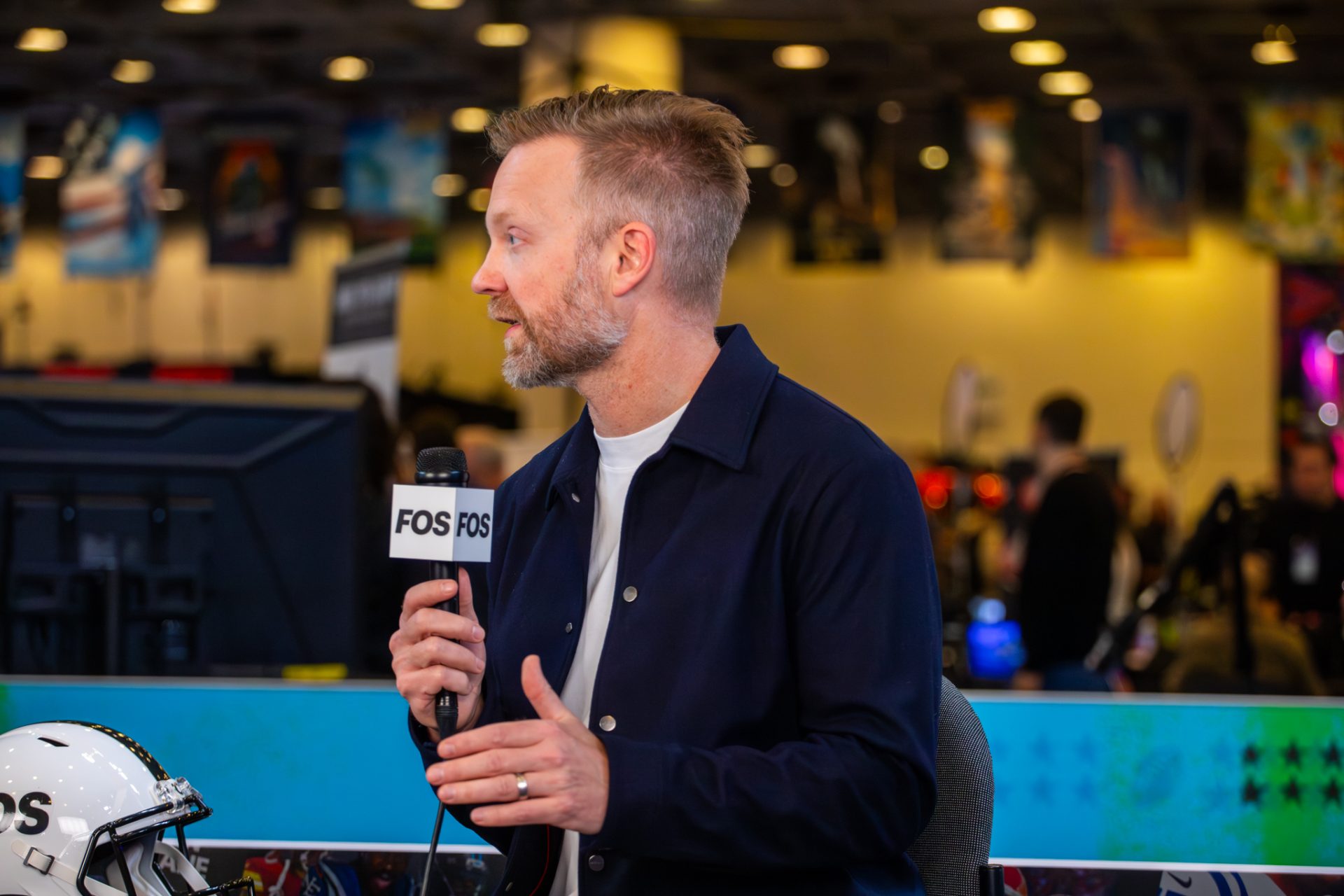
Fanatics Betting and Gaming CEO Matt King understands why prediction markets and traditional sports betting get lumped together, and emphasizes that his company applies the same consumer protection standards to both. But he says the two are distinct.
The prediction-market platform King oversees, Fanatics Markets, launched in December in 24 states—including many that don’t allow online sports betting, like California, Texas, and Georgia. Featuring event contracts powered by Crypto.com, the platform allows users to put money on who will win the Super Bowl, player props, and MVP (Seahawks are favored and Darnold is viewed as the mostly likely MVP winner), as well as “novelty” markets like how long the national anthem will be, whether the team that wins the coin toss will win the game, and more.
Trading on prediction markets and betting on sports through traditional sportsbooks are “different experiences,” King told Front Office Sports on Radio Row ahead of Super Bowl LX in San Francisco.
“One is a two-sided marketplace,” King said, referring to prediction markets. The other—traditional sports betting—features Fanatics as ‘the house.’”
“I think they will always be two distinct services,” said King, who was previously CEO of FanDuel.
That’s exactly what’s being argued in court cases across the country. Companies like Kalshi, Polymarket, Robinhood, and Crypto.com similarly maintain that what they offer is not traditional sports betting, but instead a version of trading. Many of the court cases will come down to whether prediction-market platforms fall under the exclusive jurisdiction of the Commodity Futures Trading Commission (CFTC), a federal regulator, or should be regulated on a state-by-state basis, the way traditional sports betting has been since the 2018 U.S. Supreme Court decision striking down the Professional and Amateur Sports Protection Act (PASPA). The CFTC’s new chair has signaled support for prediction markets.
“I think part of that difference will be decided as these court cases go through their various processes, probably up to the Supreme Court,” King said.
Even though he says there’s a distinction between the two, King made clear that, for both business lines, Fanatics is focused on consumer protection and integrity.
“We took all of the things we do around integrity, all the things we do around consumer protection and sports betting, and we applied them to prediction markets, regardless of what the law requires,” he said. “We know it’s the right thing to do because we know these are things that work on the sports betting side to keep integrity and consumer protection high.”
He also said he would “agree with the statement ‘there is regulation’” and made clear that Fanatics understands issues like potential insider trading—which lawmakers have focused on with regard to prediction markets—are illegal.
“Things like insider trading are actually crimes that get prosecuted if somebody is caught doing it,” he said.
The stance from Fanatics on prediction markets is at odds with the NFL’s current view (Fanatics provides NFL merchandise under a long-term agreement, and has recently taken heat for the quality and availability of its Super Bowl gear). The NFL has made clear that it needs stronger regulation in place before it will consider partnering with any prediction-market platforms—although one executive told FOS on Radio Row that the league is watching the industry closely, and is “interested” but will be “cautious.”
King says the NFL is taking the same tack it did with regulated sports betting.
“They always take a conservative approach in terms of how they think about adopting new categories,” he told FOS.