MIAMI — Before the national championship, several college sports administrators suggested getting rid of the revenue-sharing cap put in place by the House v. NCAA settlement.
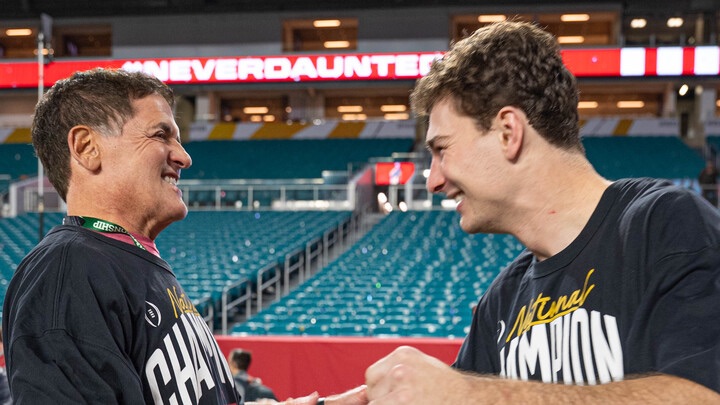
Billionaire Indiana alumnus and NIL donor Mark Cuban disagrees.
Cuban, who is also a minority owner of the Dallas Mavericks, thinks the rules should remain in place. “I like the cap,” Cuban told Front Office Sports on Monday night shortly before his Hoosiers won their first national championship. “It’s like the salary cap and the second apron in the NBA. It makes you think more. You have to be more strategic, you have to be more tactical. It protects us from ourselves. That’s the thing about salary caps in sports—you see what happens with baseball, you see the Dodgers versus everybody else.”
Currently, the rules for player compensation are as follows: Every school in Division I has the opportunity to offer up to $20.5 million in revenue-sharing to players in its entire athletic department (most top college programs are offering 75% of that to their football program). Then, schools, collectives, and others can organize outside NIL deals for players, but they have to be for a valid business purpose and offer fair-market value.
Cuban argued that, in a scenario where there are some revenue restrictions, having the most money doesn’t necessarily mean you’ll win. “It’s not even how much any given alumni gives or the whole [of] all the money they collect—it’s how it’s spent. And you can create a lot of misaligned incentives if there isn’t some form of control.”
Cuban—and his Hoosiers—appeared to embody that philosophy. Indiana won the national championship without any five-star players, and they weren’t considered one of the biggest spenders this year. During his championship press conference, Curt Cignetti said: “Our NIL is nowhere near what people think it is, so you can throw that out.”
Of course, the “salary cap” created by the House v. NCAA settlement isn’t as strict as the one in the NBA. Name, image, and likeness collectives and schools across the country have, in many cases, been eschewing the rules—whether that has meant not reporting NIL deals for scrutiny or offering deals that could be considered pay-for-play.
But despite these dynamics, Cuban said he believes the current rules are strict enough to offer some form of control.
“There is [a salary cap] in that there are ways you can and can’t spend it,” Cuban said. “There are some restrictions. And the other part of it is … the players that are there, the ones that are getting paid the most, are only there for a year or two. And in some respects that puts a cap on it as well.”

![[Subscription Customers Only] Jun 15, 2025; Seattle, Washington, USA; Botafogo owner John Textor inside the stadium before the match during a group stage match of the 2025 FIFA Club World Cup at Lumen Field.](https://frontofficesports.com/wp-content/uploads/2026/02/USATSI_26465842_168416386_lowres-scaled.jpg?quality=100&w=1024)
![[Subscription Customers Only] Jul 13, 2025; East Rutherford, New Jersey, USA; Chelsea FC midfielder Cole Palmer (10) celebrates winning the final of the 2025 FIFA Club World Cup at MetLife Stadium](https://frontofficesports.com/wp-content/uploads/2026/02/USATSI_26636703-scaled-e1770932227605.jpg?quality=100&w=1024)