Roku to Release Sac State Series Produced by Omaha, Overtime
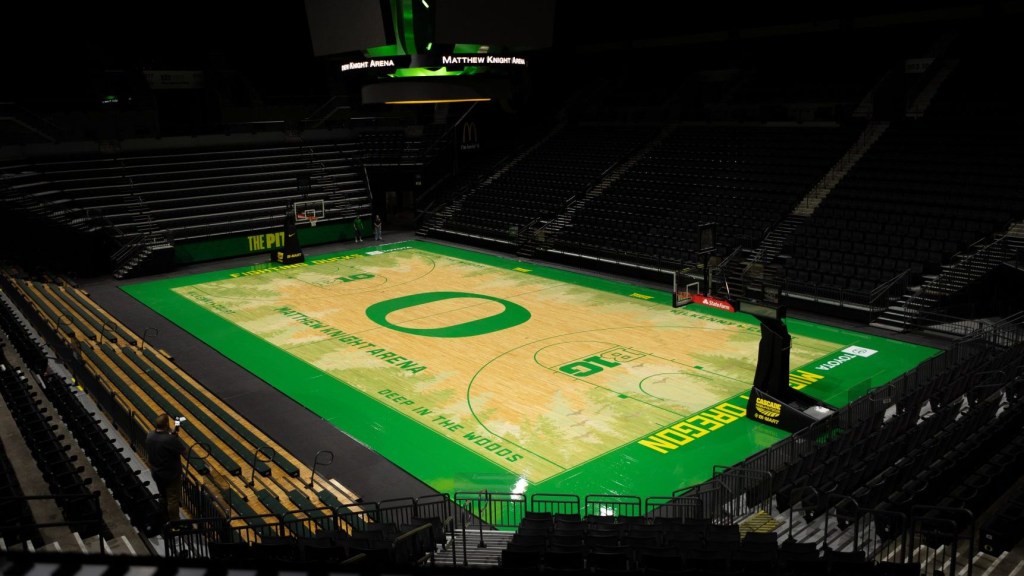
The original basketball court design at Oregon’s Matthew Knight Arena is one of the most iconic playing surfaces in sports. The brainchild of legendary Nike shoe designer Tinker Hatfield, it featured a perimeter of brown-hued trees extending inward to form a halo-like shape at center court—an homage to the 1939 national championship Oregon basketball squad known as “The Tall Firs.”
Before the arena’s 2011 opening, Hatfield rallied Oregon mega-donor and Nike founder Phil Knight to spring for something unorthodox in a court design. “I asked Phil, ‘What do people see every time they turn on the TV and watch their favorite team play basketball?’ And he goes, ‘I don’t know, the color of the seats,’” Hatfield tells Front Office Sports. “I said, ‘No, it’s the floor, Phil.’”
The design is also one of the most polarizing. Hatfield says the court was instrumental in cementing Oregon’s identity as “a little flashier and a little more out there,” but it also drew mixed reviews over the years, with the most common complaint being that the brown coloring made games hard to follow on television.
Then, last year, as Oregon joined the Big Ten, it was time for the court to get a refresh. Ahead of the 2024–25 men’s and women’s basketball seasons, the father-son design-firm duo of Todd and Quinn Van Horne drew up new options. They put each rendering through several rounds of TV testing, and they went through roughly 50 different color stains and consistencies. “The Oregon video team set up a broadcast camera so we could see how the court would look on TV in real time,” Todd says.
The final design, which was unveiled for the Ducks’ first season in its new conference, is familiar. It honors Hatfield’s original vision, but it relies more heavily on shades of bright green. As an unconventional design, it’s still fairly controversial—but Todd says the reception among Oregon’s athletes has been overwhelmingly positive.
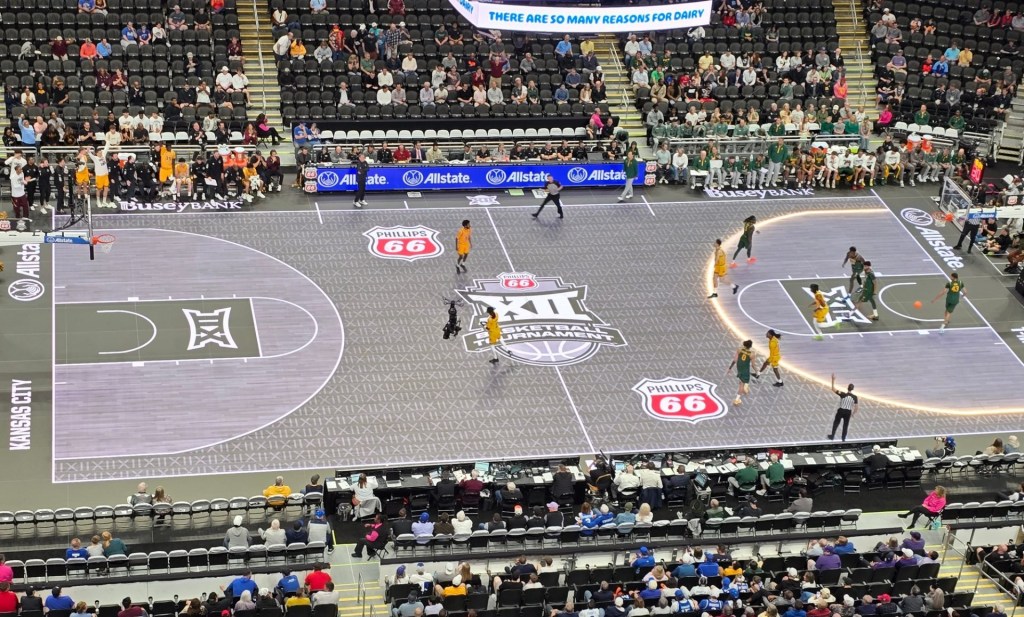
Court design is a meticulous, sometimes grueling, process. It’s an alchemy of manufacturing, design, and logistics—which keeps the industry quite small. Replacing a basketball playing surface is also rarely quick and often expensive. But the right court—like Oregon’s—can quickly become iconic, and even become an economic and recruiting boon.
In sports flooring, two companies dominate: Connor Sports and Robbins Sports Surfaces, which both started as family-run businesses in the 1800s. (They see each other as formidable, but ultimately friendly, competition.)
Connor Sports is the exclusive court provider of the NCAA’s March Madness tournament, while Robbins Sports Surfaces’s calling card is its high-profile clients. “About 40% of NCAA schools—including bluebloods like Duke and North Carolina—practice and play on our floors,” says Kevin Price, a regional sales manager at the company.
The backbone of nearly every basketball court—regardless of its final paint job—is maple. Robbins Sports Surfaces installs about 6 million square feet of it each year. Some schools request alternative woods, usually for aesthetic reasons—beech being popular—but maple remains the overwhelming choice.
“Maple’s specific characteristics provide the best durability and integrity over the lifespan of the floor,” says Zach Riberdy, director of marketing at Connor Sports. “If you install it correctly, it’ll last 30 years on the low end, and even up to 60 or 70 years if it’s well cared for.”
But even more important than a court’s hardwood is the subfloor system that lies beneath it, for which both companies maintain proprietary designs. “Most people see maple paneling and think that’s all there is,” said Robbins’s Price. “The real science is what’s underneath. It’s the wood substructure and padding that drive a court’s performance and playability.”

Design discussions generally begin once a school has selected a flooring system, which sources tell FOS is the biggest pain point in the entire process. What was once a back-and-forth between athletic directors and facilities managers now includes voices from university marketing, brand, and creative departments. More stakeholders can slow the process, which Riberdy says can sometimes take a couple of years.
Portable courts, which can be disassembled for multipurpose arenas, typically cost between $200,000 and $250,000, while permanent installations are a bit cheaper. Elaborate designs needing complex paint jobs—handled by specialized court finishing firms once floor installation is complete—can add anywhere from $30,000 to $100,000 to a project’s total tab.
“Finishing is a particular process with a lot of moving parts,” says Dan Olson of Texas-based QHF Sports. “We print vinyl stencils, lay them out, stain the court, seal it, and then add all the graphics with specialized paint.” This usually happens in the early summer, when most college facilities are empty, and installations can proceed uninterrupted.
Oregon’s redesign—installed by Connor Sports—was driven by evolving the school’s visual identity. But fan feedback catalyzed a new court design for the University of Arizona’s McKale Memorial Center for the 2025–26 season. The new look brought back the school’s retro cactus logo to center court for the first time since 2009.
“From the moment I stepped on campus a year and a half ago, fans have been asking to bring the cactus logo back,” says Tony Daniel, Arizona’s senior associate athletic director for revenue generation and engagement. “Every time we went on social media, there were people saying, ‘Bring it back!’ So when we were due for a refresh, our athletic director finally said, ‘Let’s do it.’”
Arizona’s creative services team narrowed down dozens of preexisting renderings to four finalists and put them to an online fan vote. The winning design, which prominently features the cactus logo, was unveiled in August. The entire process took just six months from initial conversations to updated court—a fast turnaround by industry standards.
According to Daniel, in the few months since its debut, the court has already generated “a ton of online sizzle.” He says the feedback to date has been extremely positive and that the team’s first game on the court—an intra-squad matchup attended by famous Wildcat alumni including Rob Gronkowski—drew more than 9 million impressions on social media.

On the other side of the country at Florida International University, the school’s oceanfront court design came from an inspired staffer. When the floor at Ocean Bank Convocation Center needed to be replaced, then-athletics chief-of-staff Heath Glick pitched a beach-themed court that would reflect the school’s South Florida surroundings. “Our community is so proud to be part of the 305,” says Glick, who is now FIU’s deputy athletic director and COO. “I thought, ‘What better way to showcase that than to have our beaches on the court?’”
The result was FIU’s sun-and-sand floor, which Glick says is a huge point of pride—and a valuable marketing asset—for the university, especially for someone who may never have heard of the school. “Having a unique court stirs conversation. That increases our brand value and opens the door to potential opportunities that may not have otherwise been available,” says Jason MacBain, FIU senior associate athletic director for brand advancement.
Innovation in court design is just beginning—especially as money is increasingly funneling into institutions for recruiting.
Kevin Price of Robbins Sports Surfaces says there’s been “increased interest in the biomechanical benefits and properties of flooring” now that professional-level money is on the line for many athletes at large Division I schools. He adds more university trainers and doctors are getting involved in the purchasing process, too.
There are also growth opportunities for the major industry players. Rising interest in women’s court sports such as basketball and volleyball has led to increased business from NCAA programs, both Riberdy of Connor Sports and Price of Robbins Sports Surfaces say. Robbins has installed volleyball courts for programs including Michigan State, the University of Missouri, and Vanderbilt, which is in its inaugural season.
NIL (name, image, and likeness) is even leaving a mark on how meticulously designed courts come together. Mike Baldwin, associate director of creative services for the University of Arizona, says there’s pressure on universities to be more proactive—and prolific—with their creative output.
“From a design perspective, there’s way less restriction [now],” he says. “The revival of the cactus logo is a great example; we couldn’t use that for a very long time. There’s just way more buy-in for more content creation and experimentation of all kinds now, and I expect that will only continue moving forward.”
“Amid the NIL era,” agrees FIU’s MacBain, “branding is perhaps more important than ever before.”