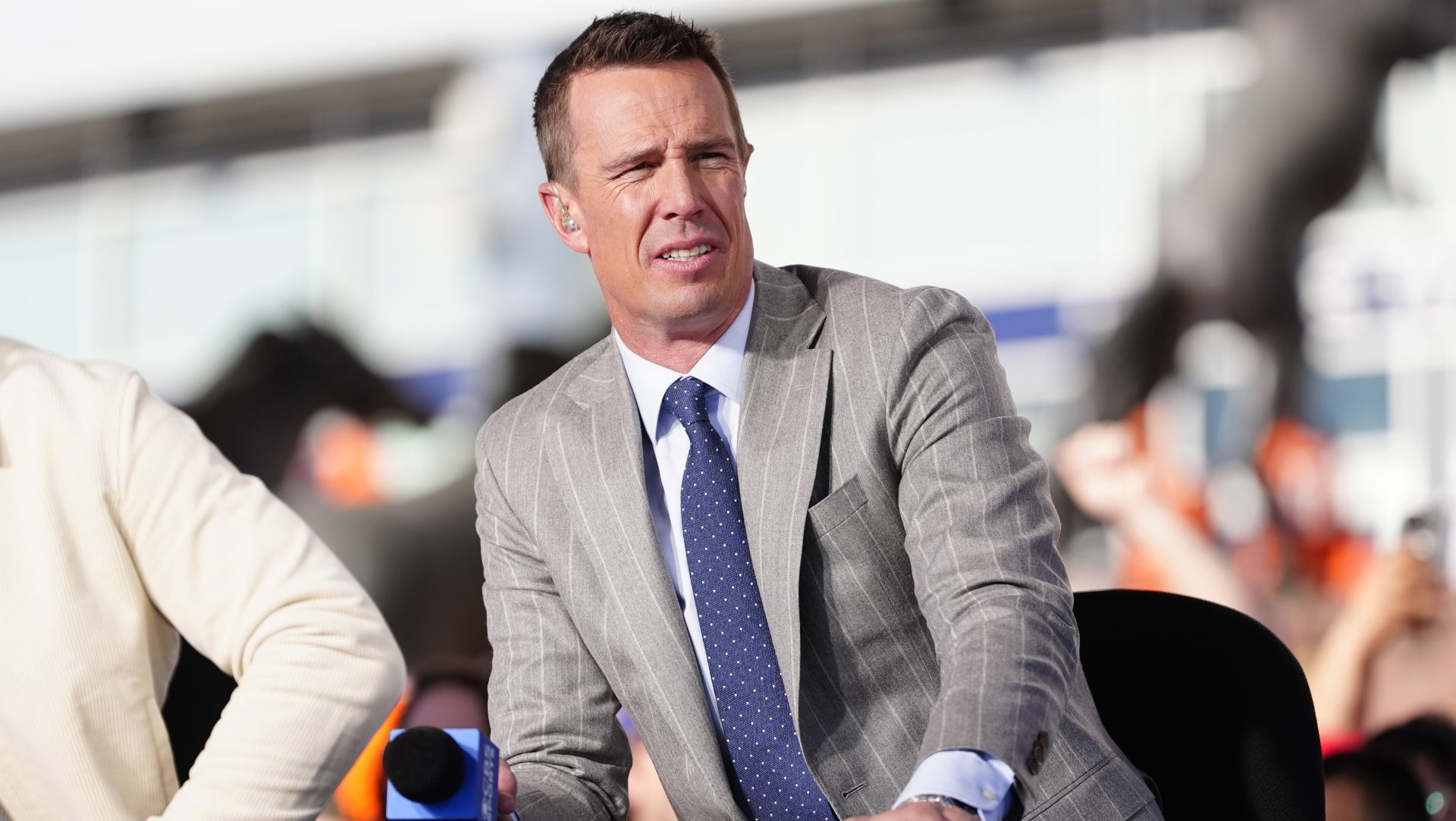
Last week, Fox’s Jay Glazer broke news that Matt Ryan—a CBS Sports analyst since 2023—was in talks with the Falcons for a newly created front office role as president of football operations.
NFL Network’s Tom Pelissero followed up Monday by noting that Ryan was “hoping to retain his duties” at CBS even if he takes the Falcons job. But the story took a twist Tuesday when Pelissero reported Ryan would surrender his cushy once-a-week CBS studio analyst gig after all.
“My understanding is Matt Ryan would not continue working at CBS if and when he’s hired,” Pelissero said on X/Twitter. By Wednesday, Pro Football Talk reported that in fact, Ryan “was never planning” on doing both jobs.
Regardless of whether Ryan wanted to double-dip and who put the kibosh on it, the old concerns about conflicts of interest are generally greeted with a shrug in today’s NFL media scene. Especially when it comes to ex-quarterbacks turned TV analysts like Ryan, Tom Brady, and Troy Aikman, who appear to have free reign and long leashes.
Brady, the seven-time Super Bowl winner, has brazenly worn two hats as Fox’s No. 1 game analyst and a 5% owner of the Raiders for the past two seasons. In his first year as a broadcaster, he was barred from participating in the pre-game interviews with players and coaches because of his ownership stake in the Raiders. But in year two, the NFL lifted the rules—Brady was allowed to join all the meetings, just had to do it remotely—and made clear it no longer cares about any perceived conflict. “We evaluated the policy after his first year and believed it was fine for him to participate remotely in a production meeting,” the NFL told Front Office Sports.
ESPN’s Aikman, a three-time Super Bowl champion, recently double-dipped by accepting an offer to advise the Dolphins on their GM search.
At least publicly, neither Fox nor ESPN raised objections to Brady or Aikman’s side hustles, despite paying them an eye-popping $37.5 million and $18 million a year, respectively.
As long as Aikman’s Dolphins gig doesn’t mess with his Monday Night Football schedule, ESPN won’t raise red flags.
“It doesn’t interfere with his responsibilities with us,” a spokesman told FOS. “His schedule remains unchanged.”
There’s an obvious difference between what Brady and Aikman are doing for the Raiders and Dolphins, and what Ryan would be doing for the Falcons.
First, Ryan’s proposed role sure looks like a full-time job. As president of football ops, he would oversee the hiring of the team’s new coach and GM after Raheem Morris and Terry Fontenot were fired. Whoever gets the job will be expected to commit 100% to rebuilding the once-proud organization, not jetting to Manhattan once a week to swap on-air chuckles with James Brown, Bill Cowher, and Nate Burleson at CBS studios on West 57th Street.
That type of day-to-day role would be a far cry from Aikman’s temporary role—which will likely end when the Dolphins hire their new GM—or Brady’s ownership role with the Raiders, where he serves more as adviser than an executive. (NFL rules dictate Brady, as a person with equity in the team, can’t have a title other than “limited partner” unless he is the controlling owner or a member of the owner’s family, ESPN reported Wednesday.)
Brady’s experience as the greatest NFL winner ever hasn’t yet helped the Raiders, by the way. Despite his occasional presence in the coaching booth, the three-time Super Bowl champions have finished 3-14 and 4-13 the past two seasons. The Raiders haven’t made the playoffs since the 2021 season.
What about the Falcons? After two straight 8–9 seasons, they haven’t reached the playoffs since 2017. Arthur Blank, their 83-year-old billionaire owner, is clearly out of patience. His franchise is 0-2 in Super Bowls, including the infamous choke job in Super Bowl LI, when Ryan’s Falcons coughed up a 28–3 lead to Brady’s Patriots.
To speed up the rebuilding, Blank is jettisoning the collaborative approach his franchise has employed over the last decade, according to The Athletic, in favor of a single decision-maker. Blank wants a battlefield general, not someone still dabbling in TV. Ryan will have to choose.
As Blank wrote in his letter detailing the changes: “I know we have fallen short of the standard you expect and we as an organization have for ourselves. That responsibility rests with me. When results do not match expectations over time, as the owner, accountability cannot be shared or softened. I believe this team should be competing at a higher level than it has, and I share your deep frustration.”
Meanwhile, frustrated fans and media in Atlanta might lose their minds if Ryan tries to play it cute. Local radio jocks made it clear they would not be happy if Ryan tried to juggle the Falcons job with his on-air role at CBS.
“I’m not crazy about that. To me, either you’re in or you’re out,” Nick Cellini said on 680 The Fan. “If this is true, I don’t like it at all.” (When Pelissero amended his report Tuesday, Cellini tweeted, “Great news!!”)
This double-dipping trend was probably inevitable. Top sports talents these days want to maximize their earnings, while indulging in the occasional entrepreneurial exercise. The old barriers and guardrails in sports media are rapidly disappearing.
And most fans probably don’t even mind. Only we in the media scrutinize so closely. The implied response to accusations of a conflict appears to be: “Shut up.”
And it isn’t Brady who started it. Stephen A. Smith makes $20 million a year at ESPN. But he’s still free to own and operate his own production company and radio shows. Kirk Herbstreit works for both ABC/ESPN on college football and Amazon Prime Video for Thursday Night Football. Nobody bats an eye.
When Elle Duncan jumped to Netflix from ESPN, there were initial rumors she wanted to maintain a foothold at the worldwide leader. That didn’t work out. But Duncan’s contract with Netflix is non-exclusive, meaning she will still be able to work with other media companies. Pat McAfee’s eponymous show airs five days a week on ESPN, yet he’s not a Disney employee. Instead, he licenses his program to the four letters. So they can’t punish him when he goes off the rails. Confused? Yes, the special exceptions can be dizzying.
And in the end, it wasn’t a conflict of interest at CBS that stopped Ryan from double dipping—it was concern about Ryan being all-in with the Falcons. Some red lines still exist; a conflict of interest just isn’t one of them any more.