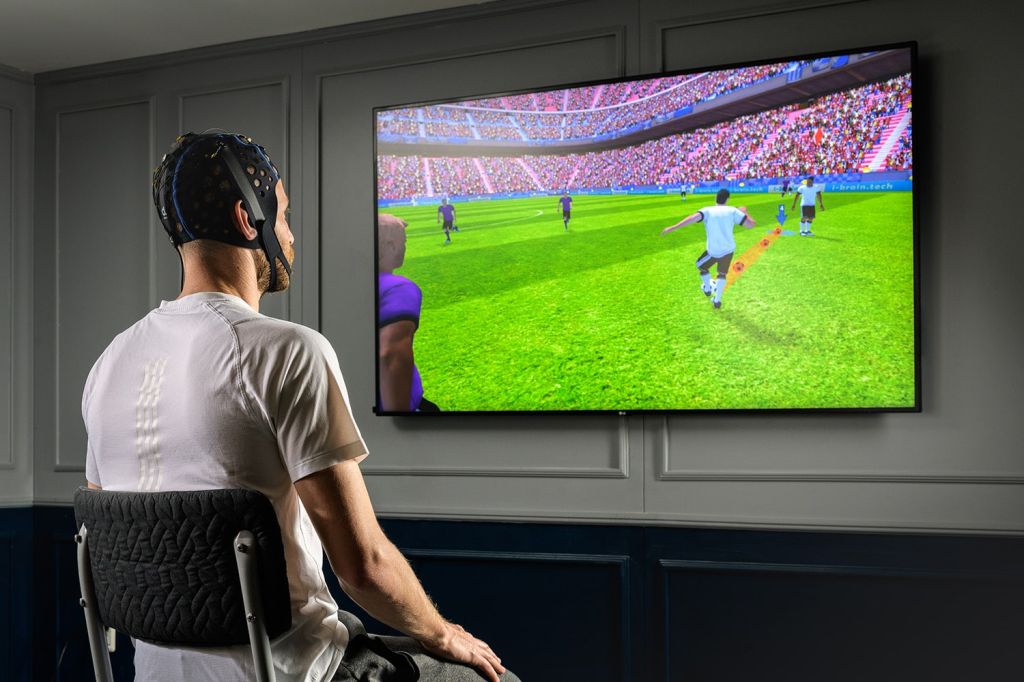
When Atlanta United FC players leave the field on practice days, they aren’t necessarily done training. Sometimes they head into an office, put on a skull cap, and play a sort of training-focused video game — using only their brains.
The skull cap and associated software, provided by Israel-based iBrain Tech, connects the players’ neural activity as they visualize a particular move, such as a corner kick or cross-field pass, to an avatar on a screen. If iBrain is working, the avatar’s action will be as successful as the accuracy of the visualization.
“Initially, we developed and patented technology to allow immobilized people to regain mobility by directly training and rehabilitating the brain,” said iBrain co-founder and CEO Konstantin Sonkin. “After a stroke or traumatic brain injury, the real cause of disability is in the brain.”
But Sonkin also thought about how to use that same principle and hardware toward improving athletic performance. Advances in computational power allowed the creation of software needed to make such a project feasible.
“We’re thinking about the brain as an orchestra,” said Sonkin. “Before, we were able to record the sophisticated music of the brain. Now, with mathematical methods, we can isolate not only specific instruments but specific oscillations of every string of every instrument in real time.”
That ability to zoom in on specific neural regions is essential to facilitating what iBrain does. Equally important is the ability to translate that data into actions in a simple video game within seconds.
iBrain is currently in its second funding round with $6 million closed and received between the two rounds so far. The company expects to raise a small additional amount by the end of the year.
Brain Power
Everything you do, from breathing to driving to playing chess, starts with your brain.
If you can jumpstart neural activity by visualizing it, then accurate, focused visualization can be an effective practice method for any number of physical tasks. No brain scans needed.
So why bother with brain-scanning? Because visualizing effectively is a lot harder than it sounds. iBrain’s technology provides a feedback mechanism to evaluate and correct the visualization.
After evaluating the underlying research and iBrain’s technology, Atlanta United decided it was worth a shot.
- In addition to Atlanta United, a Premier League team also works with iBrain, and a second MLS team is coming on board.
- Two NBA teams have signed up to work with iBrain once the technology gains approval from the league.
- The company is exploring moves into tennis and golf.
“We are very, very conservative when trying new technologies,” Ryan Alexander, the team’s director of sport science, told me. “We want validation. We want reliability. We want to be able to be a platform of predictability of how the players will respond.”
In addition to the MLS club, Atlanta United’s organization includes a second-division USL Championship team and seven academy squads. iBrain training is used everywhere from the U-15 level (14- and 15-year-olds) on up to the top tier.
“iBrain has allowed us to increase our exposure to different actions within a game without that same risk of having them out on the field striking a ball [repeatedly],” said Alexander. “They can still focus on performing those activities — with the literature supporting that there are actual practical benefits to be reaped from that — and we can remove and decrease that risk of injury by controlling the overall physical stimulus.”
Alexander mentioned that “muscle memory” is a misnomer — your muscles aren’t doing the remembering. When you get on a bike and remember immediately how to balance and pedal, your brain is activating well-established patterns.
This distinction is crucial not just to iBrain’s methods, but to athletic training in general.
There is definitely some amount of muscle development involved with athletes in the batting cage or at the free-throw line — but the real training is taking place in the nervous system.
Hockey in VR
Czech Republic-based Sense Arena targets the brain with a very different method: virtual reality.
Using an Oculus and some proprietary hardware that stands in for a hockey stick or tennis racquet, users are immersed in game simulations in which they must make decisions.
“The whole trick is that your brain learns or improves in an activity by experience,” said Sense Arena founder and CEO Bob Tetiva. “The more times you are faced with certain situations, your brain hard-wires. And then when you are in the real situation on ice with just a split-second to make that decision, your brain acts based on patterns it has already experienced in the past.”
Sense Arena’s list of long-term contracts is only growing:
- New Jersey Devils
- Los Angeles Kings
- Arizona Coyotes
- Vegas Golden Knights
- A fifth NHL team that chose to remain private
- 12 NCAA Division I teams
- 19 professional teams in Europe
While iBrain has expanded to hundreds of drills, its best fit is with isolated actions that don’t involve the fluid dynamics of game play, such as free kicks or foul shots. Sense Arena goes more directly at the chaos of the game — it’s less about honing a wrist shot and more about determining what defensemen should do when a faceoff puts the puck in their zone.
Another purported benefit of Sense Arena — which has raised $5.5 million to date — is simply gaining a feel for the speed of games where serves and slap shots can top 100 MPH. Youth players can experience virtually what it’s like at the highest levels.
Mind Games
Both Tetiva and Sonkin spoke of the practical aspects of their programs, such as being able to practice without a facility, while fatigued or injured, or without risking injury.
Alexander has seen players respond to iBrain’s training similarly to on-field practice.
- Players show a fatigue response.
- After an intense iBrain session one day, they won’t be as sharp the next.
- He has also noticed that players who are experienced in a certain action, like a corner kick, will perform better on iBrain’s tests of that skill than those who never take them on the pitch.
Your ability to visualize an action is inextricably wound up in your ability to perform it.
With their core technologies in place, iBrain Tech and Sense Arena are looking to expand to more sports.
Then there are uses that might draw in the rest of us non-professionals.
Tetiva suggested we might one day be able to play a realistic game of tennis on a metaverse court.
Sonkin went further, laying out a vision of better living through technology.
“There might be an era of useful games,” he said, the passion palpable in his voice. “Maybe we will decide as humans not to waste time anymore just for leisure and pleasure, but try to find a way to fuse entertainment and learning, entertainment and training.”
Whether or not these companies unlock the potential of brain-focused exercises, the concept is not going anywhere.
Research, computational power, and the financial incentives to gain a competitive edge in sports are drawing in both companies that can make ideas a reality and users willing to take a chance on them.