Want more from Front Office Sports
in your search results?
DraftKings stock is down more than 50% in the past six months. So is FanDuel parent company Flutter. Penn Entertainment is down about 30%, and so is Caesars in that time.
It isn’t just from the threat of prediction markets like Kalshi and Polymarket—but that’s a big part of it.
Victor Rocha, conference chair of the Indian Gaming Association advocacy organization, thinks DraftKings and FanDuel have already entered prediction markets in the wrong way. According to Rocha, executives from DraftKings and FanDuel previously expressed to him that they wouldn’t enter California without Native American tribes as partners—but both reneged on that pledge late last year by launching prediction-market platforms that offer sports event contracts in states where online sports betting is not yet legal, like California.
“I think FanDuel and DraftKings have lost their minds,” he told Front Office Sports. “They are so freaked out by Polymarket and Kalshi eating their lunch. It’s like a midlife crisis.”
DraftKings and FanDuel are not the only companies to launch prediction-market platforms, as Kalshi and Polymarket have surged in usage and valuation. Others include Fanatics, Robinhood, Coinbase, and Crypto.com, to name just a few of the many new offerings.
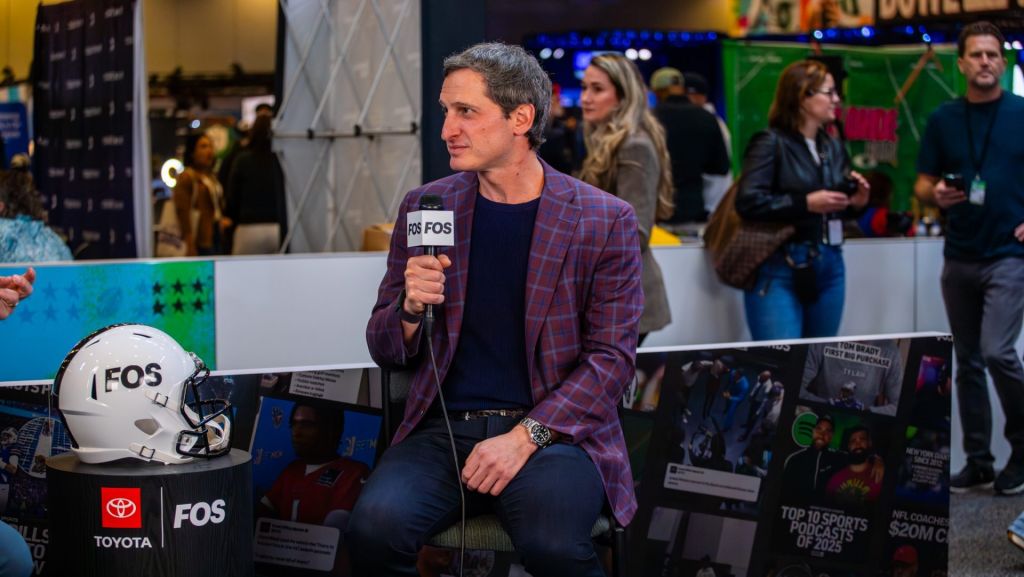
“There’s a real opportunity here, and that’s what you’re seeing,” DraftKings CEO Jason Robins said in a conversation with FOS on Radio Row at the Super Bowl. “We’ll see how big it ultimately can be. … I know just like any competitive market, others are going after it, too. But we like our chances, we think there will be multiple winners. … This is also a product that’s so nascent, particularly the sports side of it, it’s really only a year-and-change old.”
In the early innings, industry onlookers wondered whether Kalshi or Polymarket could be acquisition targets for larger betting giants. But now their valuations have ballooned to more than $10 billion each as they’ve continued to raise billions in funding.
“Those companies are raising money at huge valuations, so it would be tough to do a transaction at this point—meanwhile our stock is getting killed,” Robins said. “Which I don’t think is necessarily fair, but such is life. We have to prove it. Which we will do.”
And that was before the company’s earnings miss made the stock go a leg lower.
Analysts expected DraftKings’s 2026 sales guidance to be roughly $7.3 billion, but DraftKings reported guidance of between $6.5 billion and $6.9 billion. Robins said during the company’s recent earnings call that the lowered expectations were purposeful to make sure it beat expectations next time.
“It kind of went like this: My team came in and showed me a number and said we can hit this. And I said, ‘No, go make it lower.’ They went back, and they said O.K., now really, like, we are sure we can hit this. And I said, ‘I do not care; make it lower again.’ And that is what we got. But you know, for me, missing numbers again is just not acceptable, and so it is not something we are willing to do.”
His story did not convince analysts at J.P. Morgan. In a Tuesday note, J.P. Morgan said investors are interpreting the lowered guidance “more as a tacit admission of industry growth concerns than a beatable target.”
It added that “uncertainty abounds, and our patience is wearing thin.”