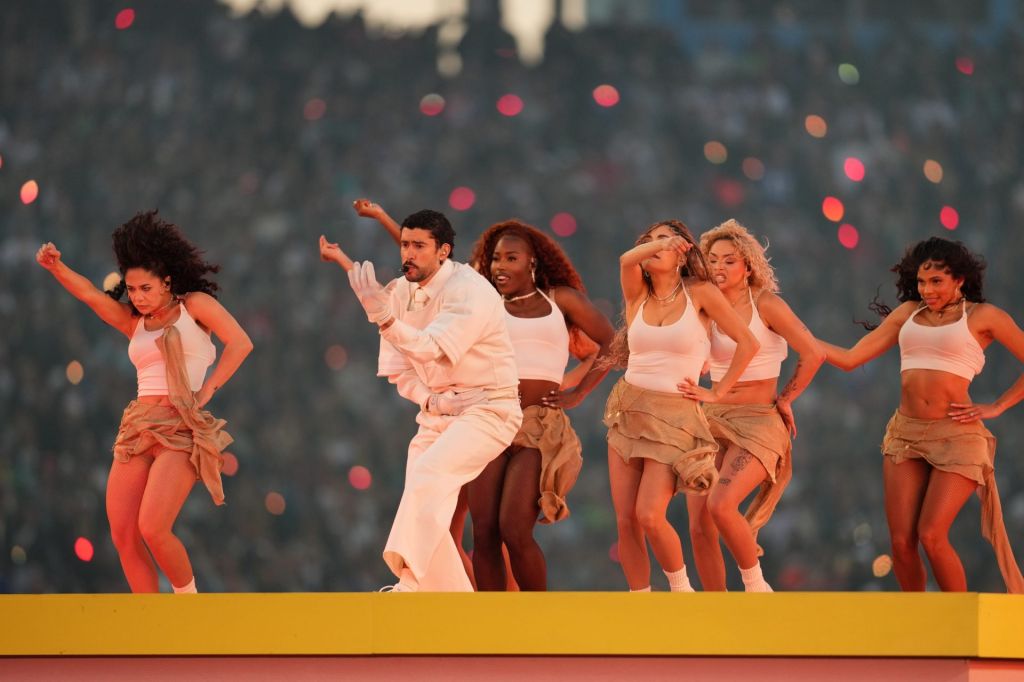
Grammy-winning rapper Cardi B was dancing and singing as part of Bad Bunny’s Super Bowl halftime show on Sunday. Whether the cameo counts as her “performing” is a topic of much debate on prediction-market platforms Kalshi and Polymarket.
More than $47 million was put on Kalshi’s market for “who will perform at the Big Game?” Kalshi declined to share specifics on how much of that total was placed on Cardi B.
On Polymarket, there was just under $10 million placed on “who will perform at 2026 Big Game halftime show?” That $10 million figure comes only from Polymarket’s international site; its U.S. app had only one Super Bowl market—on which team would win. Of the total $10 million, more than $5 million was put on Cardi B (although it’s not clear how much of that total was traded on “yes” she would perform versus “no” she would not).
The way both markets were resolved has frustrated some traders. As first reported by Dustin Gouker in his “Event Horizon” newsletter, at least one user filed a complaint with the Commodity Futures Trading Commission, the federal regulator charged with policing prediction markets, over the way Kalshi handled the situation.
On Kalshi, it’s important to read the fine print. Under Kalshi’s rules, singing and dancing counted as a performance, but just dancing in the background did not. Although Cardi B appeared to be singing, it’s possible she was simply “mouthing” the words, a person familiar with how Kalshi handled the market tells Front Office Sports. Because of the ambiguity, Kalshi settled the market at its last-traded price, which it determined to be “fair value.” That means people who traded “no” on Cardi B performing took home 74 cents for each dollar traded, while those who traded “yes” got the other 26 cents. All funds traded were distributed to users, the person says; Kalshi keeps none of it.
Kalshi’s determinations are made by a “markets team” that includes lawyers, former traders, and market experts, although further specifics were not disclosed. In the Kalshi “help center” on its website, it says “our markets team is always eager to assist and provide clarity on any rules or procedures. If you find yourself confused or in need of more information before purchasing shares in a market, do not hesitate to reach out. We aim to provide you with all the necessary information to make informed decisions.”
Adhi Rajaprabhakaran, who according to LinkedIn worked at Kalshi for almost three years—including on “market structure”—posted on X/Twitter that “there was a brief period of my life where it was my job to come up with these judge-like settlement decisions on the fly” and “I absolutely do not miss it, lol.”
On Polymarket, the rules around the Cardi B market were less robust. Initially, the site simply said the market would resolve to “yes” if Cardi B “performs live and in person” during the halftime show, and that otherwise it would resolve to “no.” At some point, Polymarket added a note with “additional context,” saying that a “qualifying performance” included “participation in the halftime show without singing so long as the aforementioned criteria are met.”
Initially, the Cardi B market resolved to “yes,” she performed. But that outcome was disputed as traders cried foul, with some saying in comments under the market on Polymarket’s website that the additional context was added only after the halftime performance happened. “It just keeps getting more dodgy,” one trader wrote in a comment that included crying laughing emojis. “They’ve just added ‘additional context’ after the event has occurred.”
Any user is allowed to initiate the dispute process within two hours of a market being resolved.
Disputes are debated and voted on by holders of the UMA crypto token. During the debate period, Polymarket users can “contribute evidence to the discussion” on the “UMA Discord” server, and once token holders cast votes, whichever side of the debate gets a majority vote is the winner. In this case, a final decision is expected by the end of the day on Feb. 11.