Free agency is an integral part of roster construction in the NFL, but it’s rarely the defining factor in a team’s Super Bowl bid.
The Chiefs, winners of three of the last six Super Bowls, acquired their core pieces through the draft (Patrick Mahomes, Travis Kelce, Chris Jones). Other Super Bowl champions have also benefited from key trades, like when the Rams won the Super Bowl in 2021 after trading for Matthew Stafford in the offseason.
But this year’s Patriots don’t follow the same blueprint. While the franchise has made some key draft selections in recent years, including quarterback Drake Maye in 2024 and left tackle Will Campbell last year, a significant portion of the roster was built through free agency.
New England’s 53-man roster has 21 players who were acquired through free agency, more than twice as many as the Seahawks, their Super Bowl LX opponent. That’s also more than Rams (13) and Broncos (18), the two teams that were eliminated in the conference championship.
The franchise’s roster construction made sense given their situation. They entered the 2025 offseason with $121.1 million in cap space, the most in the NFL and about 29% more than any other team, according to Over The Cap.
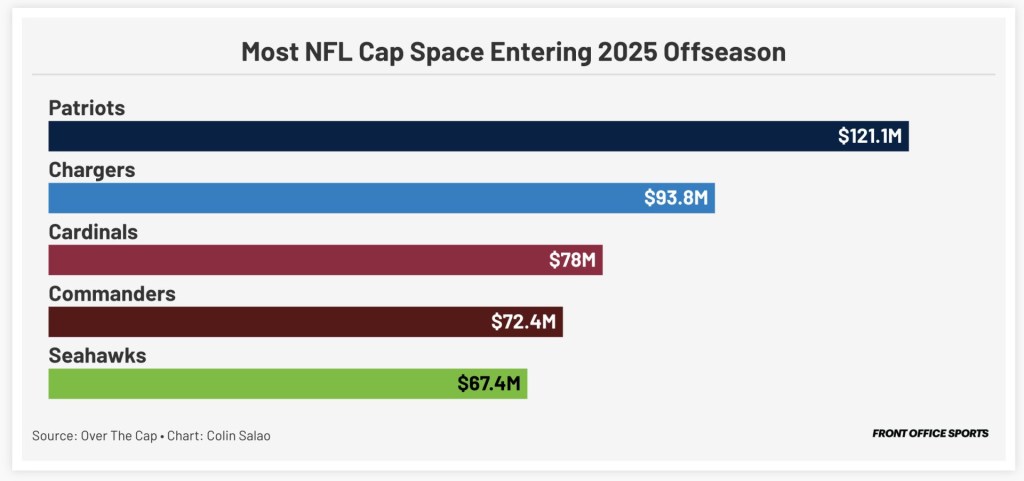
The cap space was a sign that the Patriots were destined for a rebuild, not a Super Bowl run. (The franchise was a 125-to-1 underdog to win Super Bowl LX at the end of last season.)
New England had still been reeling from the 2020 departure of Tom Brady and the subsequent exit of head coach Bill Belichick in 2024. Mac Jones, the No. 15 pick in 2021, couldn’t come close to filling Brady’s shoes and was out after three years. Jerod Mayo, Belichick’s successor, produced a 4–13 season before he was quickly let go.
The team used free agency to fill the pieces around Maye. It signed Super Bowl champion Milton Williams from the Eagles (4 years, $104 million), veteran corner Carlton Davis (three years, $54 million), and edge rusher Harold Landry (3 years, $43.5 million).
It also revamped its offensive line with Morgan Moses (three years, $24 million) and Garrett Bradbury (two years, $9.5 million).
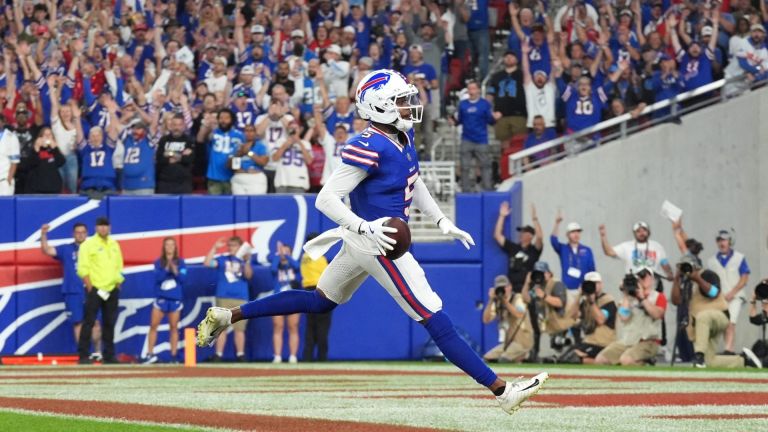
New England also bet on four-time Pro Bowler and 2020 receptions leader Stefon Diggs (three years, $63.5 million) to become its No. 1 receiver—and he answered with a 1,000-yard season.
But perhaps the most important offseason move is not seen on the team’s salary cap sheet.
In January 2025, before last season even officially ended, New England hired Mike Vrabel, the 2021 NFL Coach of the Year with the Titans. Vrabel also won three Super Bowl rings as a player with the Patriots in the 2000s, alongside Brady and Belichick.
Vrabel is credited for the culture shift in the organization, particularly the ability to unlock quarterback Drake Maye, turning him from an inconsistent rookie to an MVP candidate in one season.
“It’s a group effort. It wasn’t just me,” Vrabel said after New England won the AFC championship game.
Regardless of the result Sunday, the Patriots are set up for sustained success.
Maye has two years remaining on his rookie deal. He will have a $10 million cap hit next year and $11.6 million in 2027. In a league where quarterbacks are paid a premium, having a star signal-caller on a budget allows the team to spend on the edges.
The Patriots will enter the 2026 offseason with $42.7 million in cap space, 11th in the league. The team has enough space to bolster other parts of its roster, or perhaps explore a deal for a superstar skill player in the offseason.