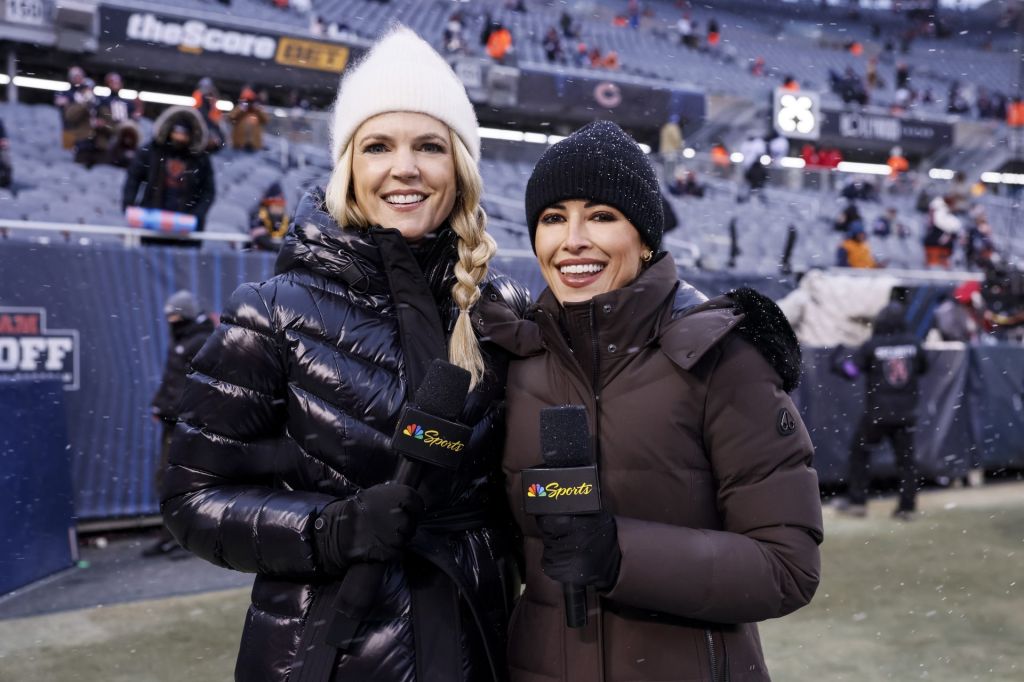
When Kaylee Hartung was growing up, her guy friends used to call her “Melissa” after her role model: sideline reporter Melissa Stark of ABC Sports.
Now the NBC Sports sideline reporter is poised to call Super Bowl LX with Stark this Sunday. It will be the first Super Bowl assignment for Hartung—and the second for Stark, who called her first Big Game 23 years ago.
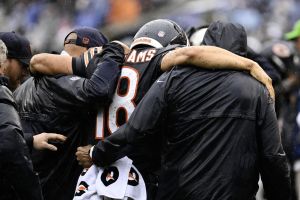
The duo worked the frigid Bears-Rams NFC divisional playoff game on Jan. 18. The Big Game will mark a full circle moment for Hartung, noted Stark.
“When I first met Kaylee at the 2022 NFL Draft in Las Vegas, and she told me her friends called her Melissa when she was in high school, I was so honored!” says Stark. “She is a true journalist at heart and loves sports. I have watched as she relentlessly pursues her stories and always brings a fresh angle. I have loved sharing the sidelines with her and cannot wait to do it on the biggest stage.”
Front Office Sports went one-on-one with Hartung. Here are excerpts from the interview:
Front Office Sports: Tell us about working your first Super Bowl.
Kaylee Hartung: It doesn’t seem real. Maybe it will hit me when I’m holding the mic at Levi’s Stadium—and the national anthem is being sung. It’s a great thrill.
FOS: Growing up, you idolized Melissa. Why?
KH: It’s 100% true. … She was doing Monday Night Football. She was the standard. She was in the spotlight. I was in high school in Baton Rouge. The biggest LSU Tigers fan. My mom worked for the athletic foundation. I was lucky enough to grow up around that athletic department—and experience the success from [Shaquille O’Neal] playing basketball to our national championship in baseball. And, of course, there was LSU football. I was always just comfortable around the coaches and the athletes.
My guy friends started calling me Melissa because I was the girl who could talk sports with the boys. She was, in their minds, the sideline reporter to aspire to be, as she was in my mind. I remember pulling up to the stadium in Detroit the first time I worked a divisional playoff for NBC a couple of years ago. I texted one of my best guy friends growing up and said, “I am in tears. Pulling up to my first playoff game with NBC—and I am sitting next to Melissa Stark. I never could have imagined this if you guys hadn’t put it in my head all those years ago. This would be a job that I would be doing.” It’s unbelievable. So doing a Super Bowl with her is a dream come true.
FOS: How about Melissa working her second Super Bowl 23 years after her first?
KH: She’s a great model for women in the workplace. You can be at the top of your career. You can choose to walk away, and have a family, and prioritize that. Then you can come back and keep killing it. I admire her greatly for that.
FOS: Will you approach Super Sunday differently?
KH: It sounds like a cliché you hear from a coach. In a lot of ways you have to treat every game the same. I’m really proud of the way I prepare for every game. I’m a preparation-breeds-confidence kind of gal. That system I have is the same as it is for any other game. Except the difference being I’m really focused on one team. Melissa and I splitting the sidelines changes the workflow for both of us in unique ways. It gives you more time to really dive into your roster. But then a game breaks out. As the game ends, we’re both interviewing players from the winning team. So you have to be ready for that as well. … You do what you do for both teams the best you can. Then you are ready for anything.
FOS: I’ve seen sideline reporters swallowed up by the crowd on the field. How do you make sure you reach your target?
KH: Melissa and I will each have a security guard throughout the game. Sometimes women. Those security guards can be super helpful in those moments. We also each have a producer with us on the sidelines who’s helping. And the truth is these NFL teams, their PR staff, are fantastic to work with. They understand where we are trying to go. A lot of times we’ll have a meeting point planned. But of course live TV is live TV. Sometimes you have to elbow your way in to make sure you get that key player in time. But it is chaotic. I’m sure on the Super Bowl level it’s a whole other ball game.
FOS: When the game ends, will you go to the winning QB or coach?
KH: That’s a good question. I should ask Rob Hyland, our producer. Typically in the NFL, it’s always the star player. I would hope in a Super Bowl environment, that there would be a winning coach interview as well. But that’s a very good question to ask.
FOS: Networks like NBC, ESPN, and Fox are now using two sideline reporters per game, not one. What’s your take?
KH: The role of a sideline reporter to a broadcast can be invaluable. Everybody involved has to take what the game gives you. But if there’s an injury on the field, no one has better access at that moment than I do to tell the viewers what’s going on. We are the eyes and ears of the broadcast in a way the play-by-play and the analyst in the booth just can’t be. We are literally boots on the ground who provide a very unique insight to a broadcast. Sideline reporters have the best seat in the house, so to speak. Even though we don’t sit down for a moment of the game. We’re right there up close to all of the action.
As for two sideline reporters, one of my worst fears as a sideline reporter, when I’m working a game alone, is I’m not where I need to be when there is an injury or an altercation at any moment the broadcast wants to spotlight. It’s a big field. Sometimes you get lucky; you’re in the right place at the right time. But a lot of times you can’t prepare to be there when that moment happens. … To add a second reporter to games of this magnitude is a really smart production decision. It allows both sidelines to be covered. You’re increasing your chances that your reporter has the best vantage point at any given moment. I love watching [Fox’s] Tom Rinaldi and Erin Andrews together. Or [ESPN’s] Laura Rutledge and Lisa Salters. I think there’s a wonderful way two reporters can play off each other.
FOS: What’s the key to asking a smart question at the moment of truth?
KH: First and foremost, it’s knowing your subject. It’s knowing how to put them in a position to share information that enriches the broadcast. And to actually say something that helps us all better understand the moment that they’re in.
FOS: How do you respond to male critics who say female sideline reporters don’t add anything to telecasts?
KH: I am there to tell the stories. I am there to highlight the athletes playing this game. I didn’t play the game. And I don’t pretend that I did. But I think one of the greatest values I can bring to a game is to help fans understand why they should care about these athletes, why they should have respect for the dedication, hard work, and sacrifice these athletes put into being excellent at their craft. For me it’s about highlighting the human side of these sports we all love to watch. I take great pride in that.