
Vicious Infighting Is Jeopardizing the Future of Women’s Baseball
The stereotypical NBA success story is associated with those who seemingly dedicate everything to basketball. Success in basketball is equated with being all in—think Kobe Bryant’s 5 a.m. practices or Michael Jordan’s otherworldly competitiveness.
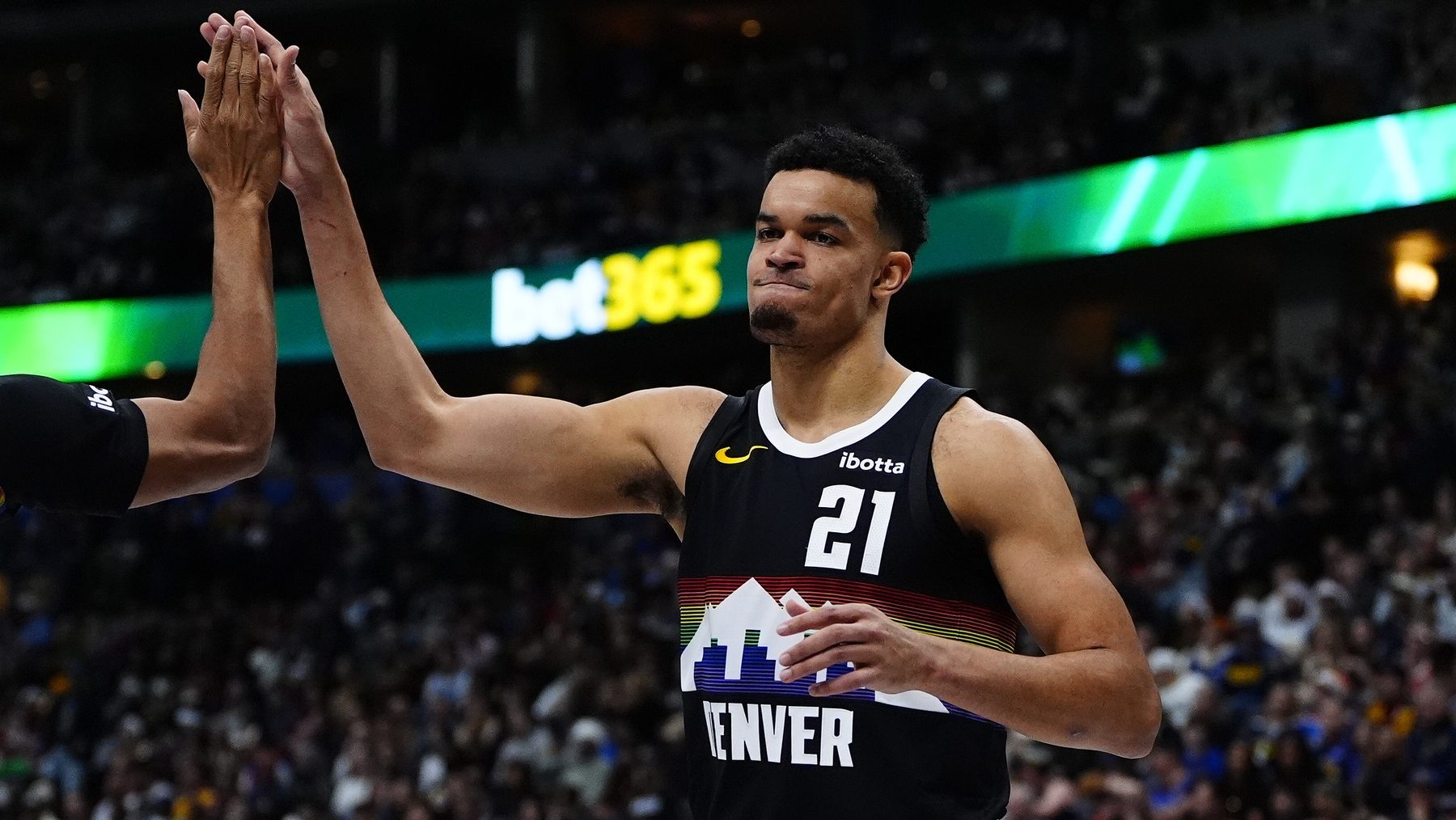
But Nuggets forward Spencer Jones has never really been a ball-is-life guy.
Coming out of high school in Kansas, the 6-foot-7, three-star recruit was hoping basketball would help him land at a reputable college, not the NBA. It worked out perfectly when he committed to Stanford in 2019.
“I was not planning on making it big,” Jones tells Front Office Sports. “The goal was just to use basketball to get into a place like [Stanford]. Everything else kind of felt like a bonus.”
It was only after his sophomore season in 2020–21 that the NBA became a realistic option. But he was expected to be a second-round pick at best, so he believed a Stanford degree should take priority.
“Spencer has always liked basketball, but he never was one of those guys that said, ‘My dream was playing in the NBA,’” Dwayne Jones, Spencer’s father, tells FOS.
But that doesn’t mean Jones is taking his basketball career for granted. He might just be rewriting the success blueprint.
Midway through his second NBA season, Jones has turned into one of the most important players on the roster of the championship-contending Nuggets. The undrafted forward is averaging six points, three rebounds, and a steal per game on efficient shooting splits while often being asked to defend the opposing team’s best player. He’s playing nearly 24 minutes a night, starting 31 of 43 games as Denver has dealt with significant injuries across its roster.
Yet he’s continued to succeed in his second career outside basketball, even turning into a mini social media influencer in a rather peculiar way.
Basketball Jones
Spencer Jones loves to post photos of his NBA games on social media, just like many of his contemporaries. But instead of one-line captions, they’re accompanied by 10-paragraph spiels with a basketball-related life lesson.
Last month, the 24-year-old Jones posted about the underappreciated art of defense, a “difficult and unglamorous job” that’s helped him carve out a role with the championship-contending Nuggets. A few weeks later, he explained the importance of adaptability through his career’s evolution from preps to pros.
His content is tailor-made for LinkedIn, the business-focused social network for career connections, job hunting, and yes, earnest lessons about how everything in life comes back to enterprise software sales. Jones has more than 23,000 followers on the platform—more than twice as many as on Instagram; he often clears 1,000 reactions with a comments section full of company founders and executives.
Although Jones’s LinkedIn activity nods to his on-court success, he’s really using the platform to prepare for a career after basketball.
“I know once my [basketball] career is over,” Jones tells FOS. “I’m using all this to just pretty much seamlessly bounce into the next thing.”
Jones had an idea what the next thing could be. While basketball was central to his Stanford experience, so was learning about venture capital investing, reading pitch decks, and understanding start-up financials. He also mingled with the school’s elite network.
“Every time we came to Stanford, I’d walk around before games, and Andrew Luck would come up to him and Condoleezza Rice—he’s kind of friends with her,” Dwayne Jones says. “That was a shocking development to me, to be honest, because I didn’t see a lot of that growing up. He wasn’t a shy guy, but he really wasn’t outgoing so much, looking for mentors or talking to business people. A lot of that happened when he got to Stanford.”
Jones graduated from Stanford in 2024 with a degree in management science and engineering, and the NBA remained an option. In 146 career games in college, he averaged 11 points on 40% from three-point range while showcasing defensive versatility. While he wasn’t expected to be a first-round pick, he took the chance to earn an NBA salary.
But even as basketball took a front seat, Jones found he couldn’t entirely turn away from what he’d been building at Stanford: He was worried that his NBA career would derail the network he’d built. So he began actively posting on LinkedIn to stay connected.
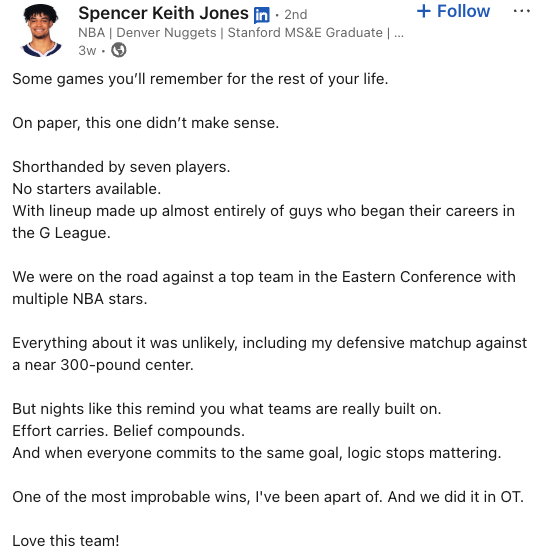
“The last thing you want to do is not reach back out to any of those people, or not have them feel like they’ve heard from you at all, and then have a career for five or six years, and then try to reach back out,” Jones said. Sticking with it paid dividends: His pro basketball career quickly lent him credibility and a bigger platform.
“A couple of posts blew up, and I saw the network really branching out.”
Two-Way Player
Jones has yet to sign a standard NBA contract. He’s played on a two-way deal with Denver since going undrafted in 2024.
Two-way contracts allow players to be active for a maximum of 50 NBA games, with the rest of the time spent in the developmental G League. Two-way players make about $630,000, half of the league’s standard minimum salary.
Jones is looking at his early career earnings differently from most players in his position—he sees them as enough to start investing in start-ups, which could pay dividends once his career is over. He’s acutely aware that a professional basketball career is short, with the average NBA player lasting less than five years in the league.
He started exploring VC investing during his final year at Stanford, when he secured his first six-figure NIL paycheck. He now has a stake in “about eight to ten companies,” mostly in the sports and health space. “Some portion of my venture investments have actually come, maybe not directly from LinkedIn, but from connections from LinkedIn,” Jones says.
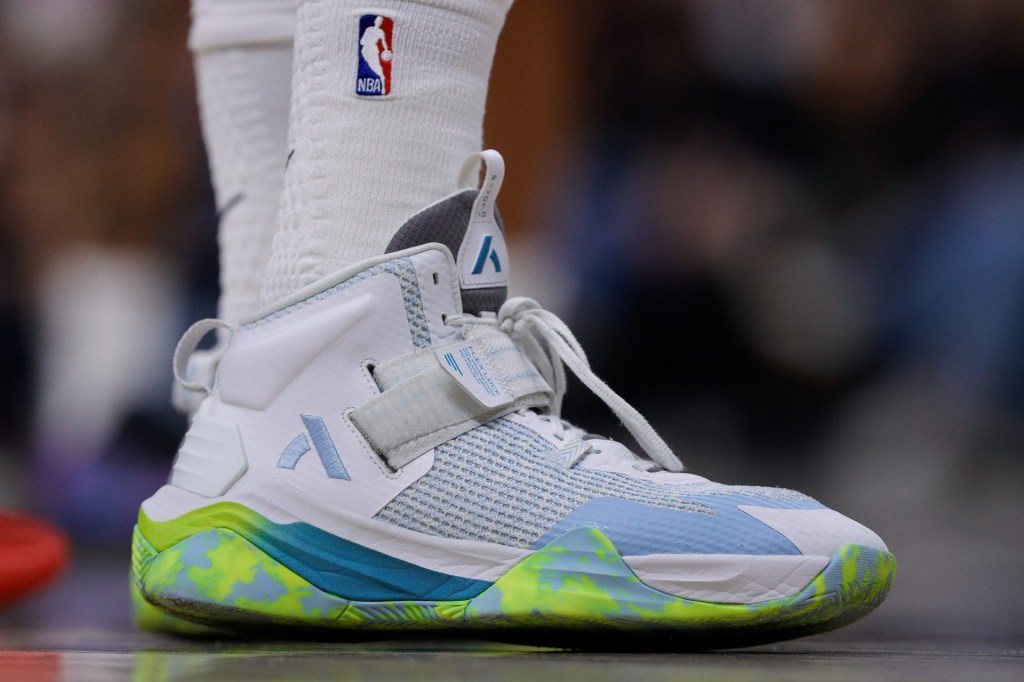
That includes Andiem, a shoe brand designed to prevent ankle injuries. The company announced in December that Jones signed on as an investor, advisor, and ambassador. He’s worn Andiem’s Pivot 1.0 shoe since the beginning of the 2025–26 season. Jones met with Andiem founders Alex Morel and Ezra Smyser at the 2025 Las Vegas Summer League through mutual connections formed through the social network.
Morel says he’s made several business connections for Jones. “I got so many requests to introduce founders to Spencer, and he’s really open and curious. He will really look at the deck, he will look at the website, and he’ll say, ‘This is interesting. This fits my thesis. This is in my interest area,’” Morel says. “I just don’t understand how he has the time and energy to do all of that while also being an NBA player.”
Jones says he has more time now that he’s a professional than he did at Stanford. “It’s never taken away from the basketball stuff, especially coming from Stanford, where I had to deal with the classes on top of the basketball,” Jones said. “Here, where it’s just straight basketball, you practice a little bit less, and we’re much more efficient with our time. And so you get a lot of downtime.”
Jones only has 3 more games left before he reaches his 50-game limit. The Nuggets have an open roster spot if they want to convert his deal, but they’ll likely wait until he hits the game threshold before they make the decision.
Regardless of whether he makes the roster, Jones knows his future is secured. “It’s still a two-way [contract],” he says, “so the whole thing was just using this platform to get the most out of it for as long as I have it.”