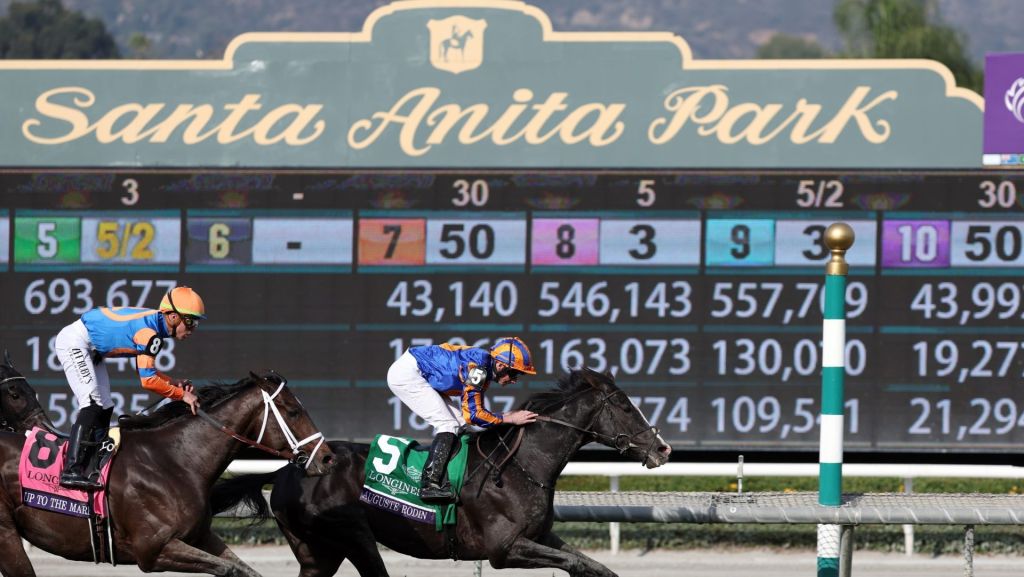
The famed Santa Anita horse-racing track and California are in a vicious legal fight over gambling machines, which were seized by officers from the state’s justice department during a raid on Jan. 17.
In other locales, the devices are referred to as “historic horse racing,” and ask gamblers to select the first three finishers of randomized past races. These machines have been legalized in Kentucky, which deemed them as “parimutuel devices.” Hard Rock Bet uses a variation of them based on past auto races on its sports betting app in Florida.
Santa Anita’s parent Los Angeles Turf Club sued the California Department of Justice and Attorney General Robert Bonta in the state’s superior court in Los Angeles County, seeking a writ of mandate and declaratory relief that these wagers are legal.
The suit alleges that Bonta “abused his discretion” in presiding over the seizure of the machines, and asks for their return.
The suit claims that the track “has not received any statement of DOJ’s position other than a form notice provided to Santa Anita Park employees at the conclusion of DOJ’s seizure.”
The suit also claims that the track was “afforded no due process before DOJ’s seizure and no California agency has issued any determination that the 3 X 3 wager violates any state law.”
The suit also describes how the so-called “3 x 3 wager” machines work.
“In a 3 X 3 wager, a patron selects the horses that they believe will be the top three finishers in three separate races, and payouts occur if the patron correctly selects the position of at least three and up to all nine horses in the wager. If the patron correctly selects a ‘trifecta’ in all three races—meaning the patron correctly selects the top three finishers in each race in the correct order—they are awarded the major and minor shares from the wagering pool,” the suit details.
Bettors get paid at varying rates based on how many horses they get right, and the jackpot for selecting all nine goes up progressively until someone wins.
There are multiple subplots to this lawsuit. First, a report from the web site Gambling Insider notes that California tracks like Santa Anita have been operating with “one arm tied behind its back” because, without the extra revenue streams from these types of machines, the California tracks have to offer lower prize pools than competing tracks in other states.
The other is the California tribes, which control all of the gambling in the state other than traditional horse racing. The Los Angeles Times reports that the state’s raid of Santa Anita means that it “seems to be siding with the California tribes” in blocking the track from having the machines. The tribes also have ongoing litigation against Kalshi and Robinhood for offering prediction markets in the state.