Want more from Front Office Sports
in your search results?
The NWSL Players Association filed a grievance Wednesday against the league saying it violated the collective bargaining agreement and federal labor law when it added the new “High Impact Player” rule designed to keep Trinity Rodman in December.
The union’s opposition is unsurprising after the union had loudly protested the league’s original “HIP” rule offer and countered with its own proposal last month.
“The solution is straightforward and collectively bargained by raising the salary cap,” NWSLPA executive director Meghann Burke said in a statement Wednesday. “What the League cannot do is invent a parallel pay system outside the salary cap that was never negotiated, then limit access to compensation through League-controlled criteria that excludes some Players.”
The NWSL first proposed the “High Impact Player” rule in mid-December. It’s a concept similar to what MLS has, where teams can go over the salary cap, without taking the full cap hit, to pay stars bigger contracts. Originating with David Beckham, the MLS rule carries through today to players including Lionel Messi. The key differences are that MLS “Designated Players” can sign massive contracts—the NWSL’s HIP proposal said teams could each go only $1 million over the salary cap—and the NWSL proposed criteria limiting which players could sign those deals. Women’s soccer stars in and out of the NWSL like Sam Kerr, Racheal Kundananji, Rebeca Bernal, and Sarah Gorden were among several prominent players who would not qualify.
The players’ association strongly opposed the model, saying the criteria were too strict and those funds should instead be available to all players. Burke told Front Office Sports at the time that she had “not heard from a single player who thinks this is a good idea.” The union instead proposed to the league that the salary cap be raised by $1 million for all teams.
“It is not a problem for this collective that Trinity Rodman would consume a significant percentage of Washington’s salary cap,” Burke said. “Our position is simply, take that million dollars and move it into the team’s salary cap so that teams have flexibility and the opportunity to spend it where they see fit in order to be competitive.”
The league marched ahead with the “HIP” rule anyway, declaring on Dec. 23 that it would be implementing the new policy. The league said in a statement then that it made its decision “following consultation with the NWSL Players Association.” The union strongly pushed back against that claim, saying in a statement it “opposes the League’s decision to move forward without bargaining” over the rule and “would take action to enforce the rights of the Players we represent.” Wednesday’s announcement is precisely that action.
“The NWSLPA is seeking immediate rescission of the HIP Rule, an order requiring the League to bargain in good faith over any proposed Player compensation rules prior to implementation, and to make-whole relief for any Players impacted by the League’s unilateral actions,” the union said in a statement Wednesday.
In response to Wednesday’s grievance, the NWSL called the “HIP” rule a “targeted mechanism that unlocks compensation for all players across the roster” that will “raise the competitive and commercial profile of the league.”
“We disagree with the NWSLPA’s assertions challenging the NWSL’s ability to implement the HIP Rule,” the league said in a statement. “The NWSL has fully complied with the CBA and federal law and we will defend those positions in our collectively-bargained grievance process.”
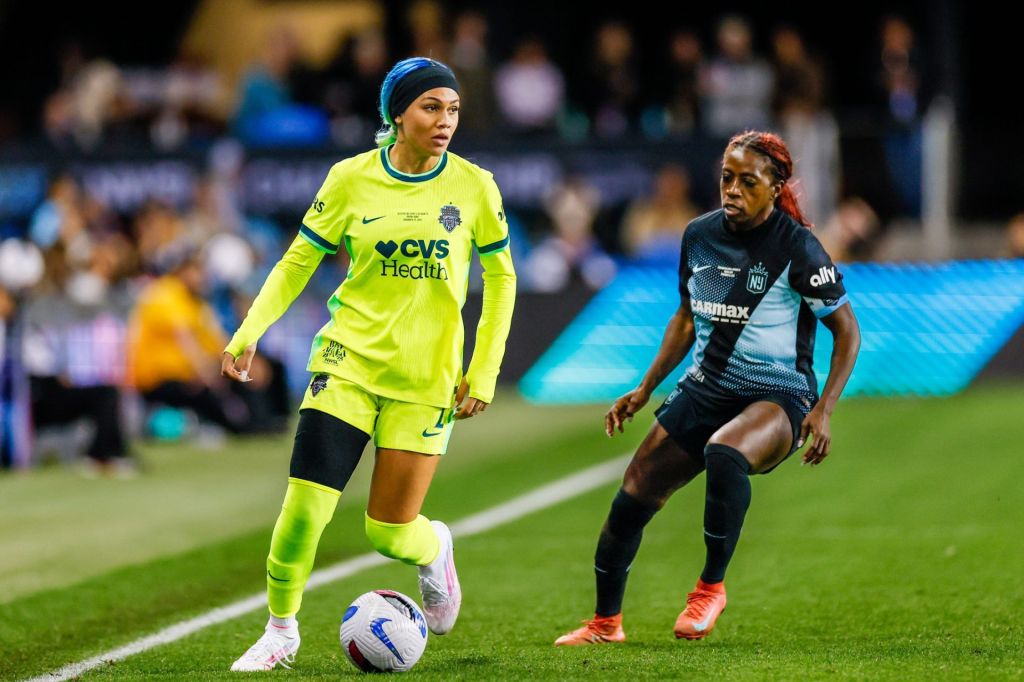
All of this is happening largely because of Trinity Rodman, who has an expired contract with the Washington Spirit and lucrative offers from other clubs in Europe and the U.S., her agent said. Rodman and the Spirit worked out their own backloaded deal before the “HIP” proposal, which the league rejected. The union filed a separate grievance about that situation in early December, when Burke told FOS: “If the NWSL can interfere with Trinity Rodman’s free-agency rights, they can interfere with anyone’s.”
A grievance is a formal complaint outlined in the CBA that, if not resolved, goes to arbitration. The league has 14 days to respond to the new complaint.
Rodman has still not signed a deal with any club in the NWSL or otherwise during the back-and-forth. In the meantime, several of her U.S. women’s national team teammates have made decisions to either stay or move across the pond in both directions: Sophia Wilson re-signed with the Portland Thorns, Sam Coffey left the Thorns for Manchester City, and Lindsey Heaps announced she will leave Olympique Lyonnais after this season to join the Denver Summit expansion team.
The NWSL has seen other USWNT stars like Naomi Girma and Alyssa Thompson depart for bigger salaries in Europe in 2025. The league’s base salary cap in 2026 will be $3.5 million before revenue-sharing, which tacked on an extra $200,000 last season.