Want more from Front Office Sports
in your search results?
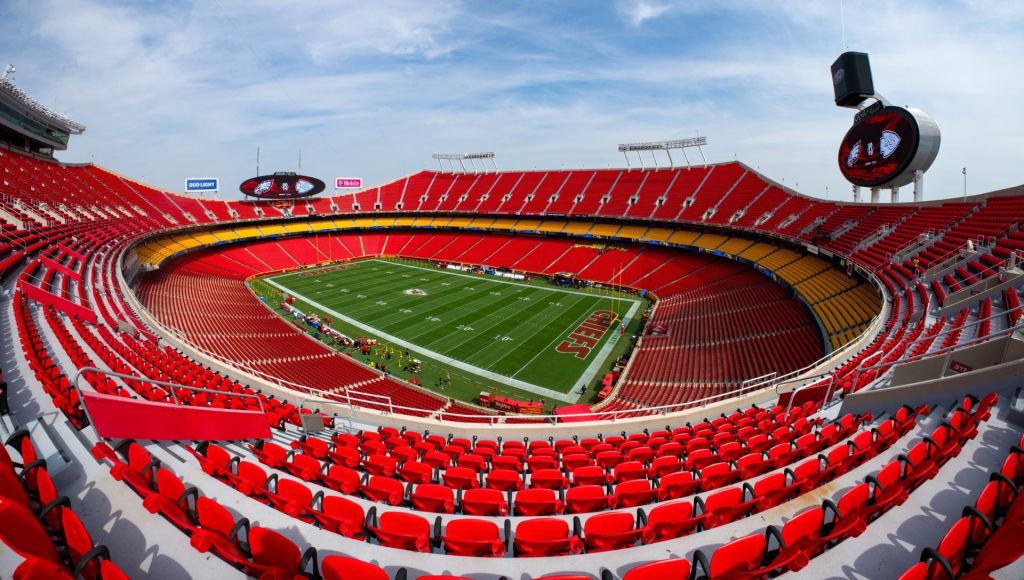
The Chiefs’ plan to relocate from Missouri to Kansas with help from $1.8 billion in public subsidies sparked outrage from fans and dismay from Missouri lawmakers. It also serves as a reminder that economists find little to no economic benefit for taxpayers who foot the bill for new stadiums.
Patrick Tuohey, senior fellow at the Show-Me Institute—a St. Louis-based think tank that supports free-market policies—says decades of research shows that new arenas rarely create jobs, increase local income, or boost tax revenue in a meaningful way. Instead, much of the money simply shifts from one form of entertainment spending to another.
“These deals are bad for taxpayers,” Tuohey tells Front Office Sports.
Tuohey says there is “unanimity” on this from economists.
“There’s no one who hedges,” he tells FOS. “This is as accepted a principle as the sun rising in the east.”
The Cato Institute published an article last May called “Sports Are Great, but Stadium Subsidies Stink,” which argued that, even though public subsidies for stadiums are on the rise, “the harsh reality for even the biggest sports fan is that arena subsidies are a terrible use of finite government resources and a ridiculously egregious redistribution of wealth from regular Americans—fans and haters alike—to some of the wealthiest people and organizations on the planet.”
Despite economists’ warnings, there’s no indication the trend will reverse anytime soon. Here are three of the most recent examples of publicly funded sports venues, complete with details of how they are being funded and who has opposed them.
Buffalo Bills
The Bills’ new stadium is set to open next year, and under a 30-year lease, they will remain in Orchard Park, New York, through at least 2056. What was slated as a $1.4 billion stadium being erected with the help of $850 million in public financing quickly ballooned to a $1.9 billion project thanks to rising labor and materials costs.
The additional costs will be the team’s responsibility, but taxpayers are still on the hook for $850 million through the deal with the state of New York and Erie County. New York Gov. Kathy Hochul has said the state’s $600 million will come, at least in part, from a debt settlement with the Seneca Nation—a plan the tribe has railed against. The $250 million Erie County is contributing will come from issuing municipal bonds—the county will borrow the money and repay it over time using public revenue.
Hochul touted that the new stadium would generate $27 million in annual tax revenue, but economists say the Bills’ owners would be the real beneficiaries, calling this a “boondoggle.”
Tennessee Titans
The Titans’ new $2.1 billion stadium, expected to open in 2027, will receive at least $1.26 billion in public funding, surpassing the Bills for biggest public subsidy for a stadium in U.S. history. Under the 30-year lease, the team should stay in Nashville through at least 2057.
The state government will issue $500 million in bonds, with the Metropolitan Government of Nashville and Davidson County issuing $760 million in bonds. That debt is expected to be paid off via a 1% hotel/motel tax, all in-stadium sales tax, and 50% of sales taxes from 130 acres surrounding the stadium, according to ESPN.
Skeptics of the plan include former Metro Councilmember Bob Mendes, who stepped down in September, as well as Kennesaw State University economist J.C. Bradbury.
Oklahoma City Thunder
The Thunder are funding their new arena—expected to be ready by the 2029-30 season—through a unique structure: of the $900 million projected to be required for the project, at least $772 million will come from a 72-month, one-cent special sales tax. The deal is meant to keep the team in Oklahoma City until at least 2050.
That plan passed overwhelmingly in December 2023, prior to the Thunder winning last year’s NBA Finals. Taxpayers agreed to the novel solution that citizens of other cities have rejected; taxes to fund stadiums in cities such as Kansas City, Phoenix, Tampa Bay, and elsewhere have all failed.
Opponents of the plan include state Senator Nikki Nice and city Councilwoman JoBeth Hamon. Hamon has said the deal “was negotiated from a position of fear and scarcity, which benefits those who are wealthy, while the benefits never trickle down to regular folks.”
Download the FOS App
The business of sports, in your pocket.



Scan the QR code to get the app now.