Want more from Front Office Sports
in your search results?
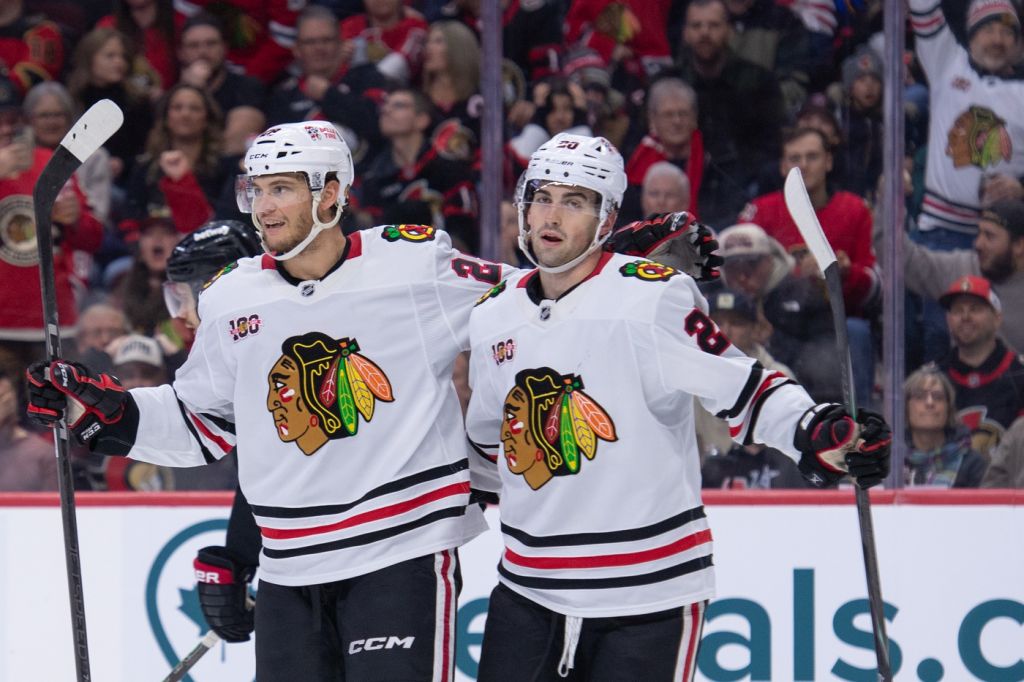
The Blackhawks are breaking the ice on prediction markets.
The Chicago NHL team has reached a deal with Kalshi, making them the first North American pro sports team to partner with a prediction-market platform, according to a statement shared with Front Office Sports.
Under the agreement—which takes effect this week—each side can use the other’s intellectual property for co-marketing purposes, they will cross-promote on social media platforms, and Kalshi will be promoted during home games at the United Center and on Blackhawks broadcasts. Financial details were not disclosed.
“We’re proud to share an innovative mindset with Kalshi,” Blackhawks EVP of revenue and strategy Matt Gray said.
Kalshi was already an “official partner” of the NHL through a multiyear deal reached in October. Polymarket, Kalshi’s main rival, is also an “official partner” of the NHL. (Polymarket is not involved in the deal with the Blackhawks.)
Polymarket and Kalshi have been engaged in a partnership battle since Polymarket was cleared to return to the U.S. after having been banned for roughly four years. Kalshi has other agreements with CNN and CNBC, and this month signed a deal with U.K. six-on-six soccer league Baller League that includes live media rights for Kalshi to broadcast games on its website and app. Polymarket, meanwhile, has deals with UFC and Yahoo Finance. Both are also partnered with Google and Pro Pickleball.
The NHL is the only one of the big four North American sports leagues that has embraced prediction markets, which have generated controversy because of their similarity to traditional sports betting. While sports betting is regulated on a state-by-state basis, prediction-market platforms like Kalshi are federally regulated by the Commodity Futures Trading Commission (CFTC). They also offer more than just sports—users can put money on the prices of gold, cryptocurrencies, and more.
In November, NHL commissioner Gary Bettman said the agreements with Kalshi and Polymarket were made in part because the league thinks it’s important for fans to know that event contracts are “based on real data.” (Event contract trading involves a user buying a position based on the predicted outcome of an individual game or event, such as “Will the Blackhawks beat the Flyers?”)
“But more importantly, it gives us control, because we have the ability to take down any contracts we don’t think are appropriate,” Bettman said.
The NFL, NBA, MLB, and NCAA have yet to come around. NFL commissioner Roger Goodell said earlier this month the league was not ready to join in on the prediction-market parade, while NCAA president Charlie Baker said the lack of oversight could be “catastrophic.” MLB issued a memo to players over the summer instructing them not to participate in prediction markets, while the NBA’s assistant general counsel in May wrote a letter to the CFTC requesting “specific regulatory provisions that can mitigate the associated integrity risks” of prediction markets.
Kalshi has spent much of the year fighting against state regulators who want to snuff out sports event contracts in their states. At least 10 state regulators have issued cease-and-desist orders, and Kalshi is involved in more than a dozen lawsuits over its sports offerings—most recently a proposed class action brought by consumers who claim Kalshi is to blame for losses suffered using its platform. Following a recent ruling in Nevada, Kalshi faces the threat of enforcement action from that state’s gaming regulator—the Nevada Gaming Control Board could seek to force Kalshi to stop offering sports event contracts while the case continues, although it has yet to take such action.
Despite the controversy, prediction-market platforms continue to pop up like worms in the dirt after a rainstorm. The NHL may view itself as a pioneer; prior to the 2018 U.S. Supreme Court decision striking down the Professional and Amateur Sports Protection Act (PASPA)—which had effectively prohibited sports betting outside Nevada and a handful of states with sports lotteries—it, the NFL, NBA, MLB, and NCAA all opposed sports betting.
Download the FOS App
The business of sports, in your pocket.



Scan the QR code to get the app now.