Want more from Front Office Sports
in your search results?
WASHINGTON — After more than three decades, Major League Soccer’s days of conducting itself like a startup are over.
League commissioner Don Garber has not decided on his future, and his contract currently runs through 2027. Team owners, however, have formally begun a succession planning process that not only includes the commissioner’s post but numerous other senior positions in the MLS office.
“MLS has been operating almost like a startup for 30 years, so we never gave any thought to succession planning, but high-performing companies need to do that,” Garber tells Front Office Sports. “So the start of this process is about having a proper succession for not just the next commissioner but for the next leader of our commercial business, the next leader of our sporting business, and so on.
“My agreement ends in 2027. I’ve got a lot of work to do before then. I haven’t made any decision about what I’m doing. Right now, I’m focused on these next couple of years,” he said.
Garber, in his post since 1999, is 68.
Past, Present, and Future
Beyond the succession, historical parallels were very much on Garber’s mind as he made his annual state-of-the-league address here on Thursday night, the eve of the draw for the 2026 FIFA men’s World Cup.
The league was originally born more than three decades ago during a tournament draw in advance of the 1994 FIFA men’s World Cup, held in the U.S., and it then went through many difficult growing pains in its early years. As the draw for soccer’s biggest tournament returns to the U.S. tomorrow, Garber said the trajectory for MLS is on the cusp of significant acceleration, citing historic levels of growth in a wide range of areas, including attendance, franchise values, stadium development, quality of play on the pitch, and the forthcoming bump from the World Cup.
“The progress isn’t just clear. It’s extraordinary,” Garber said. “Soccer has arrived [in the U.S.], MLS is one of the drivers of the sport’s success in our nation. Today, our league is firmly established … and MLS has fulfilled its founding promise.”
Much of the optimism looking ahead is centered around MLS 3.0, a wide-ranging growth initiative that includes forthcoming stadiums in Miami, New York, and Chicago between 2026 and 2028; next year’s World Cup; enhanced player development rules; and the recent, landmark decision to adopt a fall-to-spring schedule beginning in 2027.
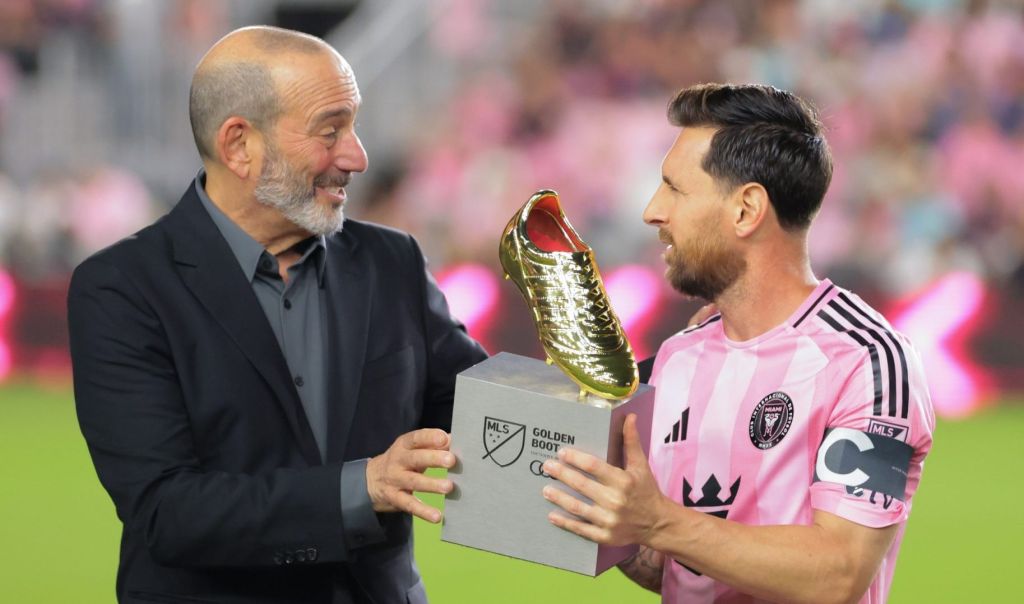
Garber’s comments also represented something of a victory lap after a flurry of recent developments that also include a dynamic playoff run by Inter Miami led by Argentine star Lionel Messi and the reworking of its groundbreaking rights deal with Apple.
“We are in the midst of a dramatic, generational change,” Garber said. “Soccer is now an American pastime.”