

Max Kellerman, LeSean McCoy Off DAZN Boxing Show As Mario Lopez Joins
Want more from Front Office Sports
in your search results?
The Chicago Bears certainly were aware last week of the extensive power of stadium renderings, centering much of an elaborate, 95-minute press conference on a new set of drawings developed by Manica Architecture for a planned lakefront, domed stadium. The team even went so far as to use those renderings as the foundation of a splashy hype video for the planned project.
“If that doesn’t make your teeth chatter, I don’t know what will,” Bears president Kevin Warren said immediately after debuting that video.
On many fronts, Warren and the Bears have achieved some initial success in their ambitious goal, thanks to those renderings. There is still firm opposition to the intended stadium location on the downtown museum campus, largely from preservationist groups, but no set of drawings was likely to sway that sentiment. Big questions certainly remain about financing, too, particularly for related infrastructure costs that could reach $1.5 billion and currently have no funding source.
But the renderings themselves? The vision displayed by the Bears and Manica was at once quite familiar and new, showing elements such as a translucent roof common to recently built stadiums such as SoFi Stadium in California, while also depicting a very different look for that Chicago lakefront area and moving far beyond the oft-criticized Soldier Field.
“These pictures are miraculous,” said Chicago mayor Brandon Johnson, with no level of restraint or irony.
The Oakland A’s weren’t remotely so fortunate. A set of drawings for a planned Las Vegas ballpark—created with the aid of Bjarke Ingels Group and HNTB and released last month following months of rising pressure—were widely criticized and only amplified growing concerns about whether the MLB team’s planned relocation to Nevada will actually happen. The A’s were already fighting uphill in the court of public opinion after acknowledging a prior set of stadium renderings were dismissed by the team as garbage, and they were merely a tool to help secure $380 million in public funding for the project.
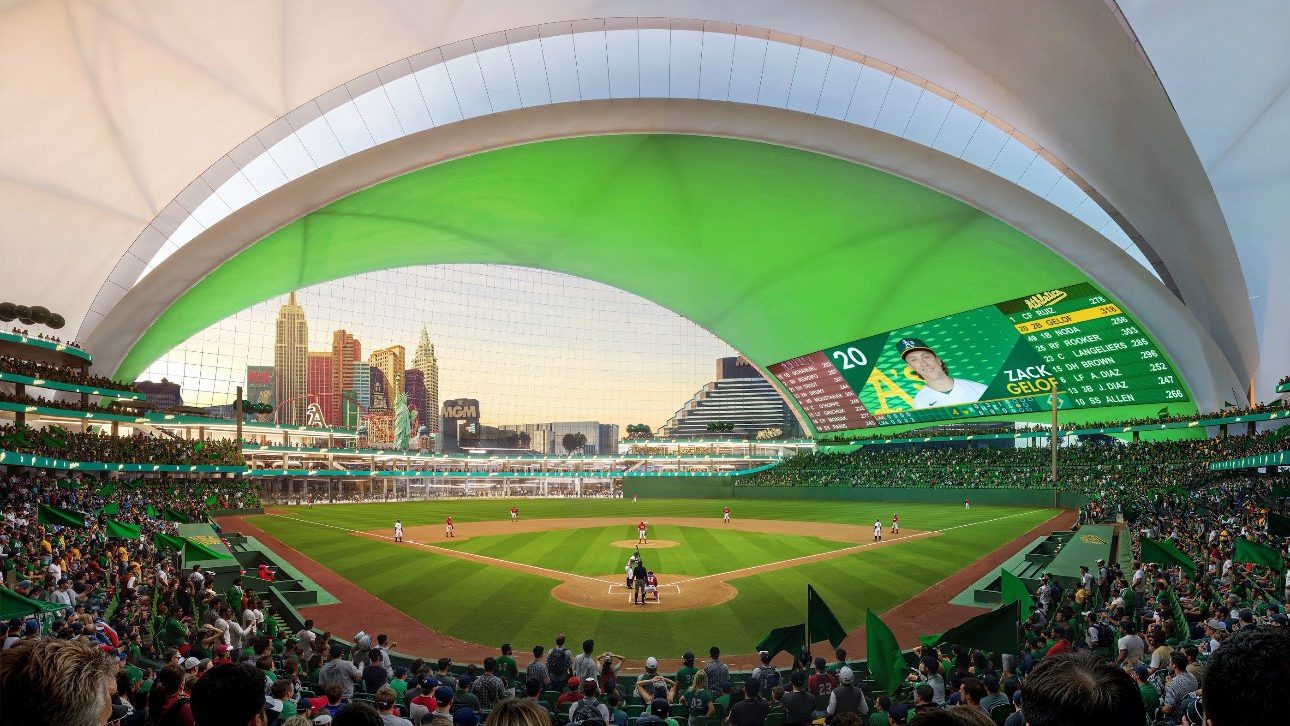
But the new drawings, showing a ballpark that the Bjarke Ingels Group described as a “spherical armadillo,” were missing many core requirements of any MLB facility such as bullpens, a batter’s eye, and stadium lighting, and they were widely mocked by fans. The A’s, perhaps in a desperate attempt to save face, turned off social media comments on X and LinkedIn for their posts of the renderings.
Such is the power of these stadium renderings. They can greatly sway politicians, open up public coffers, and excite, confound, or enrage fans. Critical early momentum behind an eventual stadium project often hinges on its quality, presentation, and plausibility. And as the sports industry continues a historic wave of new facility development, renderings are taking on a greater prominence than ever.
“In that early stage of a stadium project, people often get very interested about renderings entering into the public realm,” Christopher Dunlavey, president of Brailsford & Dunlavey, a Washington, D.C.–based development advisory firm active in sports venue projects, tells Front Office Sports. “These images, when communicated correctly, can be a very powerful marketing tool and help generate a groundswell of interest.”
Marketing of stadium renderings, however, can often backfire, particularly in the age of social media, when any released image generates an immediate, worldwide, and often visceral reaction. The situation with the A’s, of course, looms as a recent and notable example. But in many prior situations, the question of whether to release drawings at all before a crucial vote for public funding or zoning approval is a heavy one.
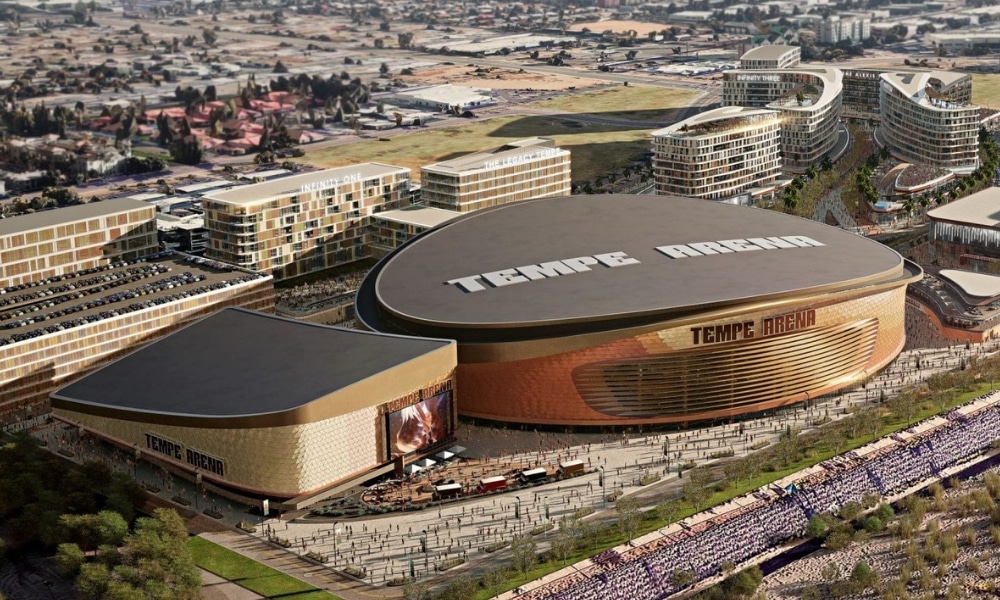
The A’s did successfully use that initial and fictitious set of drawings to secure the commitment of state aid (though that funding is now being challenged by Nevada education advocates). The NHL’s Coyotes, however, have a very different story to tell, and renderings played a role in the franchise’s ultimate departure to Utah. An elaborate set of images detailed the team’s grand vision for a $2.1 billion arena and mixed-use development in Tempe, Ariz. But even with private funding, voters there strongly rejected the plan last May, accelerating the uncertainty that ultimately led to the Coyotes’ leaving.
The team’s former owners have already tried again, releasing another set of images for a new proposed arena location in north Phoenix that, if successful, could lead to the reactivation of the Coyotes franchise. But that potential new location, as well as the depicted scale and physical orientation of the project, has already generated pushback from local officials.
Compare that situation to Oklahoma City, where the Thunder are planning to build a successor facility to the 21-year-old Paycom Center, and voters there overwhelmingly approved in December the use of taxpayer funds for most of the project’s costs. But the Thunder achieved that without the release of any renderings of a new arena, instead relying on their own relationship with city residents, as well as their own advocacy along with many city leaders.
“Reaction to a set of renderings can often take on a life of its own, and you can run the risk of a rendering codifying a negative opinion,” Dunlavey said. “So it can create a bit of a chicken-or-egg dilemma, and sometimes it can be better to wait on releasing images.”
You never get a second chance to make a first impression, as the famous saying goes, and renderings are a key part of that for any stadium project. But beyond the often-delicate nature of local politics, renderings can also create an expectation among fans that is impossible to live up to and often isn’t even the ultimate intention.
The Texas Rangers are a key example here, as the initial renderings for Globe Life Field in 2017 showed a series of differences, albeit not drastic ones, from the completed stadium. When the facility opened in ’20, some criticism soon arrived, in part due to that divergence between original concept and final reality. But given initial renderings like the Rangers’ are typically done very near the beginning of a stadium development process—and usually well before any government approvals and final architectural drawings—some changes along the way are almost inevitable.
“A rendering is an idea of what a project can be, and how you sell that idea to the public or whatever authority you’re going before,” Ryan Sickman, head of the sports design practice for global architecture firm Gensler, tells FOS. “As you then fully dive into things and they become real, there are all sorts of factors that can come into play, including availability of materials, construction timetables, funding issues, what have you. In reality, something almost always gets changed. But the goal is still to reflect reality as much as possible.”
Managing expectations around those differences is now a fundamental part of the task in front of teams like the A’s and Bears. By about 2028, when those two projects are targeted for completion, we’ll know for sure how right they were and, in the case of Chicago, whether the team’s stadium is indeed “miraculous.”
Download the FOS App
The business of sports, in your pocket.



Scan the QR code to get the app now.