Want more from Front Office Sports
in your search results?
In 2021, the NCAA fielded a barrage of criticism over inequities between the Division I men’s and women’s tournaments, from weight rooms to branding and food offerings. But those issues stemmed from structural problems that preceded the executives running the events.
Lynn Holzman, NCAA’s VP of women’s basketball, and her team were tasked with operating a tournament with a smaller budget and men’s-centric sponsorship contract, and without “March Madness” branding or a prize money distribution structure. Even the NCAA hierarchy was problematic: Holzman ranked below Dan Gavitt, her counterpart on the men’s side. Since then, the NCAA has done a complete overhaul involving multiple outside audits and major structural changes, among them a new media contract, a new branding strategy, and even a new president. As a result, women’s March Madness is bigger and more popular than ever.
Yet this year’s event has been marred by multiple embarrassing, avoidable, and even dangerous logistical problems. After all that triage and change, the current NCAA tournament operators have no one to blame but themselves.
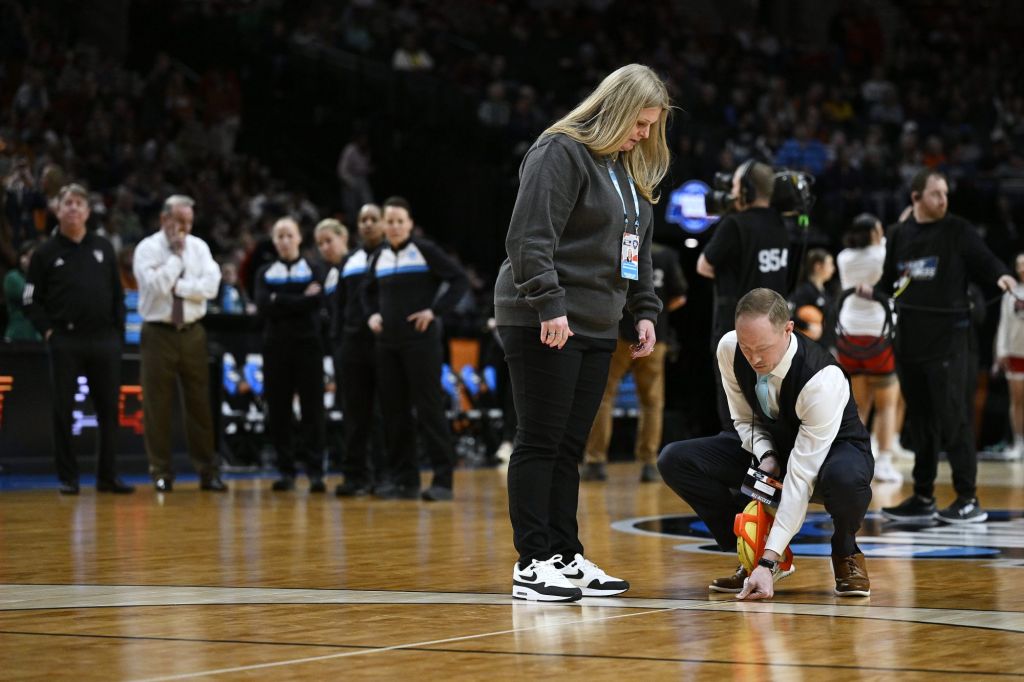
The most recent problem: The entire Portland Sweet 16 slate was played on a court with two different three-point lines before anyone noticed, let alone rectified it. To make matters worse, the disparity was discovered by a fan, not an NCAA or arena employee, according to The Washington Post. Before the Elite Eight tipped off Sunday, Texas and NC State were given the option to postpone their game to allow the Moda Center court to be repainted, but they decided to play because of a coveted Sunday afternoon TV window on ABC. (ESPN began putting more women’s games on ABC in the aftermath of the gender equity fiasco of 2021.)
“I hate to say this, but I have a lot of colleagues who would say, ‘Only in women’s basketball,’” Texas coach Vic Schaefer told reporters after the team’s loss to NC State. “It’s a shame, really, that it even happened.”
Connor Sports, the company that manufactures all of the neutral-site courts for the men’s and women’s tournaments, tells Front Office Sports that a subcontractor had painted the court, and that the botched measurements resulted from “human error.” The company took accountability, apologizing in a statement to FOS and acknowledging it was responsible for the quality of the courts it provides.
The closest the NCAA came to accountability in the immediate aftermath was a statement saying it “regrets” that the error “was not discovered sooner.” It blamed Connor Sports: “While the NCAA’s vendor has apologized for the error, we will investigate how this happened in the first place.” The governing body didn’t officially apologize until statement No. 3, published a full day later. Regardless of culpability, the NCAA could have avoided the fiasco if its employees had done their own basic due diligence.
That issue was preceded by two controversies involving NCAA referees: Notre Dame star Hannah Hidalgo missed almost half of the second quarter of the Fighting Irish’s Sweet 16 loss to Oregon State when officials forced her to remove a nose ring she had worn throughout the regular season, during the first two rounds, and in the first quarter of the game in question. (South Carolina coach Dawn Staley later remarked that NCAA referees appeared to only have the “stamina” to enforce NCAA rules inconsistently.)
That wasn’t all. At halftime of the first-round NC State–Chattanooga matchup, the NCAA replaced a referee due to a conflict of interest: She was a Chattanooga alum.
The NCAA’s worst mistake by far, however, was putting the Utah women’s basketball team in danger. The Utes played their first- and second-round games in Spokane, Wash., but the NCAA chose hotel accommodations across state lines in Coeur d’Alene, Idaho, a town known as a hotbed of far-right extremism. During their stay, the team was the target of two racist hate crimes. Their safety was threatened so severely that the NCAA (and host team Gonzaga) moved them to another hotel.
“Racism is real and it happens and it’s awful,” Utah women’s coach Lynne Roberts told reporters. “For our players, whether they are white, Black, green, whatever—no one knew how to handle it. And it was really upsetting. And for our players and staff to not feel safe in an NCAA tournament environment, it’s messed up.”
Utah was placed in danger due to the logistics of the women’s tournament: The NCAA couldn’t book hotel rooms in advance given that teams play on the campuses of the highest seeds, rather than at predetermined sites. While the NCAA is not liable for the attacks, it is certainly responsible for putting them in an environment notorious for white supremacy.
Over the past few years, the NCAA has had to answer hard questions about its value as the overseer of college sports. One of its responses: It successfully operates college sports championships. The governing body continues, however, to fumble running the women’s tournament, no matter how many audits it conducts or changes it makes.
Download the FOS App
The business of sports, in your pocket.



Scan the QR code to get the app now.