
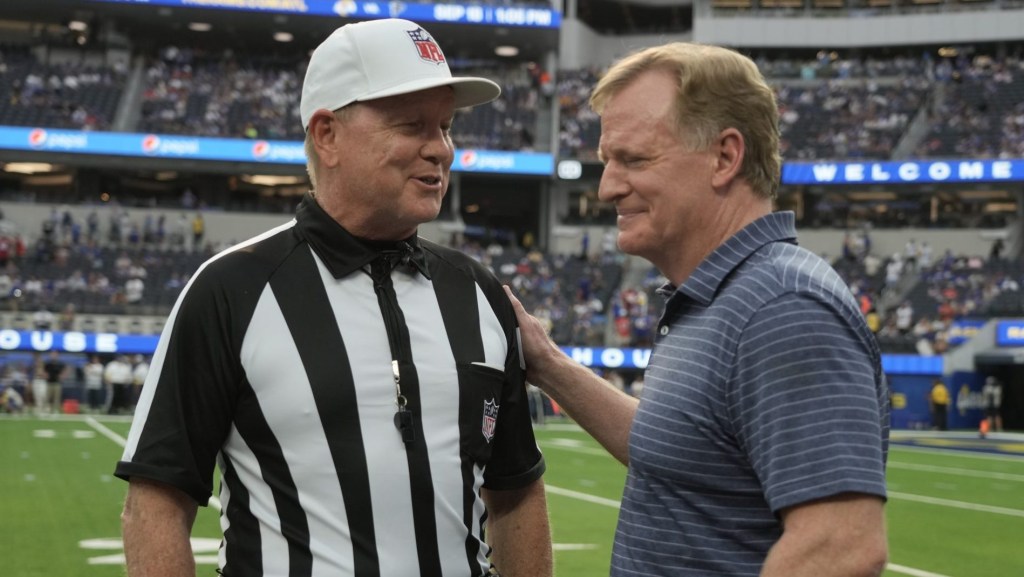
PHOENIX — NFL commissioner Roger Goodell insisted that the league will be “prepared” to play the 2026 season, regardless of the outcome of its labor negotiations with the NFL Referees Association.
Speaking at the conclusion of the league’s annual meeting, Goodell said the NFL is still seeking a resolution with the referees, but is increasingly making alternate plans.
“We obviously have obligations to our fans, to everybody in the National Football League to play, and we will be prepared to play,” Goodell said. “We are taking the appropriate steps to be ready, but we’re also keenly focused on negotiations. We’d like to get a negotiated deal and are certainly focused on that.”
Goodell’s comments arrived as NFL team owners approved on Tuesday a measure that would allow the league’s officiating department to consult with replacement on-field officials in the event of a work stoppage with the NFL Referees Association. That looks increasingly likely as the sides are in a protracted labor negotiation, and there is diminishing hope of a deal before the current pact expires in May.
The sides are divided on a series of issues, including the standards used to measure referee performance and the length of the probationary period for new officials.
“This is an opportunity for us to improve the state of our officiating,” NFL EVP Jeff Miller said. “The owners were consistent in saying, ‘We’re more than happy to pay for performance.’ This was consistent through the course of the discussions over the last couple of days. But what they are insistent upon—insistent upon—is that performance of the officials and the accountability for their performance has to improve. And that’s where we are in these negotiations and that’s exactly where we’re going to stay.”
The union, meanwhile, is taking aim at what it sees as false narratives coming from the league.
“The bottom line is our officials work for the wealthiest sports league in America, with profits that far exceed any of the others,” NFLRA executive director Scott Green said in a statement. “That’s normally a point of pride for the NFL. However, our officials are substantially under-compensated compared to baseball and basketball umpires and referees.”
There is, of course, inherent risk in the use of any replacement officials. That personnel will likely be drawn from those working in smaller colleges, and aren’t accustomed to the greater speed and different rules in the NFL.
The NFL last used replacement officials in 2012. Back then, the league used lower-level college and minor pro league officials during a 110-day lockout of the NFLRA.
Most notably, that period included the infamous “Fail Mary” game in which a Week 3 contest on Monday Night Football between the Packers and Seahawks ended in a Seattle game-winning touchdown that the league later conceded involved an uncalled offensive pass interference penalty. Had that penalty been called, it would have ended the contest in a Green Bay victory. Instead, the Seahawks’ touchdown also included two referees standing right next to each other, making opposing calls on the play.
Beginning of Something Bigger?
NFL team owners, meanwhile, approved at the annual meeting a series of other rule changes, including the ability for the officiating department to issue penalties and consider player disqualifications for flagrant acts not called on the field.
An overriding theme in many of the changes, however, is a growing role of the central league office in real-time, on-field game management. In other leagues, such as MLB and the NHL, that’s already a core feature of their operations, but it is now an increasing component of what will happen in NFL games.
“The discussion in the room was more along the lines of ‘Can we do more, not less?’” said NFL competition committee co-chair Rich McKay. “We stand true to the idea that we want replay assist and we want New York [headquarters] to be able to help. We just want to move too fast.”
Tanking and the Rooney Rule
In other developments from the annual meeting:
Goodell said the NFL is unconcerned about the notion of tanking within the league. The issue has increasingly become problematic elsewhere in pro sports, particularly in the NBA. “We don’t see any evidence of that,” he said. “We just had probably the most competitive season we’ve ever had. We had teams go from last to first. The two teams in the Super Bowl didn’t even make the playoffs the year before. So what you see is a very competitive league, and players and coaches who want to win.”
The league’s Rooney Rule, while continuing to evolve over time, will remain intact—even amid growing governmental pressure. Most recently, Florida attorney general James Uthmeier said he wants the NFL to suspend the Rooney Rule. Goodell responded that the league will continue to comply with the law, but remains committed to improving diversity throughout the sport.
“One thing that doesn’t change is our values,” Goodell said. “We continue to believe that diversity has been a benefit to the National Football League. We are well aware of the laws and where the laws are changing or evolving. We think the Rooney Rule is consistent with those.”