
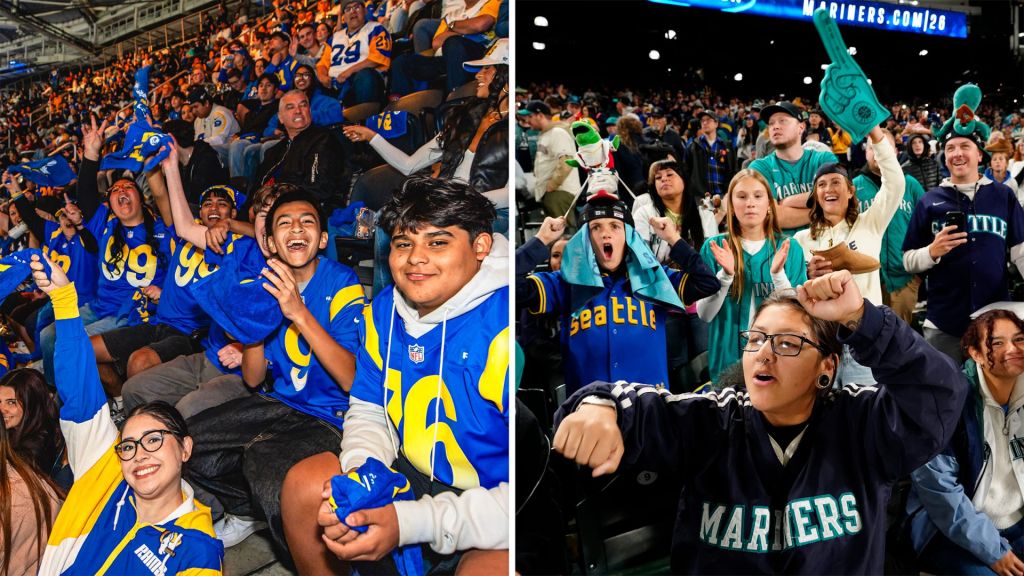
Last October, several hours before Game 7 of the ALCS between the Mariners and the Blue Jays, Abraham McCormick piled his wife and three kids into their RV and made the drive from Whatcom County, Washington, to T-Mobile Park buzzing with anticipation.
The Mariners season-ticket holder—known as “Captain Abe” among fellow diehards—came prepared for the occasion. He brought various signs, wore a bedazzled jacket, and packed a yellow trident he’d molded into the number 44, in honor of star outfielder Julio Rodríguez. When the gates opened, Captain Abe hustled to claim first-come, first-served seats behind the home dugout, then made a quick concessions run before joining a sea of more than 5,000 others clad in navy and teal filling out the stadium’s lower bowl.
Though the game itself was happening nearly 2,000 miles away in Toronto, the team’s discounted watch party inside the stadium throbbed with the tension and electricity of an actual home playoff game. And with the season on the line, McCormick didn’t want to be anywhere else.
“If I travel, I’m in somebody else’s domain. I’m not going to be sitting with my people,” McCormick tells Front Office Sports. “The watch party is a really nice, cost-effective way to give us as fans a reason and a place to grow our fandom.”
Teams are competing against an increasingly comfortable at-home viewing experience. With bigger TVs, immersive sound systems, instant replays, and second-screen engagement, fans have more reasons than ever to stay home during a playoff run. Watch parties succeed by offering something living rooms and even local bars can’t: communal die-hard energy, shared, one-sided emotion, and being part of something bigger than the game itself.
“It’s nice to be with other fans that are going to get hyped with you,” says Darian Vaziri, a Los Angeles–based sports podcaster who has attended watch parties for both the Rams and the Clippers. “The sense of community means a lot to me.”
As such, pro sports teams now routinely open their own venues for watch parties during road playoff games. With discounted tickets and parking, fans priced out of home games get the rare chance to experience the postseason from inside their team’s arena or stadium, celebrating or commiserating with thousands of fellow diehards.
These nights—recently hosted by the San Antonio Spurs, Carolina Hurricanes, Montreal Canadiens, and Los Angeles Rams—often feature DJs, merchandise giveaways, food trucks, and full concessions, creating an atmosphere that can rival the energy of an actual home game. And they’re only getting bigger thanks to technological enhancements and more dynamic video boards. What began as a consolation experience has increasingly become its own hot-ticket event—especially for fan bases starving for a title.
Throughout the Knicks’ NBA Finals run, thousands of New Yorkers waited in lengthy Ticketmaster queues and packed inside Madison Square Garden to watch the team’s road games on the jumbotron. Those who couldn’t grab a ticket cheered nearby thanks to sanctioned outdoor watch parties throughout the city, turning otherwise empty blocks, plazas, and parks into communal spectacles.
“You’re trying to build a community—and I think that’s what all teams are trying to do,” says Rams EVP of consumer revenue and strategy Dan August. “People crave being a part of the action and being part of something bigger than themselves. That’s what sports generates.”
Hometown Parties, High-Energy Crowds
The watch-party craze traces back to at least the mid-2000s, when teams like the Hurricanes and Pittsburgh Penguins first opened their venues’ lower bowls for road playoff games. Back in 2006, as Carolina marched toward a Stanley Cup, the concept attracted a modest but devoted cluster of fans. Two decades later, that once-scrappy gathering inside the Lenovo Center has morphed into a sold-out event, with production value and crowd energy that can rival the real thing.
Throughout this year’s Stanley Cup run, the Hurricanes provided discounted concession items, free rally towels, and free parking for anyone with a $10 reserved seat. Inside the sold-out 18,000 capacity arena, the team’s in-house DJ took advantage of a less-regulated game presentation, timing beats to various light shows and goal-scoring P.A. announcements. But the biggest upgrade was its application of Sprites, a player tracking system developed by Durham-based SportsMedia Technology, which projected the game’s movement onto the ice in tandem with the broadcast.
According to Matt Sutor, the Hurricanes’ VP of marketing and brand strategy, the new feature was an easy way to enhance the viewing experience and make the party feel different from other team-run events taking place outside the arena and in downtown Raleigh. “You don’t get a chance to do this for a live hockey game,” he says. “So it allows us to branch out and explore some new technology, feature a local company, and the fans are really taking to it.”
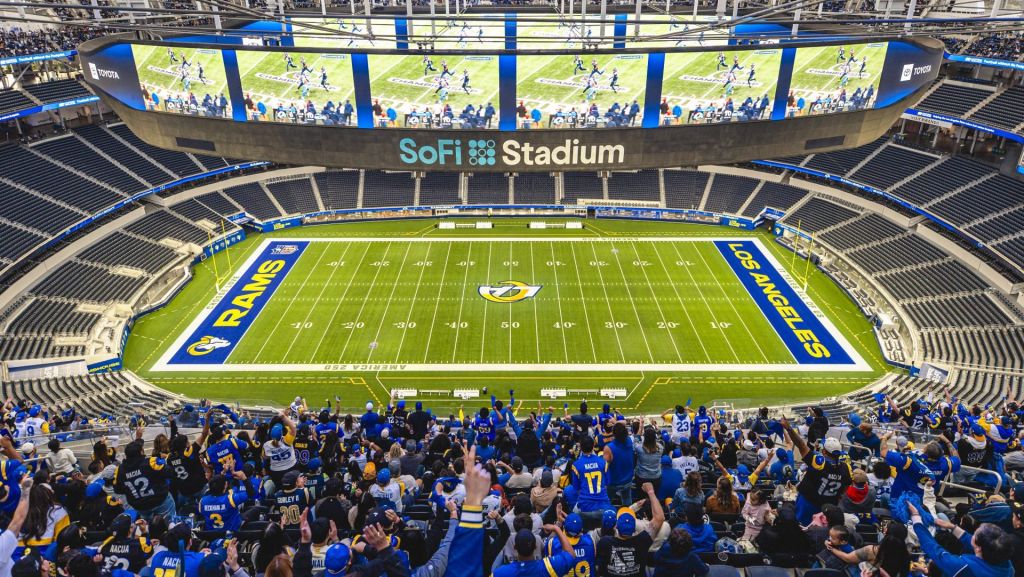
Not all teams have that technological capability at their venues, but they still find ways to be creative and utilize their unique spaces. In January, the Rams opened up the entire 400- and 500-level sections of SoFi Stadium to about 30,000 fans, broadcasting the NFC championship being played in Seattle on the stadium’s extended infinity video board, which matched the eye level of the upper concourse. Though the team had to comply with the NFL and play the broadcast’s full audio (commercials included), the energy remained high and engaged like a regular game day.
“Obviously we didn’t win, but it was a cool experience,” says Vaziri, whose video of the event received more than 40,000 views. “It got very loud when we were doing well.”
The Rams charged $10 for the general public and $5 for season-ticket holders, while offering exclusive club-level viewing to high-end guests. “The lines were long in concession stands, but people were pumped to be there, pumped to cheer on the team,” August says. “The vibes were immaculate.”
Over the last couple of years, Vaziri has had an even better time at Clippers watch parties, which take place in a park adjacent to the Intuit Dome to take advantage of the climate. “It’s essentially like watching it at a Clippers bar, but it’s a bigger screen, you’re not indoors, and the L.A. weather’s so good,” he says. “Very rarely will someone show up in a Lakers jersey at these Clipper watch parties—or they just get booed into oblivion.”
In San Antonio, where temperatures can climb extremely high, the Spurs made sure the fan base had multiple indoor options. They welcomed more than 28,000 fans inside the Frost Bank Center during the Western Conference finals and NBA Finals, and hosted more than 68,000 fans at The Rock at La Cantera, their practice facility, throughout the entire playoffs, incorporating their mascot and Hype Squad between commercial breaks.
The parties have even started new traditions. When Seattle hosted a 2022 wild-card watch party to celebrate the Mariners’ first playoff appearance in more than two decades, fans at T-Mobile Park summoned their team’s improbable comeback victory in Toronto with a “rally shoe,” akin to a rally hat, placing footwear on their heads as a good-luck charm. The organic gesture went viral and is still used today.
“It didn’t matter the scale of it,” says Mariners SVP of marketing and communication Gregg Greene. “When you have that mass of people together, they create cheers and chants and they’re watching the game together—and we can help add to the fan experience with some of the claps that we do in the ballpark.”
Building Community Through Fandom
For teams, watch parties serve a dual purpose: They keep the postseason accessible for fans priced out of playoff tickets while also creating long-term business and community value. The events can also function as a powerful marketing tool. “We’ve sold some season tickets to people attending [Rams events] and having a great time,” August says.
The financial benefits often extend beyond the franchise itself. Multiple teams told FOS they pay security and concessions staff at the same rates as a standard playoff game day, helping preserve income for arena workers even when the team is on the road. Many organizations also funnel ticket proceeds and event-related fundraising toward charitable causes.
The Mariners and Rams directed proceeds to their in-house charitable foundations, while the Spurs used their Finals watch parties to deepen local community outreach. Through postseason 50/50 raffles, San Antonio raised more than $238,000, with half going to winners and the other half supporting Spurs Give, the team’s nonprofit organization. The team also distributed up to 1,000 regular-season game tickets to local nonprofits and contributed to community projects across the city, including donations supporting facility renovations for the Salesian Sisters and upgrades to the Denver Heights Community Center.
“Free attendance allows us to make this special viewing experience accessible to as many fans as possible,” a Spurs spokesperson said. “We determine capacity on a game-by-game basis, balancing fan demand with our commitment to providing a safe, comfortable, and enjoyable experience for everyone in attendance.”
Though scheduling conflicts with concerts, special events, and other games can impede some of these parties (the Knicks couldn’t host an MSG watch party for their Finals-clinching victory in San Antonio because pop-rock outfit 5 Seconds of Summer had booked two weekend shows there), their popularity has already inspired more opportunities throughout the regular season.
“I think now we see the potential for these types of events,” Sutor says. “We haven’t had any discussions for what [it] will look like, but that will definitely be part of the conversation.”
Ultimately, the watch party has proved to be symbolic, a way to tell the entire fan base that the team appreciates its business and passion—and not just from those who can afford to spend $5,000 for a home ticket. “We want people up and down the chain,” August says. “You want fandom—and fandom begets more fandom.”