
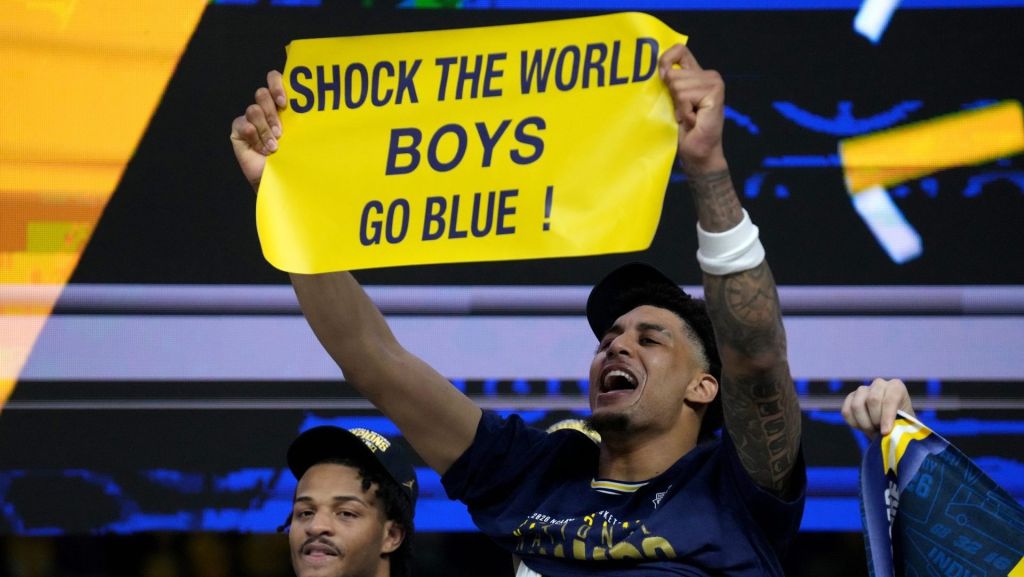
INDIANAPOLIS — Standing on the hardwood at Lucas Oil Stadium, with Michigan players and coaches eager to cut down the nets behind him, Big Ten commissioner Tony Petitti stated the obvious. “Resources matter,” he told a small group of reporters. “You have to be honest about it.”
But he followed up those comments with a point that multiple Michigan officials emphasized after winning the national championship: “You still need great coaching. You still need a commitment to winning, and performing at the high level, coming together, and building and developing players. I don’t think that’s ever going to change.”
On its face, Michigan—one of the richest schools in the country, whose men’s basketball program embraced the transfer portal—looks exactly like the type of team expected to dominate in the era of unrestricted free agency. But it didn’t shell out as much as expected.
No Complaints
Michigan’s roster construction would not have been remotely possible even two years ago, before a federal court case forced the NCAA to allow unrestricted transfers.
All five starters in Indianapolis on Monday night came to Michigan by way of the transfer portal: Yaxel Lendeborg from UAB, Morez Johnson Jr. from Illinois, Aday Mara from UCLA, and Elliot Cadeau from UNC. Nimari Burnett has been at Michigan for three whole years—he transferred out of Alabama in 2023.
“When the Oklahoma City Thunder won the championship last year … I wasn’t judging them because Shai [Gilgeous-Alexander] was drafted by the Clippers, or because they signed Isaiah Hartenstein as a free agent,” Michigan head coach Dusty May told reporters Sunday. “I thought, wow, those guys played beautiful basketball, that’s a great team, that’s a real model for young players to watch.”
Cadeau scored 19 and notched 3 rebounds, 2 assists, and 2 steals—and earned Most Outstanding Player of the men’s NCAA tournament. Lendeborg, who was nursing an ankle injury sustained during the Final Four, scored 13. Johnson rounded out the top scorers with 12 points, 10 rebounds, and 2 blocks.
“Complaining about the system right now is like complaining about tax loopholes,” Michigan regent Jordan Acker told Front Office Sports on Monday night. “That’s the law. Those are the rules. At this point, we need to be in a place where there are rules, but until then, let’s do our thing.”
Roster Investment
Michigan invested heavily in its men’s basketball program with a multimillion-dollar overhaul. It spent just about $10 million on its roster, a source confirmed to FOS.
Michigan is one of the most well-resourced athletic departments in the richest conference. Its projected budget for this year was $266 million, one of the highest in the country. May’s roster could have been one of the most expensive in the country.
But it wasn’t. Although $10 million is significant, it’s also essentially the minimum amount that power conference programs needed to be successful.
“We’re not perfect,” AD Warde Manuel told FOS a few days earlier. “We’re not the highest based on the data I know. But we really focus on providing that support to our teams.”
And comparatively, the Wolverines didn’t spend as much as some of the programs it faced throughout the tournament—including UConn.
Michigan’s men’s basketball operating budget for 2025 was $14.4 million—ranking 26th in the country, according to “Extra Points.” UConn, by comparison, spent $21.6 million. Dusty May, who Michigan recruited a year out from a Cinderella Final Four run with Florida Atlantic, was signed to a contract paying out about $3.85 million per year; he signed a new deal last summer that upped that number to $5.1 million per year. He’s not near the top of the Big Ten, let alone all of men’s college basketball. (May might have gotten an extension this weekend, however, given the rumors that he was in consideration for other jobs including UNC.)
“There’s not one way to win,” Petitti said. But Michigan’s blueprint is a pretty good one.