
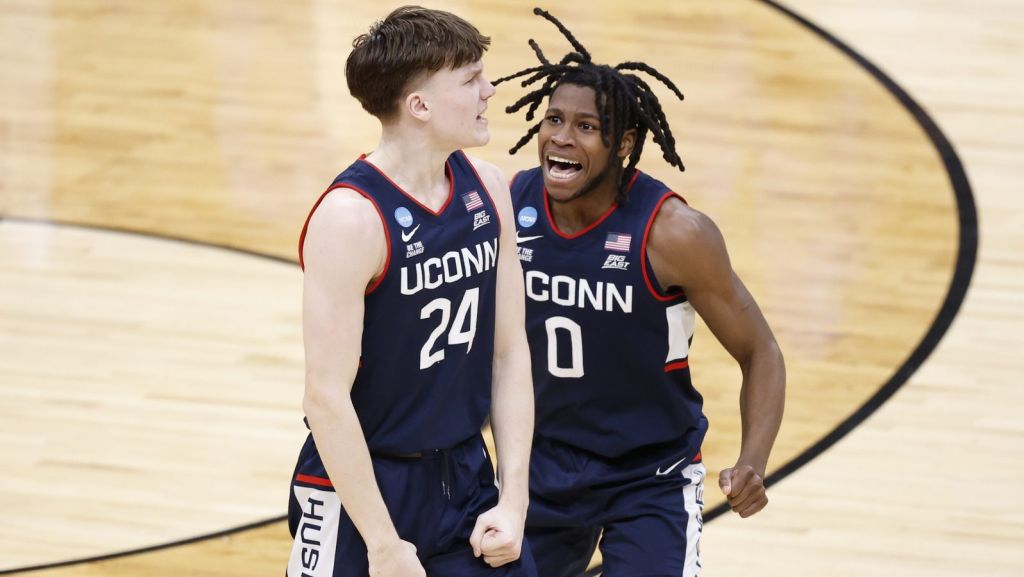
WASHINGTON — With just one second left in Sunday’s Elite Eight showdown against Duke, UConn freshman Braylon Mullins hit a game-winning three-point shot to top the Blue Devils, 73-72, and punch a ticket to the Final Four.
It was a shot that would make history for the entire school—not just the men’s program.
Earlier in the day in Fort Worth, Texas, UConn’s women’s team also took care of business, dominating Notre Dame, 70-52, to secure their own spot in the women’s Final Four.
Thanks to the UConn women’s decisive win and the UConn men’s nail-biting last-second victory, both the men’s and women’s programs will appear in their respective Final Fours for the sixth time in UConn’s history. No other school has come close to achieving this feat six times.
It’s an even more impressive feat in the current “revenue-sharing” era, which puts UConn, the only Big East school with FBS football expenses, in a particularly difficult position from a financial standpoint.
“We just find a way,” UConn AD David Benedict told Front Office Sports from the court at Capital One Arena. “You put up hurdles, we find a way to get over ’em. You put up walls, we break ’em down. So look, it’s never gonna be easy, being in the situation we’re in, but we find a way.”
UConn has dynasties on both its men’s and women’s sides, led most recently by coaches Dan Hurley and Geno Auriemma. The school has spent millions on their contracts: Auriemma is one of the highest-paid on the women’s side, with a five-year, $18.7 million contract; Hurley is one of the highest-paid on the men’s side, with a six-year, $50 million contract.
“Geno’s helped me a lot,” Hurley told FOS. “Geno’s helped me learn how to get here.”
But Hurley had also said earlier in the weekend that history, tradition, and “blue-blood” status didn’t really matter much anymore from a recruiting standpoint. It was all about the money—and that was about to get even more difficult for UConn.
This past year, UConn found itself in a rare situation straddling two worlds in the new era of college sports. The new House v. NCAA settlement allowed schools to share up to $20.5 million with their entire athletic department; at the same time, it implemented restrictions on NIL deals to ensure they would no longer be used as “pay-for-play” in disguise. The idea: there would be a salary cap of sorts for each athletic department.
UConn, however, faced several dilemmas.
First, like all non-Power 4 schools, it didn’t have access to the Power 4 media rights deals that help programs fund the full $20.5 million.
Second, it didn’t have what some predicted would be an advantage for other Big East programs: a lack of football costs. In the FBS, most schools that were hitting the revenue-sharing max were offering about 75% of their rev-share pot—about $15 million—to football, leaving about $4 million for men’s basketball and $1.5 million for women’s basketball.
So the rev-share era could be a boon for schools that didn’t have FBS football at all, because it could offer more money to their hoops programs. But UConn, with its independent FBS football program, didn’t have that positive either.
This past June, UConn said in a letter to fans that it would spend $18 million on revenue-sharing across sports and was working on beefing up revenue streams, from ticket sales to potential naming rights. But the school also asked for private donations.
Donors came through so much so that Benedict declined to give a list of names, telling FOS he feared he would leave someone out. But he did say: “We like to say that there’s a return on people’s investment in getting both of these teams in the Final Four.”
Hurley, for his part, told FOS he didn’t think the revenue-sharing era made things particularly difficult. “I don’t think so. I mean, the University of Connecticut commits in all sports. … We’re an everything school, and the university’s behind us.”
In reality, across all sports from a roster standpoint, the Huskies probably spent more than $18 million. After all, everyone had to–the basketball-only advantage never materialized; power conference programs and others in the FBS were able to supplement the rev-share cap with outside NIL deals. It became more of a floor, rather than a ceiling, for roster compensation.
“The Huskies proved today hands down why they belong in the all-time top echelon of men’s and women’s college basketball programs,” Big East commissioner Val Ackerman told FOS via text, as she was in Texas with the UConn women on Sunday after being with the two Big East men’s programs in D.C. on Friday. “Talent, leadership, grit—they have it all. Score two for the basketball schools.”
Now, the UConn men will face Illinois in Indianapolis. The UConn women will face the South Carolina–TCU winner in Phoenix. Ackerman, as she has often had to do, will do her best to fly back and forth.
“It’s the basketball capital of the world,” Hurley told FOS. “I don’t think anyone could debate that at all.”