
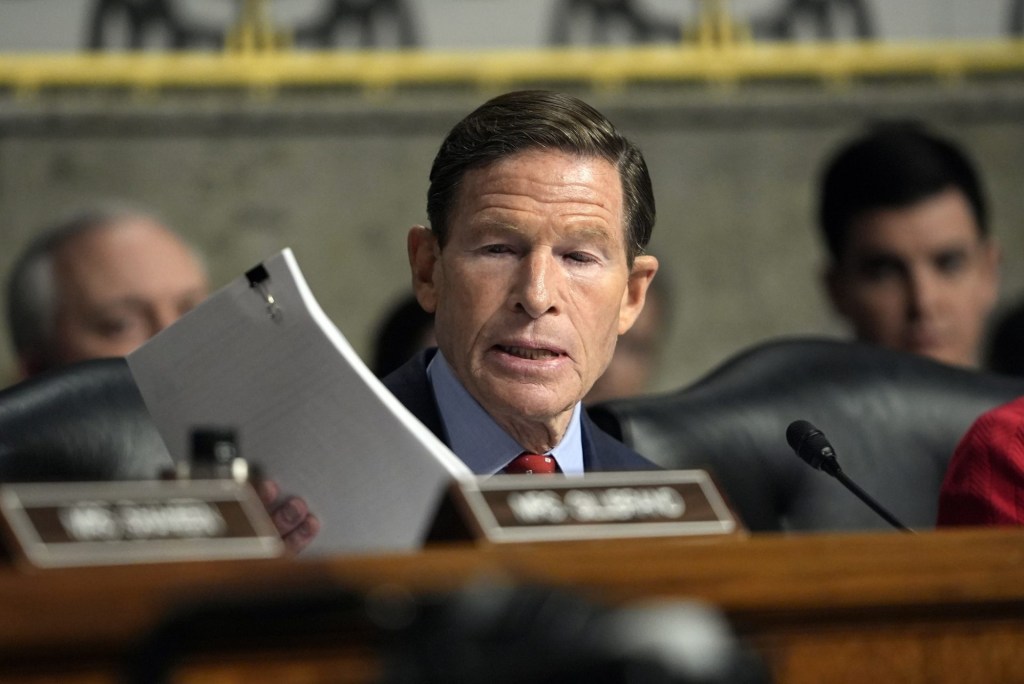
Sen. Richard Blumenthal (D., Conn.) was stunned by Major League Baseball’s deal with Polymarket.
Blumenthal isn’t buying that there’s any meaningful difference between traditional sports betting and sports event contracts on prediction-market platforms, and he thinks the MLB-Polymarket deal is lending the industry legitimacy it has not earned.
“It is astonishing and appalling that Major League Baseball would, in effect, be complicit in this,” Blumenthal tells Front Office Sports.
Alongside Sen. Andy Kim (D., N.J.), he introduced the Prediction Markets Security and Integrity Act on March 11. The bill would establish safeguards to protect against insider trading and market manipulation and ban markets on war, death, and military action.
It would also treat sports event contracts like traditional sports betting by requiring companies to operate under state-approved gambling programs, while curbing the role of the Commodity Futures Trading Commission by removing platforms’ ability to claim exemption under the Commodity Exchange Act.
Currently, platforms like Kalshi and Polymarket make sports event contracts available in almost every state—minus Nevada, which has won early court rulings against both, as well as Coinbase. Those decisions temporarily prevent the companies from offering such contracts in the state.
“This is part of the public health crisis,” Blumenthal tells FOS. “It’s a concentrated and purposeful effort to circumvent state rules and laws that provide guardrails on sports betting.”
He was not moved by the CFTC’s recent advisory that teased new rules for the prediction-market industry and acknowledged certain sports offerings are particularly susceptible to manipulation. The CFTC, established in 1974, has historically regulated the derivatives market and trading of commodities like grains and oil.
“The CFTC shouldn’t be regulating this,” Blumenthal says. “What does the CFTC know about sports betting?”
He’s particularly concerned about younger people being allowed to use prediction markets. Kalshi and Polymarket allow people 18 and older to use their apps. For regulated sports betting, many states require users to be at least 21.
“What they’ve done is taken the format of sports betting and just put it in a new app where there are less rules, and it’s allowing younger people in,” Blumenthal says. “It’s a form of what I have begun calling an ‘addiction conspiracy.’”
Blumenthal is not just singling out the prediction-market industry; he has similar misgivings about traditional sports betting. In 2024, he teamed with Rep. Paul D. Tonko (D., N.Y.) to introduce the SAFE Bet Act. That legislation, which the lawmakers reintroduced last year, seeks to ban exploitative practices like promotions that target losing bettors.
He and Kim are among a growing number of lawmakers—on both sides of the aisle—who have taken notice of the prediction-market explosion. At least eight bills have been introduced in recent weeks seeking to put stronger prediction-market protections in place. Blumenthal is open to the idea of joining with many lawmakers to propose a single, comprehensive prediction-market bill, as opposed to the piecemeal legislation that has been taking place.
“I have definitely thought about it,” he says. “It’s an idea that should have bipartisan support.”