
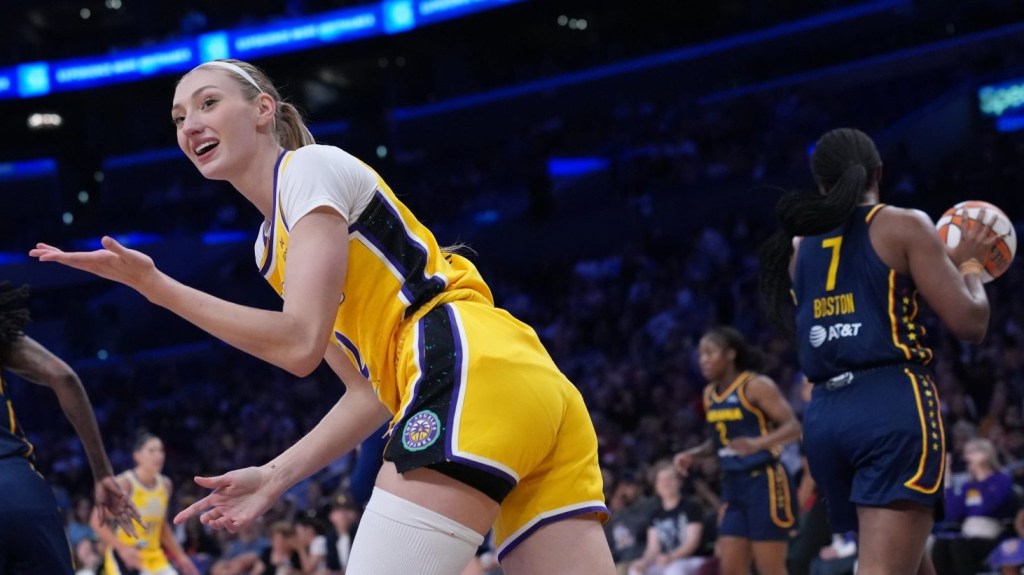
The novelty of Unrivaled’s inaugural season is gone.
Year 2 tipped off Monday with two matinee games followed by an evening slate, and it comes with a clear challenge—solidifying the start-up 3-on-3 league in an increasingly crowded women’s basketball landscape. As the league looks to stake its claim long-term, one question persists:
Is partnering with the WNBA its best bet?
“I don’t want to speak too much of what’s going on behind the scenes, but as I’ve made very clear we’re open to grow the ecosystem,” Unrivaled president Alex Bazzell said Monday. “Whichever way that looks like. For us there is nothing on the table or off the table.”
Bazzell has been open about Unrivaled’s efforts to work with the WNBA from the onset. In September, he told Front Office Sports that Unrivaled went to the WNBA “early” and was open to a formal partnership; the WNBA declined.
“What you look at right now is there’s a collaboration that’s going on in NBA Europe,” Bazzell said. “That was not a formal partnership before. As long as you can look at the space in an innovative lens, anything is doable, anything is possible.”
By this time next year, Project B—the new traveling 5-on-5 league—plans to be up and running with a number of former and current Unrivaled players committed to play in the inaugural season, including Alyssa Thomas and Jewell Loyd. Beyond that immediate threat, there is a longer-term one if the WNBA pursues exclusivity as a result of increased pay.
“We don’t believe that future is near,” Bazzell said.
That may be true; there is a belief within WNBA circles that the league is still at least one more collective bargaining agreement away from being able to offer salaries that warrant exclusivity. But for sustained success, Unrivaled needs to consider an increasingly crowded women’s basketball ecosystem.
The late NBA commissioner David Stern established the WNBA as a summer league to be complementary to the men’s league. As a result, players have historically supplemented their income and developed their talent by playing in other leagues in the WNBA offseason. For more than two decades that meant playing overseas with the biggest stars competing in Europe. In recent years leagues like Unrivaled, Athletes Unlimited, and now Project B have sprouted up.
The WNBA and WNBPA are currently in the midst of a highly contentious round of CBA negotiations; at the center of the conflict is the sides’ understanding of a suitable salary model. But the league and players have agreed in the past that increased salaries will come as a result of a lengthened competition window, bringing into question how long these new leagues will be viable.
Growing the Business
Unrivaled celebrated big wins this offseason with its announcement of an oversubscribed Series B investment valuing the league at $340 million. That followed an inaugural season when the league banked more than $27 million in revenue, and the league is trying to grow that number this season by selling more tickets at its small arena in Miami—increasing capacity from 850 to roughly 1,000—and adding a tour stop in Philadelphia.
The league is also up to eight teams with the additions of Hive Basketball Club and Breeze Basketball Club, and it added a fourth weekly night of games, which eliminated back-to-backs.
These new teams came with an additional 12 roster spots to go along with a pool of six developmental players, but the league still saw a slight drop-off in talent from its first year. Beyond cofounder Napheesa Collier, who will miss the season due to ankle injuries that will require surgery, Unrivaled failed to bring back a handful of players including stars like Sabrina Ionescu, Angel Reese, and Loyd.
Unrivaled currently has 75% of its player pool signed through 2028, meaning the league could lose more players to Project B next year. While last year players relished the idea of not having to travel abroad to earn a competitive salary, Project B’s multimillion-dollar salaries have already proved enticing enough to bring a number of WNBA stars back to overseas play.
“Honestly, I don’t know,” cofounder Breanna Stewart said last month when asked whether she sees Project B as a competitor. “Project B has a lot that’s still in the works. Until they’re on the ground and running, no. That’s no shade to them or anything, it’s just different. We’re playing 3-on-3 staying in one city; they’re playing 5-on-5 and going all over the place. The salaries, comparatively speaking, they’re pretty similar.”
If Project B is offering comparable—or better—money, Unrivaled will then need to figure out other ways to keep a competitive edge. As the WNBA looks to lengthen its calendar on both ends, whatever new league manages to partner with the WNBA could have the permanent advantage.