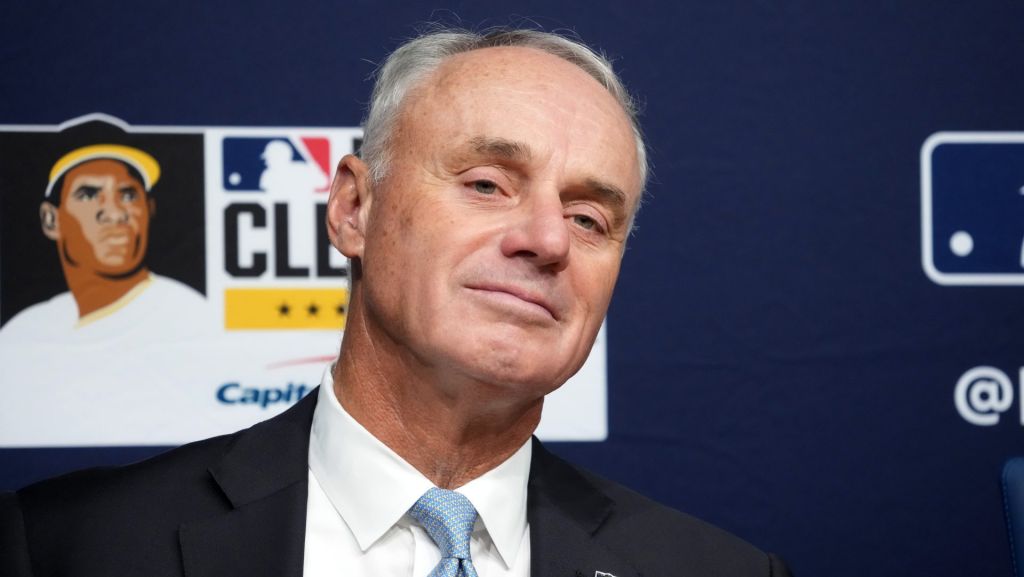
Major League Baseball is getting into the prediction-market business through a multiyear deal with Polymarket, Front Office Sports has learned.
Under the deal, Polymarket will become the exclusive prediction-market partner of MLB and will be the only platform allowed to use team logos and marks, sources say. Exact terms of the deal were not clear. One source believed it’s for three years and $300 million, with Polymarket paying MLB, while another said the initial financial figure may be closer to $150 million but that the deal could be extended.
The agreement was announced later Thursday morning.
MLB represents the latest pro league to embrace the rapidly growing industry, following the NHL, MLS, and UFC (Polymarket and Kalshi are “official” partners of the NHL, while Polymarket alone has deals with MLS and UFC).
Commissioner Rob Manfred hinted that MLB was gearing up for some kind of prediction-market partnership last month, when he said formal deals would aid in overall game integrity.
MLB’s entry shows how quickly things are changing as the prediction-market industry grows in prominence. Over the summer, the league issued a memo warning players not to use prediction markets and framing the practice as a violation of its longstanding sports betting policies.
Sports event contracts have drawn scrutiny, and resulted in lawsuits, because they appear so similar to traditional sports betting, which is regulated on a state-by-state basis. Prediction markets are overseen federally by the Commodity Futures Trading Commission, whose chairman supports the industry and recently issued guidance about which types of sports markets could be more vulnerable to manipulation than others (markets that depend on multiple players, such as which team will win a game, are less prone to manipulation than markets that rely on an individual player’s actions, the CFTC said).
MLB is working with the CFTC to ensure the integrity of markets—something that CFTC chairman Michael Selig posted about on social media Thursday. The league said it signed a memorandum of understanding with the regulator stipulating that the two sides will share information and regularly discuss “issues that may impact the integrity of MLB’s games and the MLB prediction market landscape.”
As part of the agreement with Polymarket, the platform and MLB will coordinate to “restrict markets that present an integrity risk,” including those on individual pitches, manager decisions, and umpire performance.
NHL commissioner Gary Bettman has said the agreements with Kalshi and Polymarket were made in part because the league thinks it’s important for fans to know that event contracts are “based on real data.” He also said the NHL could tell the platforms to “take down any contracts we don’t think are appropriate.”
MLS similarly said its deal with Polymarket—announced in January—was based on ensuring integrity. Chris Schlosser, SVP of emerging ventures for MLS, told FOS at the time that “it became clear that the best way to do that was to lean in and partner with these guys to create an integrity framework that we felt was really needed.”
Generally, these deals have given platforms direct access to league data while allowing them to use team names, logos, and other marks.
A spokesperson for Sportradar, which is MLB’s exclusive global data distributor and integrity partner, said in a statement that “we see a significant opportunity to monetize our products and services in prediction markets.”
Sportradar is not bound by the exclusivity between MLB and Polymarket; it can still provide MLB data to other prediction-market platforms, as well as traditional sports betting operators, media companies, and more.
The NFL, NBA, PGA Tour, and NCAA remain holdouts—although NBA players Giannis Antetokounmpo and Kyle Kuzma are investors in Kalshi, and NFL running back Saquon Barkley is reportedly invested in Polymarket.
Polymarket is backed by Intercontinental Exchange Inc., the operator of the New York Stock Exchange, which in October agreed to invest up to $2 billion in the company. Kalshi, which is backed by venture firms including Paradigm, has raised more than $1 billion. Both companies are currently in talks with investors to raise more money at $20 billion valuations.