The EPL ditched gambling ads on fronts of kits, but they’re everywhere else.  ‌ ‌ ‌ ‌ ‌ ‌ ‌ ‌ ‌ ‌ ‌ ‌ ‌ ‌ ‌ ‌ ‌ ‌ ‌ ‌ ‌ ‌ ‌ ‌ ‌ ‌ ‌ ‌ ‌ ‌ ‌ ‌ ‌ ‌ ‌ ‌ ‌ ‌ ‌ ‌ ‌ ‌ ‌ ‌ ‌ ‌ ‌ ‌ ‌ ‌ ‌ ‌ ‌ ‌ ‌ ‌ ‌ ‌ ‌ ‌ ‌ ‌ ‌ ‌ ‌ ‌ ‌ ‌ ‌ ‌ ‌ ‌ ‌ ‌ ‌ ‌ ‌ ‌ ‌ ‌ ‌ ‌ ‌ ‌ ‌ ‌ ‌ ‌ ‌ ‌ ‌ ‌ ‌ ‌ ‌ ‌ ‌ ‌ ‌ ‌

  Read online

READ IN BROWSER


Sunday Edition

November 15, 2026

Powered By

This Premier League season is the first in which gambling companies aren’t allowed to advertise anymore on the front of jerseys. But their ads are still everywhere else in the EPL ecosystem, writes Front Office Sports contributor Mike Jakeman.

—Meredith Turits

First Up

  • Gotham FC is going all-out for its relocated semifinal match by organizing ferries, charter buses, and watch parties with open bars.

  • The Ole Miss–Oklahoma game was rescheduled to Sunday at 1 p.m. ET as a result of Friday’s Federal Aviation Administration ground stop.

  • The NFL made no schedule changes to its Sunday slate of games amid the FAA travel disruptions—but one ref is working two games.

  • The Raiders got plenty of value from Kirk Cousins for $650,000. Now the Vikings hope to do the same.


English Soccer Still Inundated by Gambling Ads Despite Jersey Ban

English Soccer Still Inundated by Gambling Ads Despite Jersey Ban

REUTERS/Tony O Brien

Gambling companies love the English Premier League. 

There is no more effective platform for generating customers than advertising on the shirt of one of the 20 clubs in world soccer’s biggest league. But ahead of the current 2026–27 season, the teams bowed to political pressure from the U.K. government and banned gambling companies from the front of their jerseys. 

Major global companies including Bally’s and Betano were swapped out, replaced by tech, tourism, and financial services firms. Others, including Stake, were moved to shirt sleeves. However, the squishy terms of the ban mean there are still thousands of gambling messages for every live broadcast.

In a University of Bristol analysis of the opening weekend of the 2026–27 season, researchers found the ban on front-of-shirt sponsorship removed around 10% of the total messages—but around half of this reduction was offset by increases in shots of sleeves, training kits, and LED screens.

The Premier League’s voluntary ban has worked for all parties. The clubs have found a way to keep gambling sponsorship flowing in. The gambling firms have retained their access to their most effective advertising channel. The government has been able to show it has pushed a British institution into self-regulation. But for soccer fans, very little has changed.

“Lax” Regulation

When the Premier League launched in 1992, front-of-shirt sponsors included breweries, furniture companies, and a photocopier manufacturer. (The sums gambled on soccer in the U.K. barely rivaled those laid on horse and even greyhound racing.) But the rising popularity of the league, new government legislation, and the spread of mobile internet all worked to bring soccer and bookmakers together.

“Gambling companies require huge amounts of brand awareness,” says Sean Connell, editor of The Sponsor, an industry consultancy. “It’s one of the few sponsorship categories where there’s a pretty direct link between sponsoring a team and the number of new customers signing up for services.” He says there’s no better vehicle than a Premier League shirt to reach men, the consumers they covet.

The first gambling company to take the plunge was Betfair, which sponsored Fulham in 2002. 

As gambling companies began to compete more visibly for market share, Premier League shirts became an alternative vehicle to broadcast media—and within a decade, three-quarters of Premier League teams had a gambling logo on their shirts. A source close to several commercial deals told Front Office Sports gambling companies typically paid twice what other firms offered for a Premier League front-of-shirt deal.

Political backlash began to build. A 2020 report by a committee within the House of Lords (the upper house of Parliament) described regulation of the gambling industry as “lax,” and recommended a complete ban on all sport sponsorships by gambling companies.

The Premier League encouraged its clubs to act before the government forced them into it, while government ministers indicated any gambling reform would sidestep full-shirt sponsorships if the league opted to regulate itself. In 2023, the Premier League announced a voluntary ban on front-of-shirt gambling sponsorships that would be phased in over three years.

The agreement was carefully constructed, as it allowed gambling firms to continue to sponsor the shirt sleeves, as well as the LED screens that run around the perimeter of pitches. Alan Alger of Super Group, which owns the Betway brand, tells FOS: “Being on the front of the shirt is prestigious. You get access to the players. But the LED is what matters most for the people that are watching the games around the world.”

A Scramble for New Deals

The Premier League’s three-year grace period expired at the start of the current season, which meant half its teams had to find new sponsors last summer. 

Bournemouth turned to its stadium sponsor, insurance firm Vitality, to broaden its agreement to include the front-of-shirt. Brentford negotiated with recruitment company Indeed to add the playing shirt to its training-kit deal. Others opted for new deals in tourism, tech, financial services, and AI.

Alger argues the timing of some of these agreements—like Nottingham Forest’s eleventh-hour deal with financial-services firm Marex, signed days before the season began—is indicative of the clubs struggling to find partnerships that meet their valuations. Sunderland and Chelsea opted for sponsor-free shirts, after they were unable to strike satisfactory agreements before the start of the season. (Chelsea has since made a deal with crypto firm Circle.)

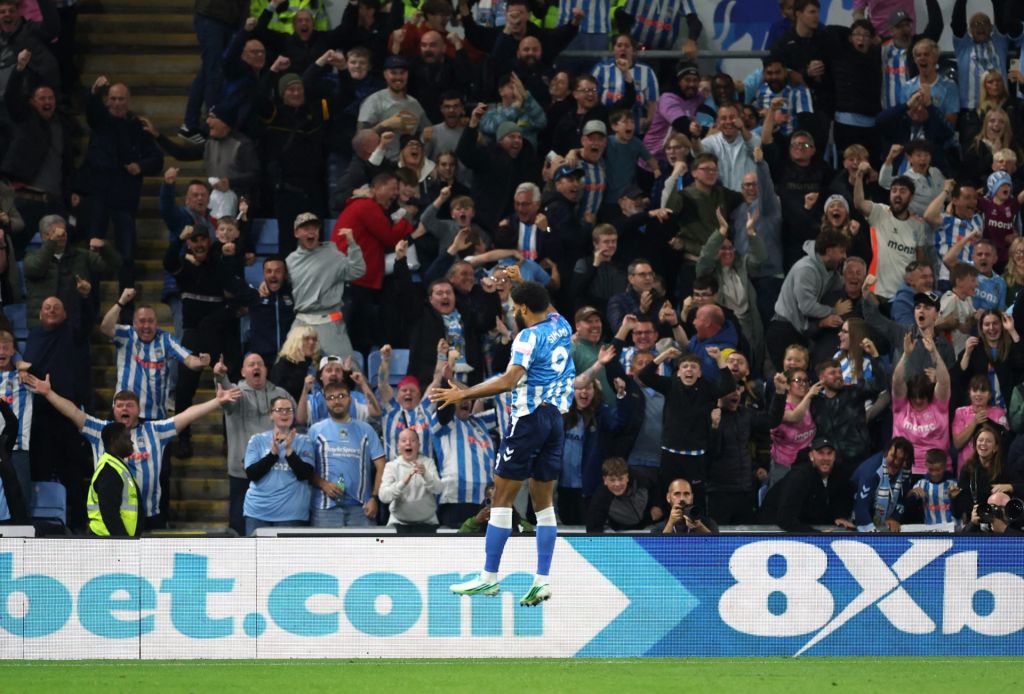
Soccer Football - Premier League - Coventry City v Newcastle United - Coventry Building Society Arena, Coventry, Britain - October 12, 2026 Coventry City's Ellis Simms celebrates scoring their third goal
Action Images via Reuters/Andrew Boyers

However, Adam Lewis, senior analyst at media consultancy Ampere Analytics, believes Premier League clubs have succeeded in plugging the revenue hole. He estimates the eight clubs that had to find new front-of-shirt sponsors have seen the combined annual value of their deals rise from $89 million (£67 million) to $99 million (£75 million).

He adds teams across the league have been able to grow the combined value of their sleeve and training-kit sponsorships from $176 million (£133 million) a year to $206 million (£156 million), largely by moving their previous gambling agreements from the front of the shirt to these new locations. Lewis believes gambling companies now account for more than 50% of the total value of training-kit sponsorships.

Prediction-Market Test

In its statement announcing the front-of-shirt ban, the Premier League identified itself as “the first sports league in the U.K. to take such a measure voluntarily.” This is true. But it is also true that English soccer at all levels remains drenched in gambling sponsorship. 

Clubs in the three divisions below the Premier League are still free to strike commercial deals with gambling companies. The government weighed the evidence and decided the clubs were so reliant on gambling sponsorship and their finances were so perilous that banning it would risk multiple clubs collapsing.

Gambling sponsorship is also highly visible in other competitions played on English pitches. Aston Villa’s previous front-of-shirt sponsor, Betano, is a lead sponsor of two of UEFA’s club competitions, the Europa League and the Conference League. UEFA and Betano also recently announced the company will sponsor UEFA’s international tournament, the European Championships, which will be held in 2028 in the U.K. and Ireland.

The next frontier of the gambling-sponsorship question surrounds the massive, rising industry of prediction markets. Teams—and the Premier League—are not yet rushing in. At present, neither of the biggest prediction markets, Polymarket nor Kalshi, legally serves U.K. users. However, as the Premier League is now a global beast, it would be plausible for a prediction market to seek to sponsor an English team purely to advertise itself to overseas clients. 

But the terms under which these markets could become front-of-shirt sponsors have yet to be tested. 

For now, a club would need to demonstrate to the Premier League that prediction markets are not gambling services. The Premier League says it “can’t comment on whether entities operating in the prediction markets as a whole will, or will not be, captured by the Rule.” The U.K.’s Gambling Commission, the gambling industry regulator, said earlier this year that “if a prediction market operator was to launch here in Great Britain, we do not believe they would be able to classify themselves as non-gambling products.” 

The precedent in Europe does not fall in the favor of prediction markets. This summer, an Italian court struck down a $21 million (€19 million) front-of-shirt sponsorship deal between Polymarket and Serie A’s Lazio, after concluding that such firms were covered under a government ban on gambling sponsorship in sport. (Serie A has a multiyear partnership with Polymarket as its exclusive prediction-market partner.)

Serie A’s limitations are determined by national legislation. The Premier League succeeded in preempting the government, and it has escaped with lighter-touch regulation. The league just might perform a similarly dexterous move on prediction markets.

 
SPONSORED BY NWSL

Now It’s Personal 💥 Gotham FC vs. Kansas City Current

The stage is set for a high-octane 2025 quarterfinals rematch between Gotham FC and Kansas City Current, but this time, the stakes are even higher. With Gotham looking to make it to back-to-back championships and the Current looking for vengeance after Gotham ended last year’s playoff run, this Sunday’s match has the potential to be electric. Will Gotham’s suffocating defense turn off the Current’s need for revenge? Find out Sunday at 3 p.m. ET on ABC/ESPN app.

 
ONE BIG FIG

Planting a Flag

Joe Pearson-Purdue University Northwest

$155,000

That’s the salary for the head coach of the women’s flag football program at Division I Cal Poly–San Luis Obispo. Front Office Sports reviewed salaries for these coaching positions at 10 schools and found the compensation varied by more than $100,000—from $18,540 at D-III SUNY Geneseo to Cal Poly’s $155,000. The average salary is $72,545.

As girls flag football explodes at the youth and high school levels, NCAA institutions are adding varsity women’s flag programs on a near-weekly basis. Activity is still largely limited to Divisions II and III. But the NCAA’s January 2027 vote to establish women’s flag as a championship sport is expected to spur a new wave of adoption by major D-I schools, prompting a more competitive coaching ecosystem—and, likely, higher salaries.


Editors’ Picks

 
College Sports Bill Proponents Mount Last-Ditch Lobbying Effort During Lame-Duck Session  

College Sports Bill Proponents Mount Last-Ditch Lobbying Effort During Lame-Duck Session

By Amanda Christovich
Protect College Sports Act proponents are sending letters, running ads, and more.
Pochettino’s Manchester United Will Still Face Major Financial Woes  

Pochettino’s Manchester United Will Still Face Major Financial Woes

By Eli Kronenberg
The club has about a billion dollars in debt.
Bears Stadium Saga Draws Flurry of Unsolicited Bids  

Bears Stadium Saga Draws Flurry of Unsolicited Bids

By Eric Fisher
Local developers are touting a previously rejected stadium site.
AppTVEventsVideoGamesShop

Written by Mike Jakeman

Edited by Meredith Turits, Catherine Chen 

Update your email preferences or unsubscribe here

© 2026 Front Office Sports

460 Park Avenue South, 6th Floor
New York, New York 10016, United States

Subscribe To Our Daily Newsletters

  • This field is for validation purposes and should be left unchanged.